

It’s a curious thing when someone who didn’t grow up around you starts noticing your habits. Sometimes it feels uncomfortable. Other times, it’s beautifully enlightening.
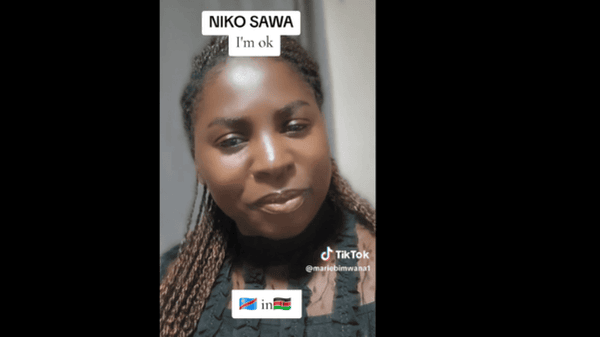
That’s exactly what Comfort Marie, a Congolese woman living and working in Kenya, has been doing — observing, noticing, and quietly holding up a mirror to the way we live, laugh, and talk.
Her gentle inquiry? One simple, yet revealing question: do Kenyans really mean it when we say “niko sawa”?
The Phrase We Say Without Thinking
If you live in Kenya, you know the phrase. Chances are you said it today. Twice. Or more.
“Unataka maji?”
“Niko sawa.”
“Chai?”
“Niko sawa.”
“Are you okay?”
“Niko sawa.”
“Do you need help?”
“Niko sawa.”
For Comfort, this was fascinating. She noticed that we use “niko sawa” almost everywhere, even when a clear “no” would suffice. It’s a reflex, a cultural shorthand — but what does it really mean? Are we always okay, or are we just polite by default? Is it a slogan for life?
And when she asked these questions on social media, the responses came flooding in.
Kenyans Respond
Kenyans are nothing if not expressive. Some wrote simply:
“Tulia tuko sawa.”
Relax. We are fine.
Others pointed out our other all-purpose phrase, “Sasa”, a greeting that can mean hello, what’s up, or even “I see you.”
Then came the more philosophical explanations:
- We don’t announce our problems.
- We don’t want to burden anyone.
- We don’t want to be seen as beggars.
- It’s a way to cut conversation politely.
- We have limited time.
- It’s our way of minding our own business.
In short: Kenyans are okay — mostly — but we protect ourselves from over-explaining.
The Many Shades of “Niko Sawa”
If you really break it down, “niko sawa” isn’t just “I’m fine.” It’s a shield, a cultural tool.
It can mean:
- I don’t want to inconvenience you.
- I am actually hungry, but I’ll wait for your insistence.
- I don’t want to explain my life right now.
- I am broke but dignified.
- I am stressed but functioning.
- I am alive, so technically okay.
As one commenter summed up:
“Ukiwa hai uko sawa, anything else ni mambo ya dunia.”
(If you’re alive, you’re okay. Everything else is worldly.)
There’s a kind of understated philosophy in that.
Niko Sawa and the Art of Kenyan Hospitality
Sometimes “niko sawa” is practical, too. A Kenyan explained that when visiting a host unexpectedly, we say it to avoid stressing the household budget. Tea, milk, sugar, gas, maybe mandazi — all of it costs money. Saying “niko sawa” is a polite way to let the host adjust.
If the host insists, we may eventually say yes. But initially? Niko sawa.
Emotional Boundaries
Another insight Comfort’s question revealed is our guarded emotional side. Kenyans are socially warm but emotionally private. We laugh, joke, and banter freely. But personal struggles? Those stay quietly tucked away.
“Niko sawa” becomes a tool of self-preservation, a gentle way to say: “I hear you, but don’t pry too deep.”
Why This Matters
Comfort’s curiosity isn’t criticism. It’s perspective. She doesn’t mock or judge; she simply notices and asks questions that make us think. Sometimes, we act so automatically that we forget to consider why. Her observations make us pause and reflect — perhaps even laugh at ourselves.
Our Kenyan Superpower
So what does “niko sawa” really say about us?
It’s resilience.
It’s maintaining dignity in struggle.
It’s protecting the host.
It’s social efficiency.
It’s peacekeeping.
And, occasionally, yes — it’s a shortcut for laziness.
Final Thoughts
Are Kenyans okay? Mostly.
Are we always okay? Definitely not.
Will we continue saying “niko sawa”? Without question.
Thanks to Comfort Marie, we’re reminded that sometimes, an outsider’s curiosity is exactly what we need to see ourselves more clearly.