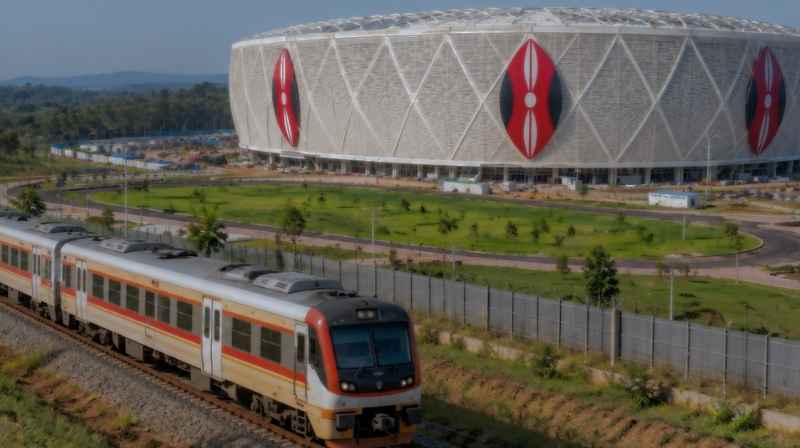

Football fans travelling to Talanta Sports City during AFCON 2027 could have a direct rail option from Nairobi CBD under plans by Kenya Railways to connect the capital’s main railway station with the new stadium.
The proposed connection will run from Nairobi Central Railway Station through the Nyayo National Stadium area and Kibera towards Talanta Sports City, creating a public transport corridor designed to move spectators, athletes, officials and workers to the tournament venues.
Kenya Railways officially announced the project in January 2026, saying the government intends to build a railway station adjacent to Nyayo National Stadium as well as a rail connection through Kibera to Talanta Sports City. The corporation said the objective is to provide commuters with a safe, reliable and affordable transport option during the tournament.
Kenya will co-host AFCON 2027 with Uganda and Tanzania. Kenya Railways identified Talanta Sports City Stadium, Moi International Sports Centre Kasarani and Nyayo National Stadium as part of Kenya’s tournament preparations, with Nyayo designated as a training centre.
For Nairobi commuters, however, the significance of the project could extend well beyond football.
Nairobi CBD to Talanta by train
The proposed link would give spectators arriving in central Nairobi an alternative to relying entirely on matatus, buses, taxis and private cars to reach the Talanta corridor.
Nairobi Central Station would effectively become the starting point for a rail journey towards the stadium area.
That could prove particularly valuable on match days, when tens of thousands of spectators may be travelling towards the same venues within a relatively short period.
The connection would also strengthen Nairobi Central Station’s growing role as a public transport interchange.
Kenya Railways is separately redeveloping the surrounding area through the Nairobi Railway City project, which is designed to integrate commuter rail with other transport modes.
ALSO READ: Kenya Train Routes: SGR and Commuter Rail Guide
Talanta and Laini Saba stations proposed
The project goes beyond constructing a short railway spur directly into Talanta Sports City.
Proposed works include upgrading approximately 13.3 kilometres of existing railway track between Nairobi Central Station and Satellite.
Plans also provide for an approximately 1.3-kilometre second line between the Kibera and Satellite areas, connecting towards the proposed Talanta Stadium station.
Two new commuter stations are proposed at:
Talanta Stadium and Laini Saba.
That is important because it means the infrastructure could serve ordinary Nairobi commuters as well as football supporters.
Pedestrian overpasses and underpasses have also been proposed at Kibera, Laini Saba, Gatwekera and Kambi Muru, improving pedestrian movement across and around the railway corridor.
Why AFCON 2027 makes the railway important
Moving spectators to and from stadiums is one of the biggest transport challenges facing cities hosting major football tournaments.
Thousands of supporters can arrive within a narrow period before kickoff and leave almost simultaneously after the final whistle.
Putting most of those journeys onto Nairobi’s roads would add pressure to corridors already carrying substantial everyday traffic.
Rail offers a different proposition: trains can move large groups of passengers in scheduled movements without adding equivalent numbers of vehicles to surrounding roads.
That is why the Talanta connection could become one of the more consequential transport projects associated with Kenya’s preparations for AFCON 2027.
ALSO READ: Nairobi Matatu Routes and Numbers: Complete Commuter Guide
Nyayo Stadium also gets a railway connection
The project is particularly interesting because it doesn’t focus exclusively on Talanta.
Kenya Railways says a station is also planned adjacent to Nyayo National Stadium.
That potentially creates a sporting transport corridor beginning at Nairobi Central Station and connecting important event locations before continuing towards Talanta Sports City.
Nyayo is centrally located and already accessible through several major road-based public transport corridors.
Adding rail would give spectators another option while creating infrastructure that could continue serving passengers after AFCON.
Talanta rail link fits Nairobi’s bigger commuter rail plan
The AFCON project also fits into a much larger ambition for Nairobi Commuter Rail.
Kenya Railways’ long-term programme includes modernising approximately 100 kilometres of track and infrastructure and expanding commuter rail to additional parts of the metropolitan area.
Its 2023–2027 strategic plan sets a target of increasing commuter numbers from 3.1 million to six million by 2027. Kenya Railways
That means Talanta shouldn’t necessarily be viewed simply as a temporary football railway.
It could become another piece of Nairobi’s developing mass-transit network.
ALSO READ: Nairobi Central to Syokimau Commuter Train Route Guide
What happens to the railway after AFCON?
This may ultimately be the more important question for Nairobi.
AFCON 2027 provides an immediate reason to accelerate transport infrastructure around Talanta Sports City, but the stadium will continue hosting football matches, athletics, concerts and other major events long after the tournament ends.
Laini Saba and the surrounding communities will also remain.
If regular commuter services are maintained after the tournament, infrastructure initially developed to move football crowds could become part of everyday public transport.
Kenya Railways already describes Nairobi Commuter Rail as a system intended to provide dependable public transport and expand rail connectivity across the metropolitan area.
Nairobi is slowly putting rail back into the transport equation
For decades, most public transport journeys across Nairobi have depended overwhelmingly on roads.
Matatus, buses, boda bodas, taxis and private cars compete for the same limited road space.
Rail changes that equation because additional passenger capacity can be created without putting an equivalent number of vehicles onto the road.
The proposed Nairobi Central–Nyayo–Kibera–Talanta connection therefore matters beyond AFCON.
If completed and supported by frequent services, good pedestrian connections and integration with matatus and buses, it could demonstrate how Nairobi can use commuter rail for something the city increasingly needs: moving large numbers of people without requiring every journey to become another vehicle on the road,
ALSO READ: Why Talanta and Kasarani Could Give Kenya an AFCON 2027 Transport Advantage