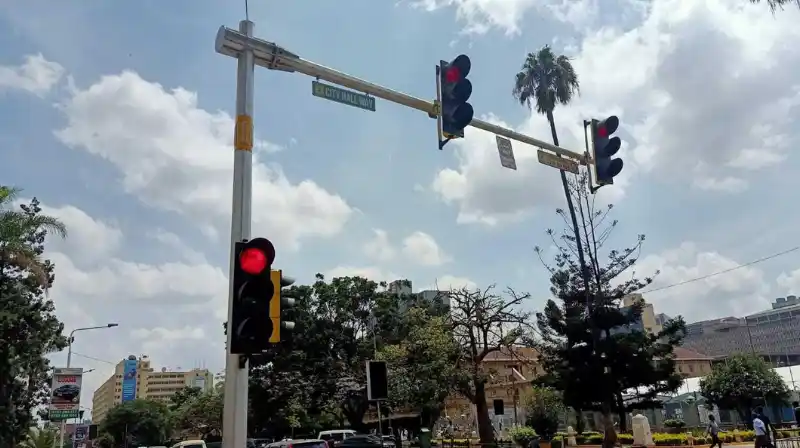
Nairobi is set for a major transformation in traffic management as the government moves to introduce a KSh44.8 billion Intelligent Transport System (ITS) across 230 major road junctions, reducing reliance on traffic police officers physically directing vehicles.
The ambitious infrastructure programme will incorporate intelligent traffic signals, real-time surveillance, electronic policing and automated traffic management, marking a significant shift towards technology-driven urban mobility in Kenya’s capital.
Roads Principal Secretary Eng. Joseph Mbugua was scheduled to preside over the Kenya Intelligent Transportation System Showcase and Achievement Launch at the JW Marriott Hotel in Nairobi on Friday, November 27, 2026.
According to Roads and Transport Cabinet Secretary Davis Chirchir, the programme will be implemented in three phases.
How Nairobi’s Intelligent Traffic System Will Work
Unlike conventional traffic lights that operate on predetermined intervals, intelligent traffic management systems can use real-time information to respond to changing traffic conditions.
Through a centralised Traffic Management Centre, authorities will be able to monitor vehicle movement, identify congestion patterns and coordinate traffic signals across connected junctions.
The system is expected to support:
- Intelligent traffic signal coordination.
- Real-time monitoring of road congestion.
- Electronic policing and automated enforcement.
- Data-driven traffic management.
- Improved vehicle movement across intersections.
- Reduced reliance on manual traffic control.
The technology could help Nairobi move away from a fragmented traffic management approach towards an integrated urban transport network.
Reduced Reliance on Traffic Police
Electronic policing will form a key component of the modernisation programme.
For decades, Nairobi has relied heavily on traffic police officers stationed at major intersections, sometimes manually directing vehicles even where traffic lights are installed.
The introduction of intelligent traffic infrastructure is expected to reduce the need for officers to perform routine traffic control duties at these junctions.
However, the system will not eliminate traffic police officers. They will continue performing enforcement, accident response, public safety and other responsibilities requiring human intervention.
Three Phases of the KSh44.8 Billion Project
The government plans to implement the programme through three investment phases.
| Phase | Junctions | Estimated cost |
|---|---|---|
| Phase One | 25 | KSh7.8 billion |
| Phase Two | 80 | KSh13 billion |
| Phase Three | 125 | KSh24 billion |
| Total | 230 | KSh44.8 billion |
The first phase will include the establishment of a modern Traffic Management Centre, which will serve as the central coordination facility for the intelligent transport network.
Subsequent phases will expand the infrastructure to additional junctions across Nairobi.
What the System Means for Public Transport
For Nairobi’s public transport sector, intelligent traffic management could improve journey predictability, reduce unnecessary delays and enhance operational efficiency.
Electric city buses, in particular, could benefit from smoother traffic movement, reduced journey times and more predictable operating schedules.
The infrastructure could also provide a foundation for future public transport innovations, including bus signal priority, dedicated bus corridors and integrated commuter information systems.
However, intelligent traffic lights alone cannot solve Nairobi’s congestion problem.
Without disciplined public transport operations, designated passenger boarding points, proper enforcement and investment in high-capacity mass transit, congestion will remain a significant challenge.
Technology must complement, rather than substitute, comprehensive public transport reforms.
Kenya’s Transition Towards Smart Urban Mobility
In December 2025, the government signed a USD185 million concessional loan agreement with China’s Export-Import Bank to finance part of the wider Intelligent Transport System programme.
The investment reflects Kenya’s growing interest in digital transport infrastructure and smart-city development.
For Nairobi, the long-term opportunity extends beyond managing private vehicles. Intelligent transport infrastructure could support the development of a more organised, efficient and environmentally sustainable public transport network.
The ultimate measure of success will not simply be the number of intelligent traffic lights installed, but how much time commuters save, how safely people travel and how efficiently the city’s public transport network operates.
Source: Pulse Kenya, November 27, 2026.