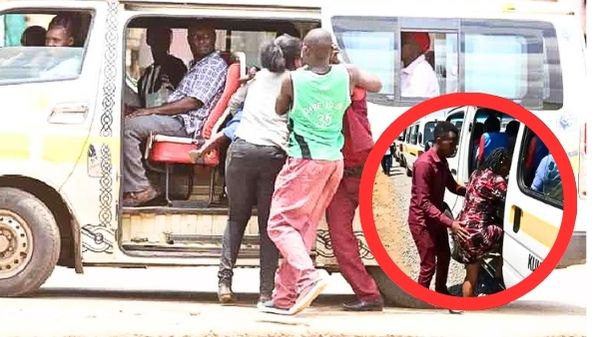

For too long, rogue matatu crews, weak enforcement, and political patronage have turned public transport into a place where commuters are expected to surrender their dignity, safety, and choice.
The petition challenging loud music in matatus raises a question that goes far beyond noise. It exposes a deeper reality about public transport in Kenya: for many commuters, some of the rights guaranteed by the Constitution seem to disappear the moment they step into a matatu.
It is a striking contradiction that a person in police custody has clearly defined legal protections regarding their treatment, yet an ordinary citizen boarding a public service vehicle often has virtually no say over the environment they are forced to endure. A passenger pays for transportation, but a small crew of two or three conductors and drivers frequently assumes complete control over the next hour of that person’s life. The volume of the music, the language in the lyrics, the reckless driving, the overcrowding, and even whether complaints are acknowledged are dictated by the crew, not by the paying customer.
This is not merely about entertainment. It is about dignity, safety, and accountability.
For years, a section of the matatu industry has cultivated a culture where aggression, intimidation, deafening sound systems, and reckless driving are celebrated as part of the “experience.” Those who object are often ignored, mocked, or told to find another vehicle. Yet many commuters have no realistic alternative. Public transport is not a luxury; it is an essential service.
The consequences extend far beyond discomfort. Kenya has witnessed countless road crashes involving public service vehicles, many linked to excessive speed, dangerous overtaking, distracted driving, and a culture that rewards spectacle over safety. Families have lost loved ones, passengers have suffered life-changing injuries, and innocent road users have paid the ultimate price. While not every accident is caused by loud music or modified vehicles, the broader culture of recklessness and impunity within parts of the sector has contributed to preventable tragedies.
Equally troubling is the regulatory failure. The NTSA, NEMA, the police, and other enforcement agencies possess legal mandates to uphold safety standards and protect the public. Yet enforcement has often appeared inconsistent, reactive, or entirely absent. Rules exist on paper, but their implementation is frequently undermined by corruption, political interference, or simple indifference.
Political leaders cannot escape responsibility either. Successive governments and influential politicians have repeatedly courted sections of the matatu industry as an important voting bloc. Instead of demanding professionalism and compliance with the law, some have chosen to celebrate or tolerate the excesses of rogue operators for short-term political gain. The result has been a culture where indiscipline is normalized, dangerous modifications are glamorized, and enforcement agencies hesitate to act decisively for fear of political backlash.
The High Court petition therefore represents more than a dispute over loud music. It asks a fundamental question: do constitutional rights stop at the door of a matatu? If passengers have rights to dignity, health, a clean environment, and consumer protection everywhere else, those rights should remain intact during their daily commute.
Public transport should never require citizens to surrender their comfort, their safety, or their constitutional protections simply because they cannot afford private vehicles. A matatu is a means of transport—not a nightclub, not a political constituency above the law, and certainly not a place where a handful of individuals exercise unchecked authority over hundreds of paying passengers every day.
If the courts affirm these principles, the decision could become a landmark moment in restoring the simple but often forgotten idea that public service vehicles exist to serve the public—not to dominate it.