
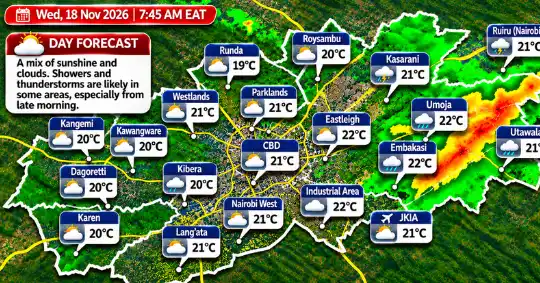
NAIROBI, Wednesday, November 18, 2026 — Nairobi’s unpredictable weather is once again testing the patience of residents and commuters, with sudden showers interrupting otherwise dry conditions and rainfall varying considerably between neighbourhoods.
Just when many residents thought the city was settling into a relatively dry spell, rain returned, raising questions about what happened to the anticipated seasonal downpours and whether more wet weather lies ahead.
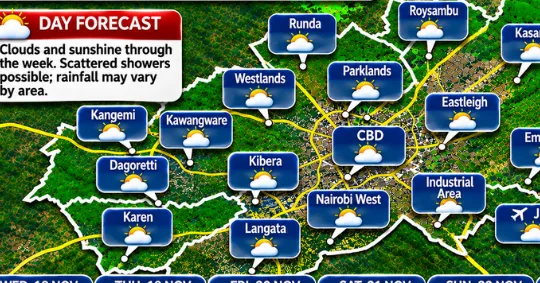
Image: Metros Kenya | Illustrative weather forecast map.
The contrast has become particularly noticeable across the capital. One neighbourhood may experience rain while another, only a few kilometres away, remains cloudy or enjoys sunshine.
For Nairobi’s commuters, this means leaving home under clear skies does not guarantee a dry journey to work.
The latest forecast from the Kenya Meteorological Service Authority suggests that this pattern of changing conditions could continue, with Nairobi among 36 counties expected to receive rainfall between November 17 and 23.
Why Is Nairobi’s Weather So Unpredictable?
Nairobi’s weather can change considerably over relatively short distances because rainfall is not always evenly distributed.
Some showers develop as isolated weather systems, affecting specific areas rather than the entire city.
This explains why residents in Embakasi may encounter rainfall while those in Westlands, Karen or the CBD experience different conditions.
However, such examples illustrate how localised rainfall works; they are not confirmation that those particular neighbourhoods are currently experiencing rain.
The changing conditions are especially significant for commuters using Nairobi’s major transport corridors.
As explained in Metros Kenya’s Nairobi’s Major Roads Explained: The Corridors That Keep the City Moving, the capital depends on interconnected roads serving thousands of daily journeys.
When rainfall affects one corridor but leaves another dry, traffic conditions can differ significantly across the city.
What Happened to the Expected El Niño Rains?
The inconsistent rainfall has also revived debate about the much-anticipated El Niño conditions.
Some Nairobi residents expected more persistent rainfall during the October–December short-rains season. Instead, the city has experienced periods of sunshine, cloud cover and intermittent showers.
But the absence of continuous rainfall does not necessarily mean El Niño has failed to develop.
El Niño is a large-scale climate phenomenon involving changes in Pacific Ocean temperatures and atmospheric circulation. Its influence on East African rainfall is complex and does not guarantee that every location will experience heavy rain.
Even during a wetter-than-average season, some neighbourhoods may receive less rainfall than others.
The Kenya Meteorological Service Authority’s latest weekly outlook confirms that rainfall is expected to continue in parts of Nairobi and several other counties.
For residents, the immediate concern is therefore not simply whether El Niño occurs, but how changing weather conditions affect daily movement.
Nairobi Weather Forecast: November 18–24, 2026
The latest Nairobi-wide outlook indicates a combination of sunny intervals, cloudy conditions and scattered rainfall during the coming seven days.
Daytime temperatures are expected to range between approximately 24°C and 27°C, while overnight lows could fall to between 16°C and 18°C.
| Day | High / Low | Expected Conditions |
|---|---|---|
| Wednesday, Nov 18 | 25°C / 17°C | Clouds and sunshine, with isolated thunderstorms possible |
| Thursday, Nov 19 | 27°C / 18°C | Mostly cloudy, with brief morning showers |
| Friday, Nov 20 | 25°C / 18°C | Mostly cloudy, with morning rain possible |
| Saturday, Nov 21 | 26°C / 17°C | Partly sunny, with isolated morning thundershowers |
| Sunday, Nov 22 | 24°C / 17°C | Mostly cloudy, with possible morning thunderstorms |
| Monday, Nov 23 | 27°C / 17°C | Sunshine and cloud, with possible thunderstorms |
| Tuesday, Nov 24 | 27°C / 16°C | Variable cloud cover, with showers and thunderstorms possible |
The forecast represents Nairobi-wide conditions rather than verified observations in individual neighbourhoods. Kenya Met’s official weekly bulletin covers November 17–23; the November 24 outlook comes from a separate weather forecast feed.
Morning Rain Could Complicate Nairobi’s Commute
One notable feature of the week’s outlook is the possibility of rainfall during the morning rush hour.
Thursday and Friday could experience morning showers, while Saturday and Sunday may see isolated thunderstorms earlier in the day.
For motorists travelling along Thika Road, Mombasa Road, Waiyaki Way, Jogoo Road and Ngong Road, sudden rainfall can reduce visibility and make road surfaces slippery.
Commuters travelling through Westlands can consult the Westlands Transport Guide: Matatu Routes, Stages & Connections to understand available connections and boarding points.
Passengers travelling through Nairobi’s central transport hubs may also find the Nairobi Bus Stations & Termini: Complete Guide to Matatu Stages and Destinations useful when planning journeys involving multiple connections.
Rainfall does not automatically mean widespread traffic disruption. However, even short downpours can create delays where drainage is inadequate or traffic is already congested.
Why Nairobi Needs Better Public Transport During Unpredictable Weather
Nairobi’s erratic weather also exposes weaknesses in the city’s public transport infrastructure.
Many passengers must wait at roadside boarding points without adequate shelter, while others walk considerable distances between transport connections.
A sudden downpour can turn an otherwise straightforward journey into an uncomfortable experience.
This reinforces the need for a more organised public transport system built around reliable services, sheltered boarding points and better passenger information.
Modern electric city buses offer an opportunity to improve the commuting experience, particularly when integrated into properly managed routes with predictable schedules and accessible stops.
Kenya’s transition towards cleaner transport is already attracting policy attention, as examined in Metros Kenya’s Kenya Moves to Write E-Mobility Law as Electric Buses and Charging Networks Expand.
Electric buses do not eliminate weather-related traffic disruptions, but they can form part of a more dependable, comfortable and environmentally sustainable transport system.
Commuter rail also provides an alternative for passengers seeking scheduled journeys. Metros Kenya previously examined this trend in Why Rail Commuting in Nairobi Is Becoming a Desirable Lifestyle.
Ultimately, Nairobi needs transport infrastructure capable of functioning reliably during both dry and wet conditions.
Kenya Met Expects Rainfall to Continue
According to the Kenya Meteorological Service Authority’s weekly forecast for November 17–23, rainfall is expected in parts of Nairobi, Kiambu, Machakos, Kajiado and numerous other counties.
The forecast also covers parts of western Kenya, the Rift Valley, central Kenya and the Coast.
This suggests that the current unsettled conditions are not confined to Nairobi.
However, a countywide rainfall forecast does not mean every neighbourhood will receive rain simultaneously or that rainfall will continue throughout the day.
The exact timing, location and intensity of showers may change.
What Should Nairobi Commuters Expect?
For the remainder of the week, commuters should prepare for variable conditions rather than assuming the weather will remain consistently dry or wet.
A cloudy morning may give way to sunshine, while some periods could bring scattered showers.
Drivers should exercise caution on wet roads, particularly where drainage is poor or visibility is reduced.
Public transport passengers may need to allow additional travelling time during periods of rainfall.
Residents should also avoid interpreting reports of rain in one part of Nairobi as evidence of rainfall across the entire capital.
For those planning journeys through unfamiliar areas, the Nairobi Matatu SACCOs: Major Operators, Routes and Destinations directory provides information on public transport connections across the city.
The Bottom Line
Nairobi’s weather remains difficult to predict at neighbourhood level, but the broader outlook indicates that scattered rainfall could continue during the week.
The capital is expected to experience a mixture of sunshine, cloud cover and occasional showers, with daytime temperatures generally remaining in the mid-20s Celsius.
For commuters, the most practical approach is to monitor current weather observations before travelling and remain prepared for changing conditions along their routes.
Metros Kenya will continue tracking Nairobi’s weather and its impact on public transport, distinguishing verified current conditions from forecasts to provide commuters with reliable travel information.