

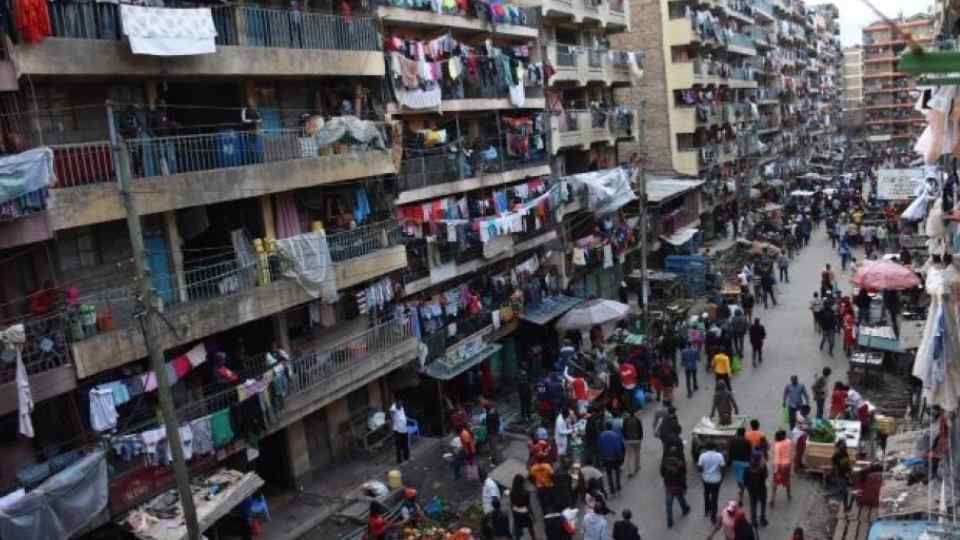

For decades, Nairobi’s Eastlands has been viewed primarily as one of the city’s largest residential zones. However, a landmark study by the Overseas Development Institute (ODI) reveals that the area has also served as Kenya’s leading urban destination for refugees seeking safety, affordable housing and economic opportunity.
The study, Hidden and Exposed: Urban Refugees in Nairobi, Kenya, found that while Eastleigh became widely associated with Somali refugees, thousands of refugees from the Democratic Republic of Congo (DRC), Rwanda, Burundi and Sudan established communities across Eastlands, integrating into local neighbourhoods and contributing to the informal economy.
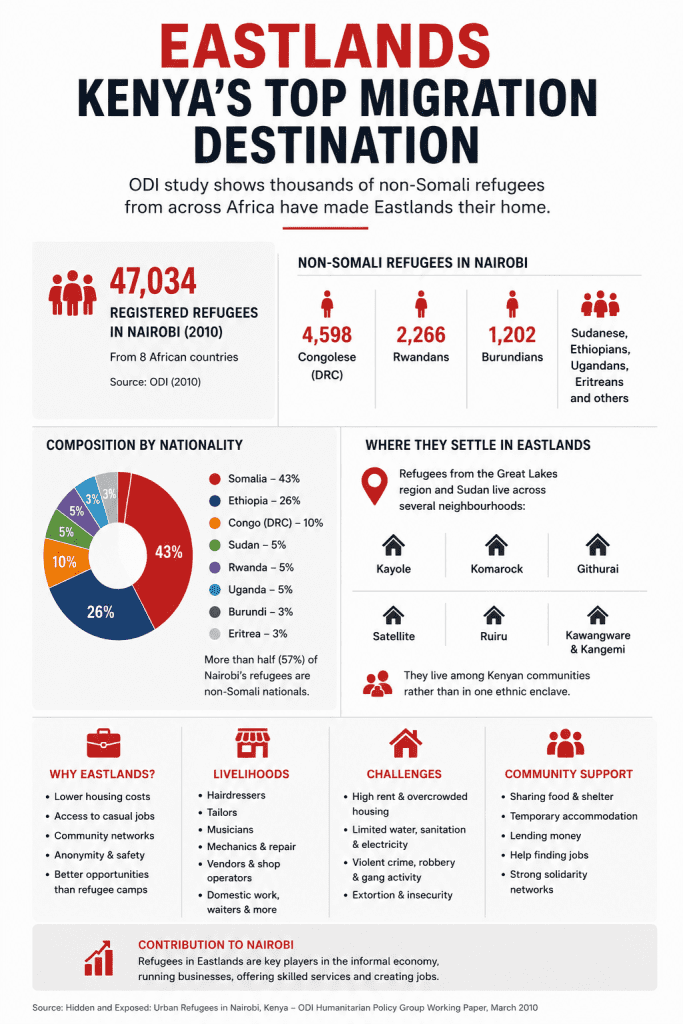
According to the report, Nairobi was home to 47,034 registered refugees at the time of the study, representing eight African countries. Somalis formed the largest group with 20,111 registered refugees (43%), followed by 12,257 Ethiopians (26%). The city’s non-Somali refugee population included 4,598 Congolese, 2,266 Rwandans, 1,202 Burundians, as well as refugees from Sudan, Uganda and Eritrea.
Unlike Somali refugees, who largely settled in Eastleigh, the ODI study found that refugees from the Great Lakes region dispersed across Eastlands and neighbouring estates including Kayole, Komarock, Githurai, Satellite, Ruiru, Kawangware and Kangemi, where they lived alongside Kenyan families rather than in a single ethnic enclave.
Why Eastlands?
The report identifies several reasons Eastlands became a preferred destination.
Affordable rent, access to casual employment, established community networks and the opportunity to blend into existing neighbourhoods made the area attractive to refugees leaving camps such as Kakuma and Dadaab.
Many interviewees told researchers they moved to Nairobi because refugee camps offered limited employment opportunities, inadequate education and healthcare services, insecurity and overcrowded living conditions.
For many, Eastlands represented an opportunity to rebuild their lives through work rather than dependence on humanitarian assistance.
Driving Nairobi’s informal economy
The ODI study found that refugees became active participants in Eastlands’ informal economy.
Many Congolese refugees worked as hairdressers, tailors and musicians, while others earned livelihoods as mechanics, shop attendants, waiters, domestic workers, casual labourers and street vendors. Some eventually established small retail shops and restaurants serving both refugee and Kenyan communities.
Because obtaining formal work permits remained difficult, self-employment became the primary source of income for many refugee households.
Challenges behind the resilience
Despite their economic contribution, the report highlights significant challenges.
Many refugee families rented single-room houses in low-income estates where access to clean water, sanitation and electricity was limited. Researchers also found that some landlords charged refugees higher rents based on the perception that they received financial support from international organisations or relatives abroad.
Security was another major concern. Refugees from the DRC, Rwanda and Burundi reported that violent robberies, gang activity and extortion posed greater threats than police harassment, particularly in lower-income neighbourhoods.
Communities built through solidarity
The report also documents the strong community support systems that developed across Eastlands.
New arrivals often relied on relatives and fellow refugees for temporary accommodation, food, loans and assistance in finding employment. These informal networks became essential in helping families establish themselves and navigate life in Nairobi.
A broader picture of migration
While public attention has often focused on Eastleigh, the ODI study paints a broader picture of Nairobi’s refugee landscape. It concludes that Eastlands has long been a major destination for refugees from across the Great Lakes region and beyond, with thousands choosing the area because it offered affordable housing, economic opportunities and established support networks.
The study also notes that these communities have become important contributors to Nairobi’s local economy through entrepreneurship, skilled trades and participation in the city’s informal sector.
Source: Hidden and Exposed: Urban Refugees in Nairobi, Kenya, Overseas