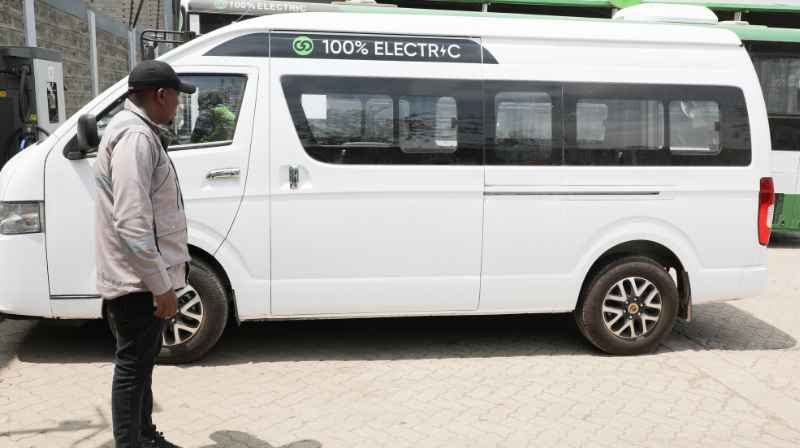

NAIROBI, Kenya — From the outside, it looks like a modern passenger van. Open the door, step inside and the difference becomes clearer: there is no diesel engine waiting to roar into life, no exhaust pipe pumping fumes into the street and no conventional fuel tank underneath.
This is BasiGo’s Golden Dragon electric van, a smaller passenger vehicle that the electric mobility company is positioning for schools, SACCOs and other transport operators looking beyond conventional petrol and diesel vans.
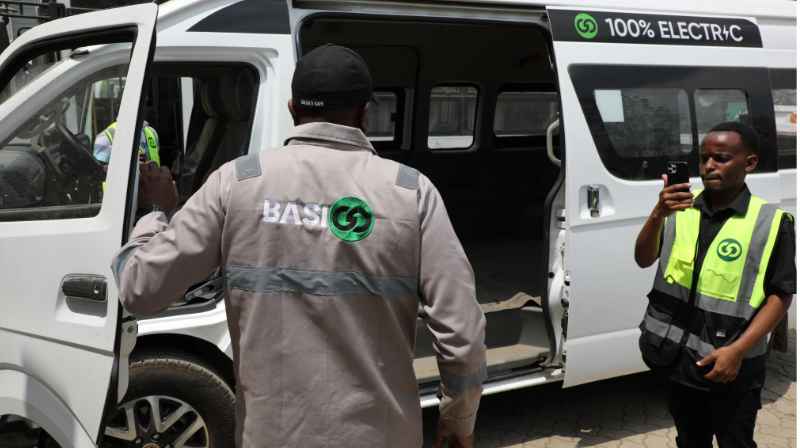
During a tour of BasiGo’s fleet operations, Fleet Manager Francis Mungai took the Metros Kenya team around the vehicle, explaining how it is sold, how customers can configure it and where the company is already seeing demand.
And according to Mungai, this is no longer simply a demonstration vehicle.
Several have already been sold.
“We have sold several,” Mungai told Metros when asked whether the electric van had actually entered the Kenyan market.
That distinction is important.
Kenya’s electric public transport conversation has largely centred on full-size electric buses and motorcycles. But the Golden Dragon van brings electrification into a vehicle category familiar to virtually every Kenyan: the small passenger van.
BasiGo’s move into this segment follows its expansion of electric buses on Kenyan roads and earlier trials of smaller electric matatus on intercity routes. Metros has previously tracked that transition through its coverage of BasiGo electric bus testing in Kenya and the first electric matatu pilot on intercity routes.
Francis opens the van — and explains what buyers actually get
Standing beside the Golden Dragon, Mungai explained that the vehicle is offered as a base unit, rather than forcing every customer into exactly the same passenger layout.
The configuration Metros was shown accommodates approximately 14+1 or 15+1 occupants, depending on how the interior is arranged.
According to Mungai, the buyer can then determine how the vehicle should be configured for its intended operation.
That flexibility opens the van to considerably more than one type of customer.
A school can specify seating appropriate for transporting students.
A SACCO can configure it as a passenger PSV.
A company could potentially use the platform for staff transport.
Another institutional operator could configure the interior around its own transport requirements.
In other words, BasiGo is not simply selling an electric van. It is offering a platform that can be adapted to the job the customer wants it to perform.
How much does the BasiGo Golden Dragon electric van cost?
Mungai put the indicative price of the vehicle at approximately KSh4.9 million, while stressing that customers should obtain final pricing from BasiGo’s commercial department.
That puts the purchasing decision into a bigger conversation about electric transport economics.
Electric vehicles generally come with a different cost structure from conventional petrol and diesel vehicles. Operators have to consider not just the purchase price but charging, maintenance, daily mileage, battery performance and the vehicle’s lifetime operating costs.
Metros has previously examined this question in its analysis of why Nairobi’s electric buses and bodas can be cheaper to operate than petrol and diesel alternatives.
For a school or SACCO, therefore, the KSh4.9 million figure is only one part of the calculation.
The more important commercial question is what the vehicle costs to operate over several years.
Up to 300 kilometres on a charge
BasiGo says the electric van platform can achieve up to 300 kilometres of range on a single charge, with fast charging allowing the battery to be replenished in around 1.5 hours under the company’s specified charging conditions.
The Ma3e platform uses a CATL lithium iron phosphate battery, according to BasiGo’s published specifications.
Those numbers become particularly interesting when placed against the daily workload of a passenger vehicle.
A school van, for example, may make concentrated morning and afternoon journeys with a long stationary period between them.
A matatu operates differently.
It may spend much of the day continuously moving passengers and accumulating substantially higher mileage.
That is why BasiGo has been testing electric vehicles under actual Kenyan operating conditions rather than relying exclusively on manufacturer specifications.
During an earlier Metros visit, Mungai demonstrated how the company tests electric buses for range, passenger load, braking and suspension before they are released into commercial passenger operations.
Electric matatus are already moving beyond Nairobi
The smaller electric passenger vehicle is not entering completely untested territory.
BasiGo has previously worked with 4NTE and Manchester Travellers Coach SACCOs in trials taking electric matatus beyond Nairobi, including services involving Thika, Nyeri, Nyahururu and Nakuru.
That matters because one of the questions surrounding electric matatus has always been whether they can work outside short urban journeys.
A van capable of handling substantial daily mileage potentially widens the market from urban shuttles to inter-town passenger transport.
For Nairobi’s existing public transport industry, the addressable market is substantial. The capital already has a dense network of operators documented in the Metros Nairobi Matatu SACCOs, Routes and Destinations directory.
Those SACCOs operate across hundreds of services mapped in the Nairobi Matatu Routes and Numbers database.
If smaller electric vans begin entering those fleets in significant numbers, passengers may encounter electric mobility on ordinary matatu routes rather than primarily on selected electric bus services.
Schools are an obvious market
Schools are another natural fit for the smaller vehicle.
Unlike a large commuter bus, many schools do not require dozens of seats on every route.
A 15-seater can serve smaller groups, shorter routes or areas where operating a full-size school bus would be unnecessary.
BasiGo has already demonstrated its interest in the education transport market. Metros reported earlier this year on the introduction of electric school and commuter buses in Nairobi.
The Golden Dragon extends that proposition into a smaller vehicle category.
For schools, the appeal is not only the absence of tailpipe emissions. Electric vehicles also operate much more quietly than conventional diesel vehicles — a noticeable difference when a school vehicle is making repeated pickups through residential neighbourhoods early in the morning.
But Francis sees another possibility: an electric ambulance
Then the Metros conversation moved beyond passenger transport.
Could this same electric van platform become an ambulance?
Mungai said the vehicle could potentially be configured for that purpose.
Because BasiGo provides the van as a base vehicle whose interior can be adapted to the customer’s requirements, an appropriate specialist conversion could theoretically transform the platform from passenger transport into another type of service vehicle.
But Mungai was equally clear about where the market currently stands.
Ambulance service providers have not yet bought into the idea.
The technology may be available, but somebody has to be willing to go first.
As Mungai explained to Metros, the sector may need an operator prepared to “blaze a trail” before others become comfortable adopting an electric ambulance.
That comment exposes one of the more interesting barriers facing electric mobility in Kenya.
Sometimes the obstacle is not whether a vehicle can technically perform a task.
It is whether the first customer is prepared to trust it with that task.
An ambulance is very different from a school van
The hesitation is understandable.
An ambulance is an emergency vehicle.
Reliability cannot merely be convenient; it is fundamental to the service.
An operator considering an electric ambulance would have to assess charging availability, emergency deployment patterns, range, downtime, equipment requirements and what happens when a vehicle is required unexpectedly.
The charging network therefore becomes just as important as the vehicle.
That is one reason Kenya’s electric transport transition cannot be measured simply by counting electric vehicles.
Metros has previously examined the infrastructure question in Kenya’s electric bus revolution and the need for supporting transport infrastructure.
For an ordinary passenger vehicle, insufficient charging can create an operational inconvenience.
For an emergency vehicle, availability requirements are much more demanding.
Any electric ambulance would also need to satisfy the applicable vehicle, medical-equipment and emergency-service requirements before entering service.
Could Kenya eventually see electric ambulances?
That possibility is what makes Mungai’s comments particularly interesting.
Electric ambulances already exist internationally, meaning electrification of emergency fleets is technically possible.
But the Kenyan question is not whether an electric ambulance can exist.
It is whether the economics, charging infrastructure, conversion standards and operational reliability can work for Kenyan emergency medical services.
The Golden Dragon platform potentially provides a vehicle on which that question could eventually be tested.
For now, however, Mungai’s message is straightforward: the ambulance market has not yet made the leap.
Someone would have to become the first serious adopter.
If that happens, Metros’ existing Nairobi emergency and hospital transport coverage provides a natural place to track how electric mobility eventually intersects with emergency transport.
The bigger story is the shrinking size of electric public transport
Electric mobility in Kenya started visibly with relatively large vehicles.
That is changing.
Smaller passenger vans matter because Kenya’s transport system is not built entirely around large buses.
Matatus dominate many routes precisely because smaller vehicles can serve neighbourhoods, adjust to demand and operate on corridors where a large bus may not always make commercial sense.
Nairobi’s bus stations and matatu termini already feed vehicles of different sizes into hundreds of destinations every day.
The arrival of a commercially available electric van means electrification can potentially move deeper into that existing transport structure rather than requiring Kenya to redesign the entire network around large electric buses.
That is a significant development.
Kenya is also writing the rules around the transition
The vehicles are arriving while the policy environment around them is still developing.
Kenya is working on a dedicated e-mobility legal and regulatory framework intended to support implementation of the National E-Mobility Policy.
Metros previously reported on the development in Kenya Moves to Write E-Mobility Law as Electric Buses and Charging Networks Expand.
The regulatory conversation will become increasingly important as electric vehicles move beyond buses and motorcycles into school transport, smaller PSVs, commercial fleets and potentially specialist vehicles.
Charging infrastructure will have to grow with them.
So will financing, maintenance capability, technical training and consumer confidence.
From demonstration vehicle to vehicles already sold
Perhaps the most important thing Mungai told Metros during the tour was also the simplest.
The Golden Dragon is already finding buyers.
That changes the conversation.
The question is no longer simply whether a 15-seater electric passenger van could work in Kenya.
Schools and transport operators are beginning to make that decision with their own money.
The next question is how far adoption spreads.
Will electric vans become a common sight within SACCO fleets?
Will more schools replace conventional vans with electric alternatives?
Could companies begin using them for staff transport?
And will an ambulance operator eventually take up Mungai’s challenge and become the first to blaze that trail?
Standing beside the Golden Dragon, the BasiGo fleet manager was effectively showing Metros something larger than a new van.
He was showing how Kenya’s electric transport transition is beginning to move from large buses into the smaller vehicles that perform some of the country’s most ordinary — and potentially some of its most critical — journeys.