
NAIROBI, Kenya — The images are difficult to miss.
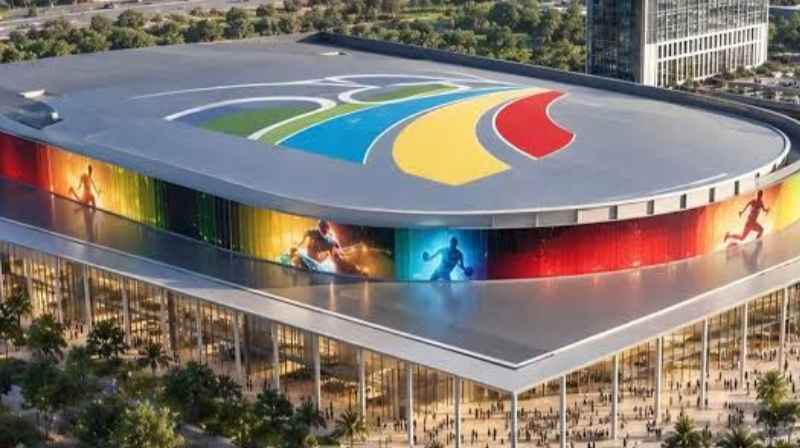
A futuristic indoor arena glowing against the Nairobi skyline. Wide pedestrian plazas. Hotels and apartments. Restaurants, landscaped public spaces and thousands of people walking through what appears to be an entirely new entertainment district.
Over the past week, artist impressions of a proposed 10,000-seat indoor arena at Nairobi Railway City have spread across Kenyan news websites and social media, accompanied by a striking figure: about KSh38 billion.
The images make the project look remarkably advanced.
But there are two important things to understand.
First, Nairobi is not building a KSh38 billion arena alone. The approximately $294.49 million, or KSh38.14 billion, figure refers to a much larger proposed mixed-use development in which the arena would be the centrepiece.
Second, the spectacular images being circulated are artist impressions of a proposed development, not photographs of a project already under construction.
The project has substance behind it. A long-term lease has been signed between Kenya Railways Corporation and Zaria Group, detailed plans have emerged and the development is going through the environmental approval process. But recent project reporting says there is no firm construction start date and detailed design finalisation and further approvals remain.
And beyond the architecture is another question that has received considerably less attention.
If 10,000 people leave a sold-out concert or basketball game at Nairobi Railway City at roughly the same time, how exactly will Nairobi get them home?
For Metros, that may ultimately be one of the most interesting parts of the project.
First, what exactly is Nairobi getting?
The proposed arena is part of a larger sports, entertainment and mixed-use development planned around Nairobi Railway Station.
The development is being undertaken by Zaria Group through its Kenyan subsidiary, Metroarena Development Company.
At its centre would be a five-storey indoor multipurpose arena accommodating as many as 10,000 spectators, depending on the event configuration.
It is intended for basketball and other indoor sports, but its proposed uses extend considerably further.
Concerts, conferences, exhibitions, banquets, cultural events and other major gatherings could all be accommodated.
But the arena is only one component.
Current plans include a 140-room branded hotel, serviced apartments, restaurants, retail and food-and-beverage outlets, a public plaza, pedestrian boulevard, sports and leisure spaces, an amphitheatre, parking and supporting facilities.
So when people read “KSh38 billion Nairobi arena,” they should not imagine KSh38 billion being spent purely on 10,000 seats and a basketball court.
It is a proposed entertainment district built around an arena.
And what about all those pictures?
This is where the story becomes more complicated.
Nairobi Railway City has been discussed and visualised for years.
The wider master plan already includes a transformed Nairobi Central Railway Station, commercial and residential development, public spaces and a multimodal transport network.
Kenya Railways describes Railway City as a major transit-oriented redevelopment centred on the existing railway station and surrounding land.
Those plans have produced their own architectural concepts and artist impressions.
More recent coverage of the Zaria development has introduced another set of images showing the proposed arena itself — including a large curved structure, extensive glazing, illuminated façades and broad pedestrian spaces.
Recent reporting explicitly describes these as renderings of the proposed structure.
That distinction matters.
An artist’s impression shows an architectural vision.
It does not prove that every feature shown will appear exactly that way when the development is eventually built.
Readers therefore need to distinguish between the wider Railway City master-plan imagery and visualisations associated specifically with the arena and entertainment development.
And all such images should currently be understood for what they are:
proposed designs, not photographs of completed infrastructure.
What is actually confirmed?
There is substantially more behind this project than an attractive computer-generated image.
On April 10, 2026, Kenya Railways Corporation and Zaria Group signed a long-term lease agreement for the development of a modern arena and entertainment district within Railway City.
The signing was witnessed at State House by President William Ruto.
The development proposal is real.
The land arrangement is real.
And the detailed project components appearing in the recent reporting are tied to regulatory documentation.
But that still does not mean Nairobi can treat the finished arena as a certainty today.
The project has been going through the environmental approval process. NEMA recently invited public comments after receiving an Environmental and Social Impact Assessment study report for the development.
Recent infrastructure reporting also states that no firm construction start date has been released and that the development remains subject to further approvals and detailed-design finalisation.
The accurate description today is therefore:
a major proposed development that has progressed beyond an idea, but has not yet reached the point where artist impressions should be mistaken for a finished project.
But this may be as much a transport project as an arena project
The location changes everything.
This isn’t a 10,000-seat arena proposed on an isolated parcel of land somewhere on Nairobi’s outskirts.
It is planned inside Nairobi Railway City, immediately south of the CBD and beside the capital’s principal railway station.
That places it beside one of Nairobi’s most important existing public-transport interchange areas.
Metros’ Nairobi Bus Stations and Matatu Stages guide identifies the Railways area as a particularly important connection point because passengers can already move between trains, buses and matatus there.
That could become one of the arena’s biggest advantages.
But it could also become one of its biggest tests.
Imagine 10,000 people leaving at 10:30pm
Consider a sold-out Saturday-night concert.
The final song ends.
The lights come on.
Thousands of spectators begin leaving within minutes of one another.
Some want a matatu.
Others need a train.
Some call Uber, Bolt or another ride-hailing service.
Others are collected by private vehicles.
Boda bodas begin arriving.
Pedestrians head towards the CBD.
Drivers begin leaving the parking areas.
This is very different from the normal commuter peak.
A weekday railway station processes passengers over a period of time.
An arena can release a large proportion of its audience almost simultaneously.
That creates what transport planners call event egress — the challenge of moving large numbers of people away from a venue safely and efficiently after an event.
For Nairobi Railway City, that could become a serious test of whether the development really works as a transit-oriented district.
Rail could become one of the arena’s greatest assets
The obvious opportunity is sitting next door.
Nairobi Central Railway Station is the hub of the city’s commuter rail network.
Metros’ Nairobi Commuter Rail guide shows how services from Central Station connect the CBD with destinations including Ruiru, Embakasi Village, Syokimau and corridors extending towards Mlolongo, Athi River, Dagoretti, Kikuyu and Limuru.
For a major event venue, that creates possibilities that an arena surrounded primarily by roads would not have.
Special event services could potentially allow spectators to arrive by train and leave the same way.
But that possibility depends on operations.
Concerts and sporting events frequently finish late.
A railway station beside an arena provides little benefit to a spectator if the useful commuter services have already stopped running.
So the question would not simply be:
Is there a railway station nearby?
It would be:
Will train schedules and capacity actually respond to major events?
That operational question will become increasingly important if the arena proceeds.
Railway City is supposed to solve exactly this kind of problem
The wider Railway City plan is built around public transport.
Kenya Railways describes the project as a multimodal, transit-oriented urban development centred on Nairobi Central Railway Station. Its plans envisage integration between commuter rail, SGR, BRT, public service vehicles, non-motorised transport and other traffic.
The government has separately said Railway City is intended to integrate rail, BRT and non-motorised transport and eventually handle more than 400,000 commuters a day by 2030.
The State Department for Roads has also projected a Central Station capable of evacuating up to 30,000 people per hour, supported by nine platforms and improved access bridges.
Against those numbers, 10,000 arena spectators might not appear extraordinary.
But event traffic behaves differently from ordinary commuter demand.
The challenge is concentration.
Thousands of people may want to leave the same location within the same relatively short period.
Matatus cannot be an afterthought
Rail alone will not solve that problem.
Nairobi’s matatu network remains fundamental to how people reach estates and satellite towns that trains do not directly serve.
The Metros Nairobi Matatu Routes and Numbers database shows how routes radiate from the CBD along corridors including Mombasa Road, Jogoo Road, Thika Road, Ngong Road, Lang’ata Road, Waiyaki Way and numerous inner-city roads.
The Nairobi Matatu SACCOs, Routes and Destinations directory further shows that those services are operated through a large network of SACCOs and transport companies rather than one centralised city operator.
That makes integration more complicated.
But it also makes matatus indispensable.
A successful arena transport plan would therefore need to answer practical questions.
Where will matatus collect passengers after an event?
Will temporary or dedicated loading areas be provided?
How will spectators know which stage serves their destination?
Will vehicles be allowed to wait nearby?
And how will thousands of pedestrians reach those vehicles without mixing dangerously with private cars, ride-hailing vehicles and boda bodas?
Those aren’t minor details.
They determine whether the journey home becomes part of the entertainment experience — or the worst part of it.
Then there are Nairobi’s roads
The proposed development is intended to be accessible through Haile Selassie Avenue, Workshop Road via Bunyala Road and Uhuru Highway.
All three sit within an already heavily used part of Nairobi’s road network.
Metros’ Nairobi Major Roads and Transport Corridors guide explains how roads such as Uhuru Highway connect into wider corridors carrying commuters between the CBD and the rest of the metropolitan area.
That makes private-car access possible.
It also creates a warning.
If a substantial share of 10,000 spectators attempts to reach or leave the arena by private vehicle at approximately the same time, the venue could place intense short-term pressure on surrounding roads.
Ride-hailing creates another problem.
One Uber occupies much less parking space than a private car left at the venue for several hours.
But hundreds of ride-hailing vehicles simultaneously stopping, waiting, turning and collecting passengers can create their own congestion.
Designated pick-up and drop-off zones would therefore be as important as parking.
Walking may be one of the most important transport modes
There is an easily overlooked advantage to the Railway City location.
People can walk.
The arena would sit beside Nairobi CBD rather than kilometres outside it.
That means some spectators could potentially arrive from CBD matatu stages on foot, while others could walk from the venue towards public transport after an event.
The proposed development itself includes pedestrian areas and a central boulevard.
But successful pedestrian access requires more than attractive paving inside the development.
The routes outside it matter too.
People need safe crossings.
Lighting matters.
Wayfinding matters.
Security matters.
Pedestrian bottlenecks matter.
And those considerations become much more serious when thousands of people are leaving at night.
The arena could become a test of the entire Railway City idea
This is where the project becomes much more interesting than its artist impressions.
Railway City is based on a simple urban-planning proposition:
Build homes, offices, businesses and public spaces around high-capacity public transport so that people do not depend overwhelmingly on cars.
An arena creates an unusually visible opportunity to test that proposition.
Imagine a basketball game attended by 8,000 people.
Some arrive by commuter rail.
Others use matatus to Railways.
Some walk from the CBD.
Others use BRT if the planned network is operational.
Private vehicles and ride-hailing services handle another portion.
When the game ends, those systems work together to disperse the crowd.
If Nairobi can achieve that, the arena becomes more than a sports building.
It becomes a demonstration of transit-oriented development actually working.
But imagine the opposite.
Thousands of spectators arrive predominantly by private vehicles.
Ride-hailing cars crowd surrounding roads.
Matatus have nowhere organised to collect passengers.
Pedestrians compete with vehicles.
Train services have already finished by the time a concert ends.
Bunyala Road, Haile Selassie Avenue and Uhuru Highway become jammed.
Nairobi could then have built an impressive venue inside a transit-oriented development while still operating it like a car-dependent suburban arena.
The environmental process is already raising traffic questions
Transport isn’t something Metros is adding artificially to the discussion.
It already appears among the project’s environmental considerations.
Reporting on the ESIA submitted to NEMA identifies increased traffic among the potential environmental and social effects associated with the development.
That is significant.
A 10,000-seat arena produces unusual peaks in demand.
The hotel, serviced apartments, restaurants, shops and other components would create additional daily movement even when there is no major event.
So the transport question isn’t simply how Nairobi handles a concert once a month.
The wider district itself would generate journeys every day.
The KSh38 billion figure makes more sense when you look outside the arena
This is also why the project’s headline price can be misleading.
The development isn’t simply buying seats and an indoor court.
It is creating a mixed-use destination.
The arena would be surrounded by hospitality, residential, commercial, food-and-beverage and public-space components.
The intention is to create economic activity before and after events rather than operate a building that becomes empty whenever there is no match or concert.
That model draws partly from Zaria Group’s experience in Kigali, where its activities are linked to an entertainment and sports ecosystem around BK Arena and Amahoro Stadium.
For Nairobi, however, the Railway City location adds something different.
It puts the development directly into the transport heart of the capital.
So, is the KSh38 billion arena real?
The project is real.
But that answer needs qualification.
There is a signed long-term lease between Kenya Railways and Zaria Group.
There is a detailed mixed-use development proposal.
There is a proposed 10,000-seat multipurpose arena.
There is a KSh38.14 billion overall project valuation reported from the development disclosures.
And there are artist impressions showing what the development could look like.
But the project has been moving through environmental approval, no firm construction start date has been publicly established in the material reviewed by Metros, and recent reporting says detailed design finalisation and further regulatory approvals remain.
That means the images circulating today should be labelled accurately:
Artist’s impression of the proposed Nairobi Railway City arena and entertainment development.
Not:
The new Nairobi arena.
At least not yet.
Nairobi has seen spectacular renders before
Artist impressions serve a purpose.
They help investors, regulators, planners and the public understand what developers are proposing.
But ultimately, Nairobi won’t judge this project by the quality of its renders.
It will judge it by what gets built.
And if the arena does rise beside Nairobi Central Railway Station, another test will begin immediately.
Not whether the building looks like the pictures.
Not whether an international artist can fill 10,000 seats.
Not even whether Nairobi can attract major basketball tournaments.
The test will begin when the lights come on after a sold-out event and thousands of people start walking towards the exits.
And they will all want to leave at roughly the same time.
That is when Nairobi will discover whether it has simply built an arena beside a railway station — or whether Railway City has actually built a transport system around an arena.