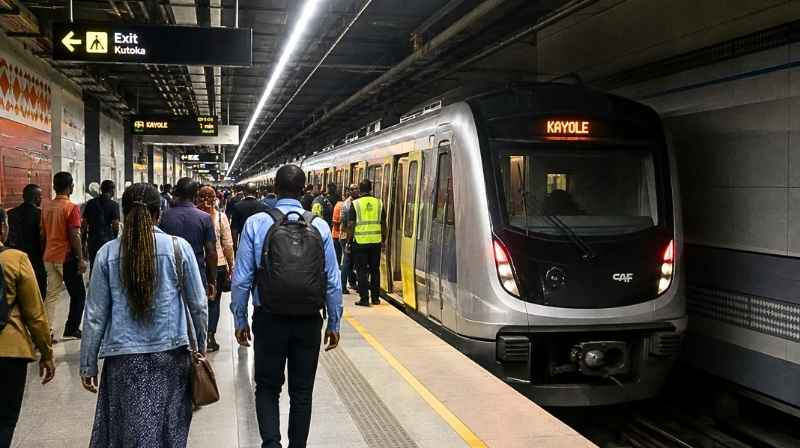

Nairobi’s proposed metro has moved beyond the initial county approval announced in July, but the latest information also makes one thing increasingly clear: there is still substantial legal, financial and technical work to complete before construction can begin.
The Nairobi City County Executive approved the implementation framework for Phase I of the Nairobi Metropolitan Mass Rapid Transit System (NMRTS) on July 21, describing an underground Central Business District core and an Eastlands Line as the first major components of the project. The county formally announced the decision the following day.
Since then, more details have emerged about how the government intends to turn the proposal into an operating railway — including new legislation, a dedicated governance structure, financing arrangements and integration with Nairobi’s existing public transport network.
The latest developments build on Nairobi’s wider rail and mass-transit ambitions. Metros Kenya has previously examined the Nairobi Metro Lines and Underground Railway project, including the proposed network, development timeline and how it could fit into the capital’s future transport system.
For commuters, however, the distinction remains important: the Nairobi Metro is still a development-stage project. Construction has not started.
Five County Bills Could Be Needed
One of the most significant developments is the emerging legal framework behind the railway.
Recent reporting on the NMRTS implementation plan says five Nairobi county bills have been identified to provide the legal and governance framework needed for the system.
Among them is a proposed Nairobi MRTS Authority Bill, intended to establish the institution and mandates needed to oversee the mass rapid transit system. Other proposed legislation would address areas including financing, transport integration and protection of the railway corridor.
This means building Nairobi’s metro would involve considerably more than procuring trains and excavating tunnels.
The city first needs a framework governing the railway, the institutions responsible for it and some of the development that would take place around the network.
New Planning Rules Could Reshape Areas Around Stations
The metro could also have major implications for development around proposed stations.
The emerging framework envisages planning regulations covering issues including station-area development, corridor zoning, building density and height, parking management, environmental protection and heritage considerations.
Two concepts are particularly important: Transit-Oriented Development (TOD) and Land Value Capture (LVC).
Transit-Oriented Development encourages housing, offices, shops and other services to be concentrated around major transport stations. The aim is to make it easier for people to live, work and access services without depending entirely on private cars.
Land Value Capture, meanwhile, seeks to recover some of the economic value created when major transport infrastructure improves accessibility and potentially increases surrounding land values.
Reported financing mechanisms being considered under this framework include development charges, impact fees, air rights and other instruments.
For Nairobi, this means the proposed metro is being conceived as more than a railway. It could become part of a much wider redevelopment of areas around major stations.
Government Is Still Working on Financing
Financing remains one of the biggest hurdles.
Governor Johnson Sakaja said in September that the county and national governments were working on the project’s financing and implementation framework following county approval and national government backing.
The government’s Public Private Partnerships Directorate has also become involved.
On July 30, PPP Directorate Director-General Kefa Seda met Presidential Governance Advisor Dr Silvester Kasuku to discuss Nairobi’s urban transport system, with particular attention to development of the mass rapid transit network.
The PPP Directorate said the discussions focused on moving beyond repeated studies towards implementation of a modern, integrated mass-transit system.
A public-private partnership is therefore expected to form an important part of the proposed delivery model.
But there is an important distinction.
Having a proposed financing model is not the same as having the billions of dollars required to construct the railway secured and available.
The financing structure still has to progress through the necessary development, procurement and financial-close stages.
Is Phase I 23 km or 30 km?
There is also an important question about the project’s evolving configuration.
Specialist railway reporting in August described Phase I as comprising a 10 km underground CBD circular route with eight stations and a 13 km, mostly elevated Eastlands Line.
That would produce approximately 23 km across the two components.
But subsequent government descriptions have presented a different picture.
Following a briefing at State House on July 31, President William Ruto described Phase I as a 30 km underground railway connecting Eastlands with the CBD through 25 stations.
September reporting has continued to describe the first phase as a 30 km underground railway with 25 stations.
That is a substantial difference.
It would therefore be premature to treat every route length, station number and underground-versus-elevated configuration currently circulating as the final engineering specification.
What is firmly established is the broader concept: Phase I is intended to establish high-capacity rail connectivity between Eastlands and central Nairobi, with an underground CBD component.
Nairobi County’s own July announcement describes the CBD underground core and Eastlands Line as the two pillars of Phase I.
Further engineering and project development should eventually provide a clearer picture of the final alignment, station locations and which sections will be underground, elevated or at surface level.
What Happens Between Now and Construction?
The implementation roadmap gives a better indication of how much work remains before Nairobi reaches the construction stage.
Planning and preparation extend across 2026 and 2027, including approvals, stakeholder engagement, governance structures and financing arrangements.
Subsequent stages are expected to include preliminary and detailed engineering, environmental work, land-acquisition planning and completion of the PPP structure.
Detailed engineering and financial close are targeted during the 2028–29 period under the reported roadmap.
The immediate programme also envisages establishment of an NMRTS steering committee and technical working groups dealing with areas including engineering, finance, legal issues, environment, land, Transit-Oriented Development and Land Value Capture.
In other words, Nairobi remains several major steps away from tunnel-boring machines appearing beneath the CBD.
Construction Has Not Started
This distinction is particularly important as visualisations and ambitious descriptions of the Nairobi Metro circulate online.
As of September 2026, the project should not be described as a railway currently under construction.
County approval of the implementation framework is significant. National government backing is also significant.
But political approval and project development are different from procurement, financial close and physical construction.
The milestones worth watching next include the proposed legislation, establishment of the project’s governing institutions, detailed designs, environmental approvals, financing arrangements, procurement and eventually the award of construction contracts.
Those developments will provide much stronger evidence of the project’s progress than visualisations of what the completed railway could eventually look like.
When Could Nairobi Metro Actually Open?
The currently reported implementation roadmap points towards major civil works extending into the early 2030s.
Under that timetable, tunnels, viaducts and stations would be substantially completed by 2032, followed by system integration, testing and safety certification.
Commercial operations are targeted from January 2034, followed by an optimisation period extending into 2035.
But 2034 should be understood as a target, not a guaranteed opening date.
Large urban railway projects depend on financing, procurement, land availability, environmental approvals, engineering conditions and construction progress.
For commuters, the more accurate description at this stage is therefore that Nairobi is targeting 2034 for the beginning of metro operations under the current implementation programme.
Where Do Matatus and BRT Fit Into the Metro?
This may ultimately become one of the most important questions for Nairobi commuters.
The proposed metro is not being designed as an isolated railway.
Nairobi County says the NMRTS is intended to integrate directly with Bus Rapid Transit routes at major interchange points.
President Ruto has similarly described the underground railway as the beginning of a broader multimodal system incorporating BRT and commuter rail.
The objective is therefore to allow passengers to transfer between different high-capacity transport modes rather than having separate systems operating independently.
But that leaves another major part of Nairobi’s transport network to consider: matatus.
Matatus currently provide extensive connectivity between Nairobi estates, satellite towns, the CBD and major employment centres. A future metro would consequently need effective feeder connections if commuters are to complete journeys between railway stations and neighbourhoods.
Exactly how matatu routes, stages and SACCO operations would be reorganised around a functioning metro network has not yet been fully established in the official material reviewed by Metros Kenya.
That will be an important issue to watch as detailed transport-integration planning progresses.
Metros Kenya’s Nairobi Matatu Routes and Numbers database shows the extensive road-based network with which any future rapid-transit system would have to interact.
The Nairobi Bus Stations and Matatu Stages and Termini database similarly provides a guide to existing passenger interchange points around the city.
Phase II Would Push the Network Further West and South
The first phase is intended to establish only the initial backbone of the system.
Nairobi County says planning for Phase II is already underway, with proposed extensions towards Westlands, Ngong Road and Lang’ata Road, serving demand from areas including Ongata Rongai, Ngong and western parts of the metropolitan area.
If ultimately implemented, those extensions could give Nairobi a much broader rapid-transit network connecting several of the city’s busiest transport corridors.
But Phase II is further down the development path.
The immediate test is whether Phase I can successfully progress through financing, legislation, engineering and procurement into actual construction.
Nairobi’s Metro Story Has Entered a More Serious Stage
The significance of the latest developments is not that Nairobi suddenly has an underground railway.
It doesn’t.
What has changed is that the proposal now has a county-approved implementation framework, national government backing, involvement from the PPP Directorate and an emerging roadmap dealing with financing, institutions, legislation and urban development.
That puts the proposal beyond being simply another conceptual metro map.
But the next stage will also be considerably harder.
Nairobi must now translate political approval into legislation, financing agreements, detailed engineering, environmental approvals, procurement and eventually construction.
For commuters who have watched versions of a Nairobi mass-transit system appear in city plans for decades, those tangible milestones — rather than proposed opening dates or architectural visualisations — will show whether Nairobi’s metro is finally becoming a railway.