
More than 15 years ago, Kenya Railways was talking about a railway that could take passengers from Nairobi to Mombasa in approximately three hours.
Kenya eventually built the Standard Gauge Railway (SGR), and the Madaraka Express dramatically changed rail travel between the country’s two largest cities.
But Kenya never got a true high-speed railway.
Today, countries including Japan, China, France and Morocco operate trains at speeds associated with modern high-speed rail, while Kenya’s railway investment remains centred on conventional passenger and freight services.
Curiously, Kenya is not alone.
The United States, despite having the world’s largest economy, has also struggled to establish a true national high-speed passenger railway network.
The experiences of the two countries raise a deceptively simple question: what does it actually take for a country to build high-speed rail?
And perhaps more importantly for Kenya: could Nairobi and Mombasa ever be connected by a genuine 250 km/h or faster train?
Kenya Railways was talking about faster trains in 2009
Long before passengers boarded the first Madaraka Express service, Kenya Railways was already considering how to replace the ageing metre-gauge railway inherited from the colonial era.
In September 2009, Kenya Railways Corporation manager Golicha Tatache gave a remarkably blunt assessment of the old railway.
“The line is obsolete.”
He added:
“If you are in a hurry in this country you use a bus, not a train.”
At the time, Kenya Railways was proposing a new high-capacity standard-gauge railway.
Contemporary reports described the project as a high-speed railway capable of reducing the Nairobi–Mombasa journey from approximately 13 hours to three hours.
Tatache argued that modernising the railway wasn’t simply about giving passengers faster journeys.
It was an economic necessity.
“Commercially this line is viable and without it we can forget about competing in the global market.”
The proposed trains were reported as capable of reaching approximately 100 mph — around 160 km/h.
That would have been fast, particularly compared with the old metre-gauge railway, although still below what is normally considered modern dedicated high-speed rail.
The railway revolution eventually happened.
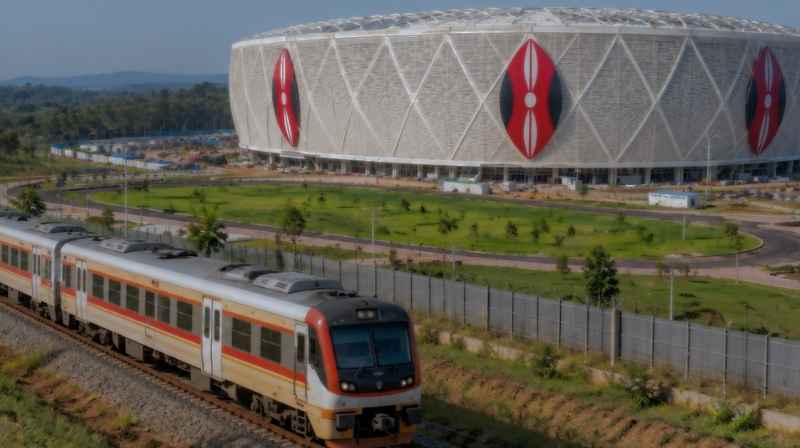
Kenya constructed the Mombasa–Nairobi SGR and introduced the Madaraka Express, giving passengers a substantially faster alternative to the old railway.
For travellers planning journeys on the existing network, Metros Kenya has a complete Kenya Train Routes: SGR and Commuter Rail Guide.
But the SGR was developed as a railway carrying both passengers and heavy freight, rather than as a dedicated high-speed passenger system.
That distinction matters.
A Shinkansen-style railway isn’t simply an ordinary railway with a much faster locomotive.
True high-speed rail normally requires infrastructure engineered specifically for sustained high speeds: suitable track geometry, signalling, grade separation, fencing, power systems, rolling stock and, depending on the desired speed, carefully designed curves and gradients.
Putting a 300 km/h train on infrastructure that wasn’t designed to support sustained operation at that speed doesn’t turn the railway into a bullet-train system.
Perhaps the most intriguing evidence that high-speed rail hasn’t entirely disappeared from Kenya’s railway thinking comes from Parliament.
During scrutiny of the SGR project, a parliamentary committee made an observation about its long-term development.
It said:
“For long-term viability, the Project should incorporate future plans for expansion of the line to a double track with a high speed line…”
The committee also recommended creating room for electric-powered trains to reduce future expansion costs.
That is significant.
It means the possibility of a future high-speed railway wasn’t merely something imagined by railway enthusiasts. It entered formal parliamentary consideration surrounding Kenya’s largest modern railway project.
But such a dedicated high-speed line has not subsequently become the centrepiece of Kenya Railways’ current investment programme.
High-speed rail nevertheless appears in Kenya Railways’ longer-term strategic context.
Its 2023–2027 Strategic Plan explicitly references the African Union’s Agenda 2063 ambition for a harmonised continental High-Speed Train Network connecting major African capitals.
Kenya Railways says its own strategy is aligned with that broader continental vision.
But its immediate priorities are considerably more fundamental.
They include extending the SGR towards Kisumu and Malaba, upgrading railway infrastructure, increasing freight and passenger capacity, improving commuter services and modernising existing railway operations.
In other words, Kenya may belong to Africa’s long-term high-speed-rail ambition, but the country is still building out its conventional national railway network.
America has the same problem — but for different reasons
This is where Kenya’s experience becomes particularly interesting.
The United States has far greater financial resources than Kenya, yet it too has struggled to establish true high-speed rail.
Railway expert Lou Thompson, who was involved in the formation of Amtrak and later worked as a railway adviser to the World Bank, recently offered a remarkably simple explanation.
Other governments:
“wanted high speed rail, and they were willing to pay for it.”
He said the US government had never simultaneously satisfied those two conditions.
The United States instead poured enormous public investment into interstate highways and aviation.
That created another problem.
Once cars, highways and domestic aviation become deeply embedded in how people move between cities, rail must compete against transport systems that governments have spent decades developing.
Kenya’s situation is different, but there is a parallel.
For decades, the overwhelming majority of Kenyan passenger transport investment and travel has centred around roads.
The country consequently has an enormous ecosystem of buses, matatus, private vehicles and boda bodas.
Rail has to win passengers back from that system.
High-speed rail rarely pays for itself through tickets alone
There’s another lesson from America’s struggle that is particularly relevant to Kenya.
Building high-speed rail is extraordinarily expensive.
That makes the idea of simply finding a private investor to build the railway attractive.
But Thompson argues that this misunderstands the economics of major railway infrastructure.
He told CBS that some of the reasons governments build high-speed rail are public benefits such as reduced congestion, pollution and road crashes.
His conclusion was straightforward:
“The simple answer is they’ve decided they want to do it and pay for it, and we haven’t.”
That question would be even more difficult for Kenya.
Would the government be willing to commit enormous public resources to a Nairobi–Mombasa high-speed passenger railway while simultaneously financing roads, commuter rail, SGR expansion and numerous other infrastructure projects?
Distance.
High-speed rail is particularly competitive with aviation on medium-distance intercity journeys.
Nairobi and Mombasa sit within the kind of distance where the concept at least becomes worth examining.
A genuine high-speed railway wouldn’t necessarily eliminate flying between the cities.
But it could change the calculation.
Air passengers must travel to an airport, check in, pass through security, wait for boarding, fly and then travel from the destination airport into the city.
Rail can potentially provide a much more direct city-to-city journey.
That means the important measurement isn’t simply:
train time versus flight time.
It is:
city centre to city centre.
Kenya already has substantial passenger movement between Nairobi and Mombasa by road, rail and air.
The unanswered question is whether that market is large enough to economically justify infrastructure capable of operating at 250 km/h or faster.
There is another fundamental difference between the railway Kenya has and a dedicated bullet train.
Freight matters enormously to Kenya’s railway strategy.
Mombasa is East Africa’s major maritime gateway, and one of the principal purposes of the SGR is moving cargo inland.
Kenya Railways’ current strategy continues to emphasise increasing both passenger and freight capacity and extending the SGR towards Uganda and the wider region.
A dedicated high-speed passenger railway has a very different mission.
That raises a potentially uncomfortable infrastructure question.
If Kenya wanted Nairobi–Mombasa trains travelling at 250 or even 300 km/h, could the existing SGR realistically be transformed into such a railway?
Or would Kenya essentially have to construct another line?
The answer would dramatically change the economics.
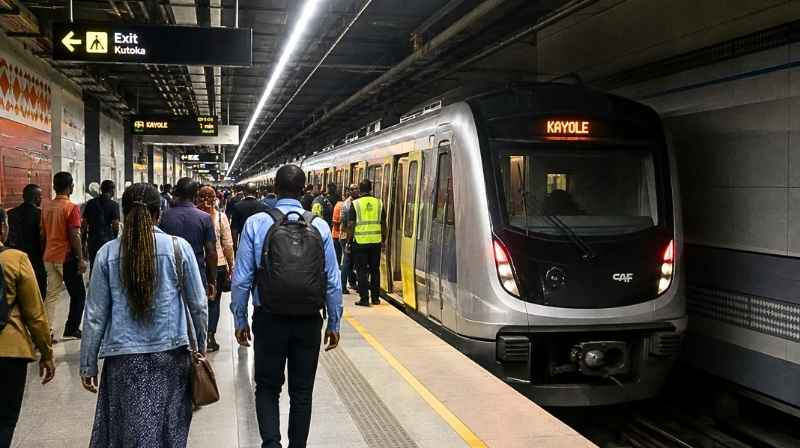
Kenya is also still solving basic commuter rail problems
Nairobi illustrates the competing priorities particularly clearly.
Kenya Railways is developing the Nairobi Railway City around a new multimodal central station intended to integrate SGR, metre-gauge rail, BRT and non-motorised transport. KRC
Meanwhile, ordinary Nairobi commuters still depend heavily on matatus and buses.
Metros Kenya’s Nairobi Matatu Routes and Numbers: Complete Commuter Guide demonstrates just how extensive that road-based public transport network has become.
Government therefore faces a choice that Japan, France and China have also confronted at different stages of development:
Should billions be invested in allowing people to travel between two major cities extraordinarily quickly, or should that money first provide better everyday transport to millions of commuters?
It isn’t necessarily an either-or decision.
But every major infrastructure project competes for financing.
Perhaps the most revealing thing about Kenya’s high-speed rail story is that the ambition never entirely disappeared.
In 2009, Kenya Railways was discussing a railway that could dramatically reduce the journey between Nairobi and Mombasa.
Parliament subsequently recommended planning for eventual double tracking and a high-speed line.
And Kenya Railways’ present strategic plan acknowledges the African Union’s ambition for a continent-wide high-speed railway network by 2063.
Yet Kenya’s immediate railway priorities tell another story.
Before the country starts building bullet trains, it is still expanding the SGR, improving commuter services, rehabilitating older railway infrastructure and trying to shift more passengers and freight onto rail.
That may ultimately explain why Kenya doesn’t have a bullet train better than any engineering argument.
The technology already exists.
Countries much smaller than the United States have demonstrated that high-speed rail can be built.
The difficult questions are where to build it, whether enough people would use it, what other infrastructure would be sacrificed or delayed — and, ultimately, who would pay for it.
Seventeen years after Kenya Railways declared the old railway obsolete, one question therefore remains unanswered:
Will the three-hour Nairobi–Mombasa railway discussed in 2009 ever become reality — or was the Madaraka Express as close as Kenya will come for the foreseeable future?