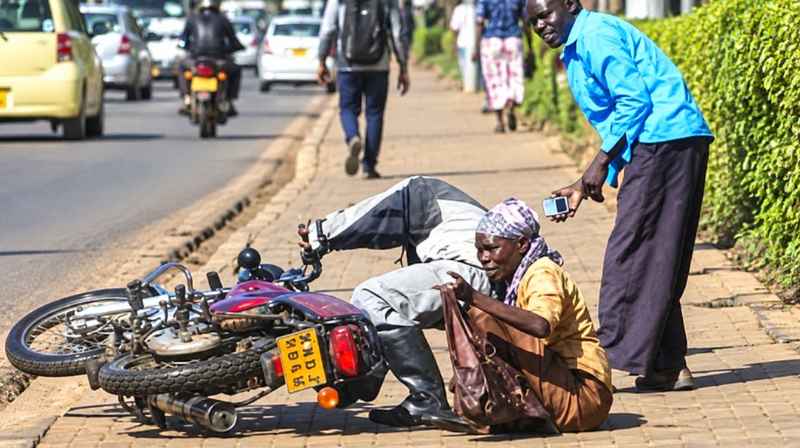

You are walking along a pedestrian pavement in Nairobi when traffic slows to a crawl. A boda boda rider decides to escape the jam by mounting the pavement. Seconds later, the motorcycle hits you.
Perhaps the rider stops. Perhaps he offers to take you to hospital. Or perhaps he accelerates and disappears before you can even record the motorcycle’s registration number.
What should you do? Who pays your medical bills? Can the boda boda’s insurance compensate you? And does the fact that you were walking on a pavement strengthen your case?
Metros Kenya spoke to the Insurance Regulatory Authority (IRA), legal practitioners and an experienced boda boda rider to understand what happens after a pedestrian is knocked down—and why the first few minutes after an accident can become crucial to any subsequent compensation claim.
For the wider rules governing motorcycle operators and passengers, see our guide to Boda Boda Laws in Kenya.
Are boda bodas allowed to use pedestrian pavements?
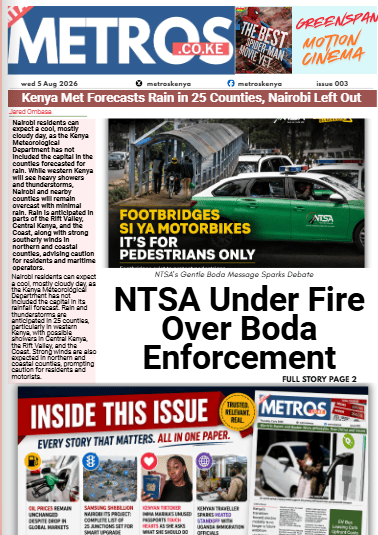
Generally, a boda boda cannot simply turn a pavement into another traffic lane because the road is congested.
Section 45A of Kenya’s Traffic Act prohibits driving a motor vehicle on or through a pavement or pedestrian walkway for the purpose of avoiding a build-up of traffic. The provision creates penalties for the offence.
That means the familiar sight of motorcycles mounting pavements to beat Nairobi traffic isn’t merely an inconvenience to pedestrians.
It can amount to a traffic offence.
This is particularly important when an accident happens because the location of the motorcycle and pedestrian can become evidence when determining negligence.
A boda boda has knocked you down. What should you do first?
Get medical attention first.
Even when an injury initially looks like a bruise or minor cut, have it assessed and documented.
The next priorities are reporting the accident and preserving evidence.
If possible, record the motorcycle’s registration number immediately. If you’re unable to do so because of your injuries, ask whether witnesses saw or photographed it.
Take photographs of the accident scene, particularly if the collision happened on the pavement.
Also look around.
A shop, petrol station, apartment building, office, supermarket or other nearby premises may have CCTV covering the road.
Get witnesses’ names and telephone numbers where possible.
And report the accident to police.
These steps can become particularly important if the rider subsequently denies involvement or disappears.
What if the boda boda rider escapes?
This is one of the most difficult situations for an injured pedestrian.
Don’t assume that because the rider has disappeared there is no point reporting the accident.
Report it to police and provide whatever information you have about the motorcycle and rider.
That might include the registration number, motorcycle colour, rider’s clothing, branding, boda boda stage, direction in which the rider escaped, witnesses and potential CCTV cameras.
Identification of the motorcycle is especially important because it can lead to its registered owner and potentially its insurer.
Momanyi and Momanyi Advocates, based at Gill House in Nairobi, told Metros Kenya:
“The key issues are reporting the accident immediately, seeking medical treatment, preserving evidence and attempting to identify the motorcycle, its owner and insurer.”
The advocates said that where the registration number is known, the victim may still have avenues for pursuing a claim even if the rider disappears.
But the situation becomes significantly more complicated where neither the rider nor motorcycle can ultimately be identified.
What should you obtain from police?
The police process becomes an important part of establishing that the accident occurred and documenting the people and vehicles involved.
Depending on the circumstances, relevant documentation may include the OB reference, P3 form and Police Abstract.
Victims should follow up on the investigation rather than simply making an initial report and assuming everything else happens automatically.
The Police Abstract can contain information relating to the vehicles and insurance involved in the accident. But the document itself shouldn’t automatically be interpreted as a final determination of civil liability.
If you’re involved in an accident while travelling in public transport, our separate guide explains PSV Accident Laws in Kenya: What Passengers Should Do After a Matatu or Bus Crash.
Who pays if a boda boda knocks down a pedestrian?
This is where insurance enters the picture.
An Insurance Regulatory Authority official explained to Metros Kenya that where a boda boda knocks down and injures a pedestrian, the first step is to report the accident to police and obtain a police abstract while ensuring the motorcycle and its insurer are identified.
The injured person should then seek medical attention and retain all treatment records, medical reports and receipts relating to the injuries.
Once the motorcycle’s insurer has been identified, according to the IRA official, the accident should be reported and a third-party bodily injury claim lodged with the insurer together with the relevant police and medical documentation.
The insurer then assesses the circumstances surrounding the accident, liability and injuries sustained.
Where liability is established, compensation may be negotiated.
If the claim cannot be resolved through settlement, the injured person may pursue the matter through the courts, after which the insurer may be required to satisfy a qualifying judgment in accordance with the law.
For a broader explanation of insurance requirements in Kenya’s public transport sector, see PSV Insurance Laws in Kenya: What Matatu and Bus Passengers Should Know.
What if the rider disappears but you have the number plate?
This is very different from a situation where the motorcycle itself cannot be identified.
The rider disappearing doesn’t necessarily mean the motorcycle’s identity disappears with him.
Momanyi and Momanyi Advocates explained:
“Where the registration number is known, the victim may still have avenues for pursuing a claim even if the rider disappears.”
The registration number can therefore become one of the most valuable pieces of evidence collected at the scene.
It can potentially assist authorities in identifying the motorcycle and its registered owner and, subsequently, determining the relevant insurance information.
What if you never got the boda boda’s registration number?
This is where things become harder.
According to Momanyi and Momanyi Advocates:
“Where neither the rider nor motorcycle can be identified, the available compensation options become more complicated.”
That is why witnesses and CCTV become so important.
If you are physically unable to record information after the collision, someone else at the scene may have seen the motorcycle.
Nearby CCTV could potentially provide another route towards identifying it.
The important point is not to abandon the police report merely because you didn’t get the number plate.
What if the boda boda hit you while you were on the pavement?
This can be highly significant.
The Traffic Act specifically addresses vehicles using pavements and pedestrian walkways to avoid traffic.
Momanyi and Momanyi Advocates told Metros Kenya:
“A motorcycle being ridden on a pavement or pedestrian walkway can be important evidence when establishing negligence.”
But being hit on a pavement doesn’t mean that a compensation award automatically appears.
The circumstances still have to be established through evidence.
That’s another reason photographs of the accident scene can matter. If the dispute later becomes whether the pedestrian was walking on the pavement or had stepped into the road, a photograph, witness or CCTV recording could become significant.
Does the pedestrian automatically win because the boda boda was on the pavement?
Not necessarily.
Civil liability depends on the evidence and circumstances of the particular collision.
But a motorcycle being ridden where pedestrians are supposed to be walking can clearly be relevant to determining whether the rider acted negligently.
The legal position becomes different again when a pedestrian is struck while crossing the carriageway.
What if the pedestrian crossed outside a zebra crossing?
Pedestrians have responsibilities too.
Momanyi and Momanyi Advocates explained that the pedestrian’s conduct can be considered when liability is determined.
“Conversely, a pedestrian’s own conduct can also be considered. If the pedestrian is found partly responsible, contributory negligence can reduce the compensation ultimately awarded.”
This is known as contributory negligence.
It means an accident doesn’t necessarily have to be entirely the fault of the rider or entirely the fault of the pedestrian.
Responsibility can potentially be shared.
That makes the factual distinction between walking on a pavement and crossing a busy carriageway particularly important.
Why do boda boda riders use pavements anyway?
The law provides one answer.
Life on Nairobi’s streets provides another.
Geoffrey Musyoka has worked as a boda boda rider for six years. He candidly acknowledges that some riders use pavements and says passengers themselves sometimes encourage the practice.
“We all have a culture whereby, if the passenger is the one using the boda boda and is in a hurry, he will urge me to use the pavement so they can get to where they are going faster. But when they are on foot, it’s a different story.”
Musyoka believes there’s a contradiction in how people view the practice.
The same commuter who complains about boda bodas invading pedestrian space may, when running late and sitting on the back of a motorcycle, encourage the rider to find the quickest route through congestion.
“So, in the real sense, they are the ones who encourage that behaviour. What can I do as a boda boda person? I am also looking for daily bread, which means I can break some rules,” Musyoka said, answering his own question with a sheepish smile.
It is a candid explanation of why the behaviour persists.
It isn’t, however, a legal defence.
A passenger being late doesn’t convert a pavement into a motorcycle lane.
“Just take me to hospital”
Musyoka also describes another reality following relatively minor collisions.
According to him, some pedestrians would rather resolve the immediate situation with the rider than begin an insurance or legal process.
“Lots of pedestrians simply want to be taken to hospital or given something small for minor injuries or bruises. They don’t want to be involved too much with the insurance or long processes.”
Musyoka believes some pedestrians expect insurance or court proceedings to take months or years.
That is his experience and perception rather than a general rule about how long every claim takes.
But it raises an important question for injured pedestrians.
Should you simply accept some money at the roadside and walk away?
The problem is that an injury that initially appears minor can subsequently become more serious.
And if the victim hasn’t reported the accident, recorded the motorcycle or preserved medical evidence, establishing what happened later can become much harder.
What compensation could an injured pedestrian receive?
Compensation isn’t a fixed amount.
Momanyi and Momanyi Advocates said:
“Depending on the circumstances and evidence, a claim may involve medical expenses, pain and suffering, loss of income, future treatment and permanent disability.”
The nature and severity of the injuries matter.
So does evidence.
The advocates identified medical records, police documents, photographs, witnesses, CCTV and motorcycle details as potentially crucial evidence.
They added:
“A particularly important issue is what victims fail to document immediately after an accident, because missing evidence can later make a compensation claim considerably more difficult.”
That makes the first few minutes and hours following the collision extremely important.
What if you were a passenger on the boda boda?
There is another person who can easily be forgotten in these accidents: the pillion passenger.
If you’re riding on a boda boda and your rider causes a crash, being his passenger doesn’t necessarily mean you have to bear the consequences yourself.
Momanyi and Momanyi Advocates said passengers may potentially have claims where their own boda boda rider caused the accident or where several motorists contributed to the collision.
Insurance is also relevant.
The Insurance Regulatory Authority has previously explained that insurance requirements for commercial motorcycles carrying fare-paying passengers include third-party protection for passengers.
Passengers themselves also have safety obligations, including helmet requirements. See Boda Boda Helmet Laws in Kenya for the rules applying to riders and passengers.
What if a boda boda and a car were both responsible?
Some accidents involve more than one negligent road user.
A boda boda rider might make a dangerous manoeuvre while another motorist is simultaneously speeding or driving carelessly.
In such circumstances, determining liability becomes more complicated.
Momanyi and Momanyi Advocates said passengers may have claims where several motorists contributed to the crash.
Police evidence, witnesses, CCTV and the circumstances of the collision can therefore become crucial in establishing who was responsible and to what extent.
The evidence you should preserve
If you’re physically able after an accident, try to preserve as much information as possible:
- Motorcycle registration number
- Photographs or video of the motorcycle
- Photographs of the accident scene
- Photographs showing the pavement or pedestrian walkway
- Rider description
- Witness names and telephone numbers
- Nearby CCTV locations
- Police/OB details
- Police Abstract and other relevant police documents
- Treatment notes and medical reports
- Hospital and pharmacy receipts
- Photographs documenting injuries
Don’t put yourself in further danger trying to collect evidence. Medical treatment and personal safety come first.
But whatever information can safely be preserved may later make the difference between an allegation that is difficult to prove and a properly documented accident.
So, what should you do if a boda boda knocks you down on a pavement?
The practical sequence is relatively straightforward:
Get medical attention → report the accident to police → identify the motorcycle if possible → preserve photographs, witnesses and CCTV → obtain the relevant police documentation → retain all medical records and receipts → identify the insurer → lodge the appropriate third-party injury claim.
If liability is disputed or the compensation claim cannot be resolved, legal proceedings may become necessary.
And if the boda boda escapes, don’t simply conclude that the case is over.
A registration number, witness, photograph or CCTV recording could still lead investigators to the motorcycle.
A pavement is still a pedestrian space
Perhaps the most revealing comment from the interviews came from Musyoka himself.
He admits that commuters sometimes encourage boda boda riders to use pavements when they are running late, only to object to exactly the same behaviour when they become pedestrians.
That contradiction may help explain the culture.
It doesn’t change the law.
Kenya’s Traffic Act expressly restricts motorists from using pavements and pedestrian walkways to bypass traffic.
For pedestrians, the lesson is equally important: if you are knocked down, don’t treat evidence as an afterthought.
Get treatment. Report the accident. Record what happened. Preserve the documents.
Because when the question eventually changes from “Are you okay?” to “Who was responsible, and who should compensate you?”, those details may be what determines the answer.