

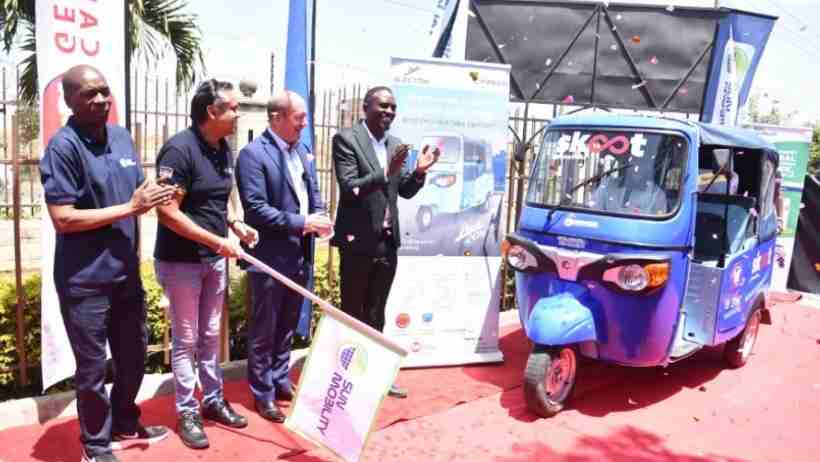

Electric three-wheelers are gradually reshaping Kenya’s urban mobility landscape, introducing lower operating costs for drivers while supporting cleaner and digitally connected transport solutions. As cities continue to expand and demand for affordable last-mile mobility increases, electric tuk-tuks are emerging as a practical alternative to conventional fuel-powered three-wheelers.
The shift is being highlighted by the rollout of the Skoot e3W, a smart electric three-wheeler launched through a collaboration between Skoot Technology, SUN Mobility, and distributor Car & General. The vehicle is designed specifically for high-usage urban environments where efficiency, reliability, and reduced operating costs are essential for daily operations.
At the core of the Skoot e3W is a combination of a Piaggio-designed vehicle platform and SUN Mobility’s ultrafast battery swapping system. Instead of waiting for batteries to recharge, drivers can exchange depleted batteries for fully charged units within minutes. This approach significantly reduces downtime and allows vehicles to remain operational throughout the day.
Battery swapping addresses one of the biggest challenges associated with electric vehicles in commercial transport—charging time. Conventional electric vehicles typically require extended periods to recharge, which can limit productivity for drivers who rely on continuous operations. With swapping, the process becomes similar to refueling, allowing drivers to return to the road quickly.
According to the companies involved, a driver covering approximately 150 kilometres per day could spend about Ksh.650 on energy using the electric tuk-tuk. This compares to roughly Ksh.850 in diesel costs for conventional three-wheelers operating over similar distances. The difference, while modest per day, can accumulate into substantial savings over time, particularly for drivers working full-time.
Beyond fuel savings, electric three-wheelers generally require less maintenance compared to diesel-powered vehicles. Electric motors have fewer moving parts, eliminating components such as complex gear systems and reducing wear associated with combustion engines. This translates to fewer service intervals and potentially lower long-term maintenance costs.
The Skoot platform also integrates a digital ecosystem designed to support driver operations. Through a dedicated mobile application, drivers can manage leasing arrangements, locate nearby battery swap stations, and access delivery contracts. The application also facilitates payments and provides operational support, helping streamline daily workflows.
Flexible leasing options have been introduced to lower entry barriers. The Skoot e3W is available under daily, weekly, and monthly plans, starting from approximately Ksh.1,200 per day. The leasing model includes maintenance, allowing drivers to operate without the burden of large upfront capital investment. This structure aims to accelerate adoption among drivers transitioning from traditional tuk-tuks.
SUN Mobility’s battery swapping technology has previously been deployed in other markets, where it has supported large fleets of two- and three-wheelers. The system uses standardized battery packs that can be quickly exchanged at designated stations. As the network expands, accessibility improves, making the system more viable for widespread use.
Car & General’s role in distribution and servicing provides additional support for the rollout. The company’s existing footprint helps ensure that drivers have access to maintenance services and operational assistance. This infrastructure is particularly important during the early stages of deployment, when reliability and support are critical for adoption.
Before commercial launch, the electric tuk-tuk underwent a 24-month pilot programme in Nairobi. The trials evaluated performance under heavy loads, battery durability, maintenance requirements, and overall rider experience. Testing in real-world traffic conditions helped refine the vehicle for Kenya’s urban road environment.
The pilot phase also assessed how battery swapping integrates into daily driver routines. Quick swap times and predictable energy costs were identified as key operational benefits. The ability to maintain consistent daily usage without extended charging breaks contributed to stable operational planning.
Electric three-wheelers are also aligned with broader efforts to reduce emissions in urban transport. Diesel-powered tuk-tuks contribute to air pollution, particularly in densely populated areas with heavy traffic. Electric alternatives eliminate tailpipe emissions, helping reduce local pollution levels and noise.
Noise reduction is another distinguishing factor. Electric motors operate more quietly than combustion engines, which may contribute to improved urban sound environments. This characteristic is particularly relevant in residential areas where tuk-tuks often operate on short-distance routes.
The introduction of battery swapping infrastructure plays a central role in scaling electric three-wheelers. Swap stations must be strategically placed to ensure accessibility across operational routes. As more stations are deployed, drivers can operate confidently without concerns about energy availability.
The digital integration offered by the Skoot system also reflects a broader shift toward connected mobility. Through app-based features, drivers can track usage, monitor battery status, and receive operational updates. This data-driven approach enhances efficiency and supports fleet management capabilities.
The adoption of electric tuk-tuks is occurring alongside growth in Kenya’s last-mile transport sector. Three-wheelers are commonly used in estates, market areas, and short-distance urban routes where larger vehicles may not be practical. Electric models aim to maintain this flexibility while reducing operational costs.
Local adaptation has also been a focus of the rollout. The vehicle’s performance was tested in varying traffic conditions, including congested urban corridors and uneven road surfaces. Adjustments made during the pilot phase helped ensure suitability for Kenya’s operating environment.
The rollout also reflects increasing interest in electrification within the transport sector. Electric buses, motorcycles, and three-wheelers are gradually entering the market as infrastructure and technology improve. Battery swapping is one of several approaches being explored to support commercial electric mobility.
Operational efficiency remains a central consideration for drivers. Reduced fuel costs, predictable energy pricing, and digital tools contribute to improved planning. Leasing models further reduce financial risk by allowing drivers to adopt electric vehicles without significant upfront investment.
As deployment expands, additional battery swap stations are expected to be introduced. Network growth will determine how quickly electric three-wheelers scale beyond initial pilot zones. Increased availability of swapping points improves route flexibility and supports broader adoption.
Electric tuk-tuks represent a convergence of multiple trends, including electrification, digital mobility platforms, and flexible leasing models. These elements collectively aim to improve operational efficiency while reducing environmental impact.
The introduction of the Skoot e3W highlights how technology partnerships are shaping new transport solutions. By combining vehicle design, battery infrastructure, and digital tools, the initiative seeks to modernize three-wheeler operations in Kenya’s urban transport ecosystem.
As battery swapping networks expand and more electric three-wheelers enter service, the technology is expected to play a growing role in last-mile mobility. The transition reflects ongoing changes in urban transport, where efficiency, sustainability, and connectivity are becoming increasingly important.