
By Kipchumba Lawi
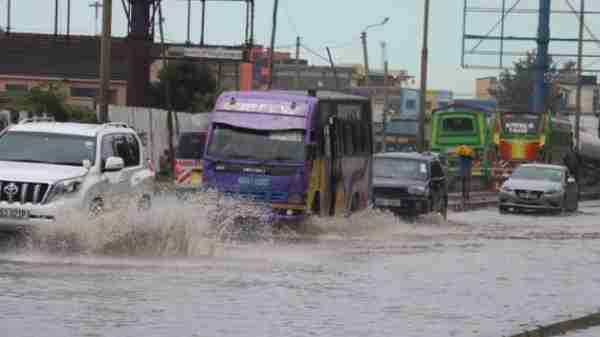
A report submitted to Metros by Kipchumba Lawi paints a detailed picture of Nairobi’s recurring drainage challenges, warning that the city’s infrastructure is increasingly unable to cope with rapid urbanisation, environmental degradation, and rising rainfall variability. The report outlines how seasonal flooding has become a persistent urban risk affecting transport, public health, and livelihoods across the capital.
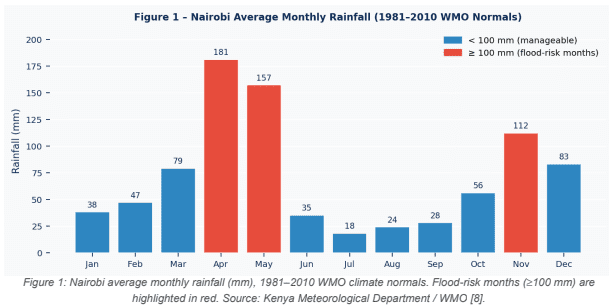
According to the submission, Nairobi’s drainage system — much of which dates back several decades — was originally designed for a significantly smaller population. Today, with more than five million residents, the system struggles to manage the volume of runoff generated during both the long and short rainy seasons. The result is widespread flooding that disrupts daily life and exposes residents to contaminated water.
The report notes that Nairobi’s geography compounds the problem. The city sits at a high elevation and is intersected by several rivers, including the Nairobi, Mathare, Ngong, and Motoine, which historically acted as natural drainage channels. Over time, however, urban encroachment along riverbanks, pollution, and informal settlement growth have reduced their capacity to carry floodwaters safely downstream.
ALSO READ: Did Kenya Railways Dismiss Claims of Ticket Hoarding Ahead of Easter?
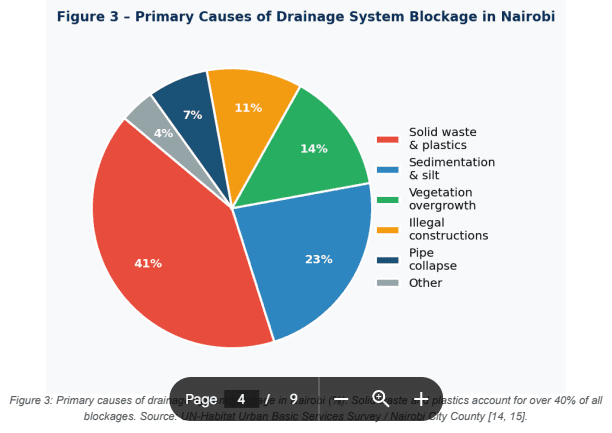
Urban expansion has also altered the city’s natural water absorption patterns. Large areas that once allowed rainwater to seep into the ground are now covered by roads, buildings, and other impermeable surfaces. This has significantly increased surface runoff, placing additional strain on ageing drainage infrastructure. In many areas, blocked drains — often clogged by plastic waste and debris — further restrict water flow during heavy rainfall.
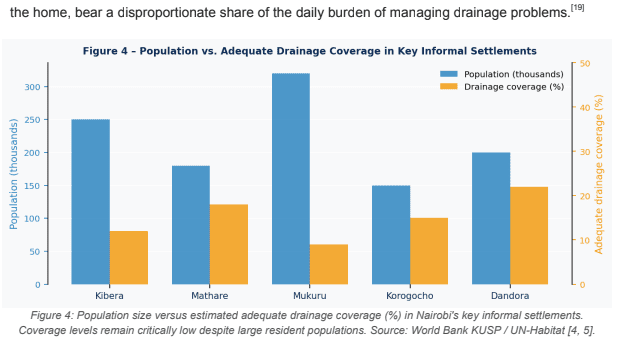
The report traces the roots of the crisis to historical planning decisions. Much of Nairobi’s drainage network was constructed during the colonial period for a small administrative town. Following independence, rapid population growth outpaced infrastructure expansion, particularly in informal settlements such as Kibera, Mathare, Mukuru, and Korogocho. These neighborhoods developed with limited or no formal drainage systems, leaving residents especially vulnerable to flooding.
ALSO READ: NTSA Withdraws Instant Fines Rollout Notice After Public Concerns
Beyond infrastructure, the report highlights governance and coordination challenges. Responsibility for drainage management is divided among several agencies, which can lead to overlapping mandates and slow implementation of comprehensive solutions. Limited maintenance budgets and weak enforcement of regulations, particularly those protecting riparian zones, have further contributed to the deterioration of drainage capacity.
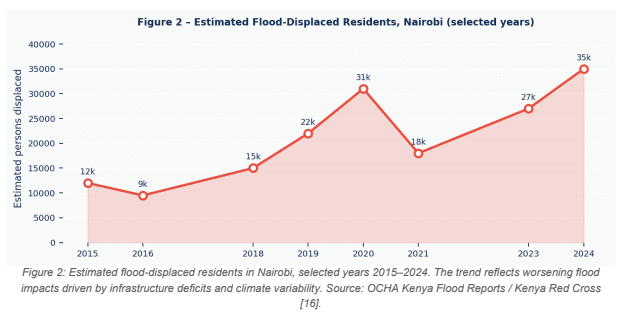
The human impact of the drainage deficit is significant. Flooding regularly damages homes, disrupts businesses, and displaces families. The report also points to increased health risks following major rainfall events, as stagnant water and sewage contamination create conditions for waterborne diseases. Transport disruptions during floods further compound economic losses by slowing movement across the city.
While acknowledging recent drainage rehabilitation efforts, the report suggests that many interventions have been short-term. Desilting operations and localized infrastructure upgrades have improved conditions in some areas, but without consistent maintenance and system-wide planning, drains often become blocked again within months.
To address the crisis, the report recommends developing a comprehensive drainage masterplan supported by sustained investment. It also calls for restoration of riparian zones, improved solid waste management, and stronger coordination among agencies responsible for infrastructure. Climate-resilient urban design, including permeable surfaces and green infrastructure, is highlighted as essential for future development.
The submission concludes that Nairobi’s drainage challenges are largely man-made and therefore solvable. However, it warns that without coordinated action, population growth and climate variability will continue to intensify flood risks. Strengthening drainage infrastructure, the report argues, is critical not only for reducing flooding but also for protecting public health and supporting economic activity across the city.