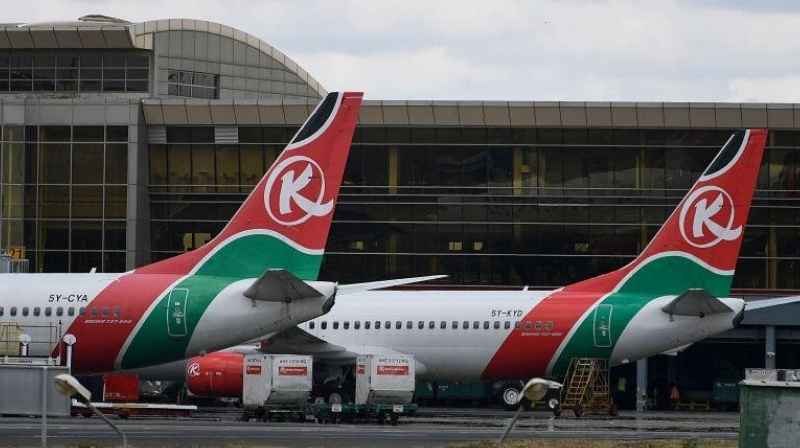

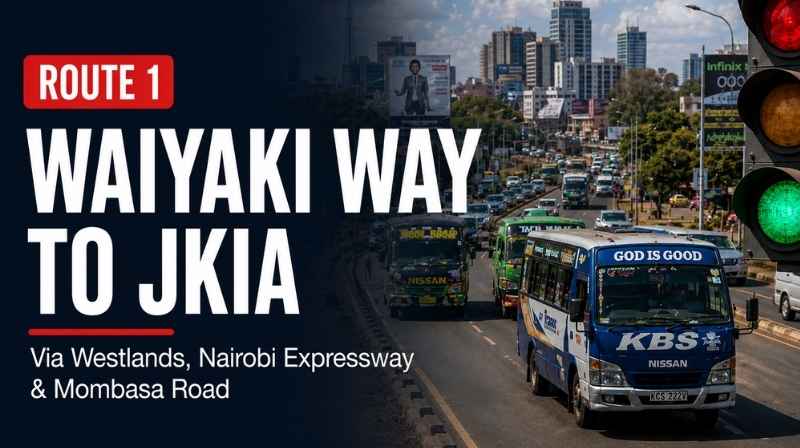

Travelling from Waiyaki Way to Jomo Kenyatta International Airport (JKIA) is one of the Nairobi airport journeys where the Nairobi Expressway can play a particularly important role.
Waiyaki Way carries traffic into Nairobi from areas including Kangemi, Mountain View, Uthiru and the Kikuyu side, before passing through Westlands and connecting with the wider city road network. For airport-bound travellers approaching from western Nairobi, the main decision is usually whether to connect to the Nairobi Expressway towards Mombasa Road and JKIA or use the conventional road network.
Metros documents the public transport services operating along this corridor in its Nairobi Matatu Routes and Numbers database, including routes serving Kangemi, Uthiru, Kikuyu and other destinations along Waiyaki Way.
The Main Waiyaki Way to JKIA Route
Unlike Jogoo Road, Waiyaki Way is on the opposite side of Nairobi from JKIA.
An airport journey therefore involves crossing a significant part of the city.
For many motorists, the most straightforward road sequence is broadly:
Waiyaki Way → Westlands → Nairobi Expressway → Mombasa Road/JKIA connection → Jomo Kenyatta International Airport
This is particularly relevant because the Nairobi Expressway begins on the western side of the metropolitan area and runs across Nairobi towards the Mombasa Road corridor.
However, the Expressway does not take motorists directly to an airport terminal. Travellers must leave the Expressway at the appropriate point and continue through the JKIA access road network.
Metros has a dedicated Nairobi Expressway JKIA Airport Access Guide explaining this final connection in greater detail.
Westlands to JKIA
Westlands is a particularly important starting point for this journey because of its proximity to the western end of the Nairobi Expressway.
For a traveller already in Westlands, the basic airport journey can be relatively simple:
Westlands → Nairobi Expressway → Mombasa Road → JKIA access → terminal
This avoids having to navigate much of Nairobi’s conventional surface-road network between Westlands and the airport side of the city.
The Expressway is tolled, however, so motorists should factor the toll into their journey.
Traffic conditions also remain relevant. Although the Expressway can bypass congestion on several conventional roads, delays can still occur before joining it, around exits or on the final approach to JKIA.
Passengers should therefore never treat the Expressway as a guarantee of a particular airport arrival time.
Kangemi to JKIA
Kangemi lies farther west along Waiyaki Way.
A traveller beginning here can proceed east along Waiyaki Way towards Westlands before connecting to the Nairobi Expressway for the journey across the city.
Kangemi also has extensive matatu connections with Nairobi CBD. Metros’ Route 23 Nairobi to Kangemi guide covers one of the public transport connections serving the Waiyaki Way corridor.
For someone travelling to JKIA, however, reaching Nairobi CBD is not necessarily the objective.
A private vehicle, taxi or ride-hailing vehicle can continue towards the appropriate Expressway entrance instead of terminating the journey in central Nairobi.
Passengers travelling by matatu may have to make an additional connection before continuing towards the airport.
Uthiru to JKIA
Uthiru sits farther along the western Nairobi corridor and is also served by Waiyaki Way public transport.
The airport journey again generally involves travelling east towards the Westlands side of Nairobi before crossing towards Mombasa Road and JKIA.
Metros’ Route 105 Nairobi to Kangemi and Uthiru guide provides more information for passengers travelling along this section of the Waiyaki Way corridor.
For an airport passenger using public transport, there are essentially two separate journeys to think about:
Uthiru/Waiyaki Way → central or western Nairobi interchange
and then:
Nairobi → JKIA
This is different from travelling in a private vehicle, where the passenger can remain in the same vehicle and connect directly towards the Expressway.
What About Travellers From Kikuyu?
Travellers beginning around Kikuyu have several strategic considerations because they are approaching Nairobi from even farther west.
Waiyaki Way provides the conventional route towards Nairobi, from where the traveller can continue towards Westlands and the Expressway.
However, depending on the exact starting point and traffic conditions, motorists may also need to consider Nairobi’s bypass network rather than automatically travelling through the busiest parts of the city.
For someone catching a flight, the important principle is to choose the cross-city route early.
Entering heavy Nairobi traffic and only then deciding how to reach JKIA can consume valuable time.
Passengers using matatus can consult the Metros Nairobi Matatu Routes database for services operating between the Kikuyu/Waiyaki Way corridor and Nairobi.
Why Nairobi Expressway Matters on This Route
The geography makes the Expressway particularly relevant to Waiyaki Way.
JKIA is southeast of Nairobi’s central area, while Waiyaki Way approaches Nairobi from the west.
The Expressway effectively provides a major cross-city connection between these two sides of Nairobi.
For airport travellers, this means avoiding numerous traffic signals, junctions and surface-road bottlenecks that would otherwise be encountered while crossing the city.
The broad journey becomes:
Western Nairobi
→ Waiyaki Way
→ Westlands
→ Nairobi Expressway
→ Mombasa Road
→ JKIA
This is why the Expressway plays a much more prominent role in a Waiyaki Way–JKIA guide than it did in our Thika Road or Jogoo Road airport guides.
Can You Reach JKIA Without Using Nairobi Expressway?
Yes.
The Nairobi Expressway is an option rather than the only way to reach the airport.
Motorists can use Nairobi’s conventional road network to cross the city towards Mombasa Road and JKIA.
The exact route will depend on the starting location, traffic conditions, road closures and where the traveller crosses central Nairobi.
Avoiding the Expressway also avoids the toll.
The trade-off is that conventional roads can expose travellers to more junctions and potentially heavier congestion.
For an airport passenger, the decision should therefore consider more than cost.
If avoiding the toll significantly increases the risk of being delayed in traffic, the cheaper route may not necessarily be the most practical one when a flight departure time is fixed.
Can You Use Southern Bypass From Waiyaki Way to JKIA?
The Southern Bypass can provide another cross-city option for some journeys originating from western Nairobi.
Rather than crossing through central Nairobi, motorists can use appropriate connections towards the southern road network and eventually reach the Mombasa Road side.
Whether this is worthwhile depends strongly on the traveller’s exact starting point.
Someone already near Westlands may find the Expressway more straightforward, while someone starting farther west or southwest may find a bypass connection worth considering.
This is why motorists should check current navigation and traffic information before departure rather than relying on one route every time.
Using Public Transport From Waiyaki Way to JKIA
There is a major difference between the road route to JKIA and the matatu route to JKIA.
Waiyaki Way has extensive matatu services connecting places such as Kangemi, Uthiru and Kikuyu with Nairobi.
But these ordinary Waiyaki Way services should not be interpreted as direct airport services.
A passenger travelling entirely by public transport will normally need to change vehicles.
Depending on the chosen journey, this may mean travelling towards Nairobi and transferring to public transport serving the Mombasa Road, Embakasi or airport corridor.
Metros has documented Route 34A between Nairobi, Pipeline, Embakasi and JKIA, one of the routes relevant to understanding public transport on the airport side of Nairobi.
Passengers should still confirm the actual drop-off point before boarding because serving the JKIA area and delivering a passenger directly to a particular airport terminal are not necessarily the same thing.
Using a Matatu and Taxi Together
For some passengers, a mixed journey may be more practical than either travelling completely by matatu or paying for a taxi from the far western side of Nairobi.
For example, someone starting farther along Waiyaki Way could use public transport for the first part of the journey and switch to a taxi or ride-hailing vehicle at a convenient point.
This becomes especially useful when travelling with luggage.
Multiple matatu interchanges with suitcases can make an otherwise inexpensive journey considerably more difficult.
A traveller should therefore balance fare, convenience, luggage and flight departure time rather than simply choosing the cheapest transport option.
Early-Morning and Late-Night Flights
Flight time changes the character of the Waiyaki Way–JKIA journey considerably.
During Nairobi’s busiest commuting periods, congestion can develop along Waiyaki Way and around approaches to major junctions.
At quieter hours, conventional roads may perform very differently.
Public transport availability may also be reduced very early in the morning or late at night.
Passengers with flights outside normal commuting hours should therefore confirm their transport arrangements beforehand rather than assuming the same options available during daytime will be operating.
Allow Enough Time to Cross Nairobi
This is particularly important for Waiyaki Way passengers because the journey involves travelling from one side of Nairobi to the other.
A passenger should account for more than the estimated driving time.
Allow for possible delays while reaching the Expressway, traffic around the airport exit, the final JKIA access road, airport entry procedures, airline check-in, baggage drop and security screening.
The longer the starting distance from JKIA, the greater the value of maintaining a reasonable time buffer.
Know Your Terminal Before Leaving
Before beginning the journey, check the airline booking and establish where at JKIA you need to go.
A traveller should ideally know the airline, flight number and relevant terminal before leaving Waiyaki Way.
The Metros Jomo Kenyatta International Airport (JKIA) passenger guide provides additional information for travellers using Nairobi’s main international airport.
This road guide and the airport guide serve different purposes:
Waiyaki Way to JKIA guide: helps plan the journey across Nairobi.
JKIA passenger guide: helps the traveller understand the airport and onward flight process.
Waiyaki Way to JKIA at a Glance
Starting corridor: Waiyaki Way
Destination: Jomo Kenyatta International Airport (JKIA)
Major starting areas: Westlands, Kangemi, Mountain View, Uthiru and the western Nairobi/Kikuyu side
Main cross-city option: Nairobi Expressway
Airport approach: Mombasa Road and JKIA access road network
Alternative: Conventional Nairobi roads or appropriate bypass connections
Public transport: Usually requires an interchange
With luggage: A taxi, ride-hailing vehicle or mixed matatu/taxi journey may be more convenient
Before departure: Check traffic, determine your route and confirm your JKIA terminal
For passengers beginning their journey farther along Waiyaki Way, the Metros Nairobi Matatu Routes and Numbers database can help