

Kenya Railways is recruiting specialists as plans to electrify Nairobi’s commuter railway move forward, just as Siemens Mobility advances a new generation of high-speed trains capable of travelling at up to 350 kilometres per hour in Vietnam.
The two developments are happening thousands of kilometres apart and involve very different railway systems, but together they offer a glimpse into two stages of modern electric rail development.
In Kenya, the immediate objective is to transform Nairobi’s commuter railway into a more reliable mass-transit system capable of moving substantially more passengers across the metropolitan region.
In Vietnam, the ambition is considerably faster: dedicated high-speed passenger rail using Siemens’ latest Velaro Novo trains.
For Kenya, the comparison raises a bigger question. Could the electric railway technology now being introduced in Nairobi eventually put the country on a path towards much faster trains?
Kenya Railways’ current recruitment is connected to the World Bank-supported Kenya Urban Mobility Improvement Project (KUMIP), which is intended to improve public transport and urban mobility across the Nairobi Metropolitan Area.
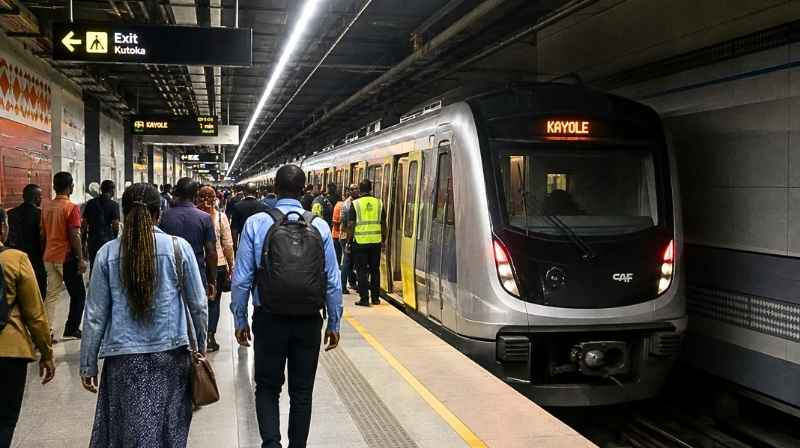
The corporation’s project plans specifically include electrification of the Nairobi Commuter Railway Network, development of the Nairobi Central Station–Thika commuter corridor and acquisition of Electric Multiple Units (EMUs) and Diesel Electric Multiple Units (DEMUs).
Kenya Railways is seeking specialists in railway electrical systems, signalling and telecommunications, rail civil engineering and transit-oriented development as preparations for the programme continue.
Those disciplines reveal how much more is involved in electrifying a railway than simply replacing diesel trains with electric ones.
Electrical infrastructure must provide power to trains, signalling systems must safely control their movements, tracks and stations must support the new operation, while transit-oriented development is intended to better integrate railway stations with surrounding communities and other forms of transport.
The programme also includes maintenance facilities for the new trainsets, station access roads and multimodal transfer facilities. Kenya Railways has said the project is intended to contribute to an integrated, efficient and reliable Nairobi transport system.
For passengers, this could eventually change a railway network that currently serves corridors including Ruiru, Embakasi, Syokimau, Lukenya, Kikuyu and Limuru. Metros Kenya’s Nairobi Commuter Rail: Stations, Routes, Timetable & Fares explains how those existing services fit together, while the Kenya Train Routes, SGR and Commuter Rail Guide covers the wider passenger railway network.
But while Kenya prepares for electric commuter trains, Vietnam is moving ahead with trains in an entirely different performance category.
Siemens Mobility and Vietnam’s VinSpeed signed a strategic agreement covering high-speed rail development, with Siemens selected to provide its next-generation Velaro Novo trains together with signalling, telecommunications and electrification systems.
The Velaro Novo platform is designed for speeds of up to 350 km/h and Siemens says it can provide at least 10% more passenger capacity than previous generations while using approximately 30% less energy.
The trains will also use European Train Control System Level 2 signalling integrated with Automatic Train Operation technology.
For a Kenyan passenger, however, perhaps the most important lesson from the two projects is surprisingly simple:
Electric does not automatically mean high-speed.
Could Kenya’s electric railway eventually lead to a bullet train?
The electric trains envisaged for Nairobi and Siemens’ 350 km/h Velaro Novo are designed for fundamentally different jobs.
A Nairobi commuter train needs to move large numbers of people between relatively closely spaced stations. Rapid acceleration, braking, capacity, frequency and short station dwell times can matter more than an extraordinary maximum speed.
A 350 km/h high-speed train is designed principally to move passengers rapidly between cities over dedicated or specially engineered railway infrastructure.
That means Kenya cannot simply purchase a Siemens Velaro Novo—or an equivalent Chinese, Japanese or other high-speed train—place it on an existing railway and expect it to travel at 350 km/h.
High-speed operation depends on the entire railway system: track geometry, curves, gradients, signalling, electrification, grade separation, fencing, stations and safety systems.
Kenya’s SGR presents an additional complication because it was developed for both passenger and heavy freight operations rather than exclusively as a high-speed passenger railway.
Metros Kenya previously examined this question in Kenya Dreamed of a 3-Hour Nairobi–Mombasa Train. So Why Did the Bullet Train Never Come?, tracing discussions about dramatically faster Kenyan trains back to 2009.
At the time, Kenya Railways Corporation manager Golicha Tatache described the old metre-gauge railway bluntly:
“The line is obsolete.”
He also observed that passengers in a hurry were choosing buses rather than trains.
Kenya eventually built the Standard Gauge Railway and introduced Madaraka Express services between Nairobi and Mombasa, transforming intercity passenger rail. But the country did not build a dedicated 250–350 km/h high-speed railway.
The distinction matters even more now that Nairobi itself is moving towards electrification.
Kenya’s immediate railway challenge is not necessarily getting commuters from Nairobi to Ruiru or Thika at 300 km/h. It is making rail frequent, predictable and convenient enough to become a serious alternative to congested roads.
That is particularly important along the Thika corridor, where trains compete with an enormous road-based public transport system. Metros’ Nairobi Matatu Routes and Numbers: Complete Commuter Guide shows how deeply matatus remain embedded in everyday movement around the capital.
Successful electrification could allow rail to play a substantially larger role.
Electric multiple units can accelerate quickly between stations, while modern signalling can allow operators to manage trains more efficiently. Better station access and interchange facilities could also make it easier for passengers to combine trains with matatus, buses, walking and other transport.
That may be far more valuable to an everyday Nairobi commuter than headline-grabbing maximum speeds.
Vietnam nevertheless provides an intriguing glimpse of what lies much further along the technological path.
Its high-speed programme demonstrates that the engineering required for 350 km/h rail is commercially available. The challenge for Kenya is not whether manufacturers can produce such trains.
They can.
The much harder questions concern infrastructure, passenger demand and financing.
A future Nairobi–Mombasa high-speed railway, for example, would require Kenya to determine whether passenger numbers could justify an enormous capital investment, whether any part of the existing SGR could form part of such a system, and whether faster intercity rail should take priority over expanding conventional and commuter railway services elsewhere.
For now, Kenya Railways is concentrating on the more immediate transformation of Nairobi’s commuter network.
But the timing of the Kenyan and Vietnamese projects makes the contrast difficult to ignore.
Kenya is preparing the specialists and infrastructure needed to make electric commuter rail a reality. Vietnam is preparing railway technology capable of 350 km/h.
They are very different projects.
Yet both illustrate the same fundamental lesson: modern trains are only as capable as the railway system built around them.
For Kenya, electrifying Nairobi therefore shouldn’t be mistaken for the arrival of the bullet train.
It may, however, be another important step towards a country in which electric rail plays a much bigger role in how people move.