
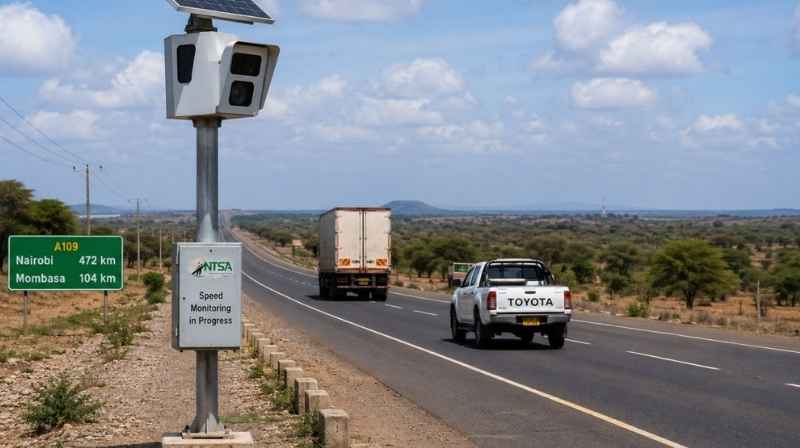

NAIROBI, Kenya — Motorists driving across Nairobi are increasingly encountering fixed and mobile speed-enforcement operations as authorities enforce speed limits on major highways and urban roads.
Some of the corridors where motorists have reported speed-camera or police speed-enforcement activity include Thika Road, Mombasa Road, Waiyaki Way, Southern Bypass, Nairobi Expressway, Ngong Road and roads within and around the Nairobi CBD.
However, motorists should not treat reported camera locations as a definitive map of enforcement points. Mobile equipment can be moved, while the applicable speed limit can change between different sections of the same road.
The safest approach is therefore to follow the posted speed-limit signs throughout the journey rather than slowing down only at known or reported camera locations.
Thika Road speed cameras and enforcement
Thika Road is among the Nairobi corridors where motorists frequently report encountering speed-enforcement operations.
For eligible motor cars and motorcycles, Kenyan regulations provide for a maximum of 110km/h on dual-carriageway highways, but that does not mean motorists can legally drive at 110km/h throughout Thika Road. Lower limits can apply to particular sections, vehicle classes and areas where traffic signs prescribe them.
Motorists have reported speed enforcement around:
Muthaiga Primary School → Safari Park → Kasarani Stadium → TRM → Kahawa Sukari area → Kenyatta University → Ruiru Sports Club → Thika Town → past Del Monte → Makenzie area
Drivers should pay particular attention when approaching built-up areas, junctions and sections where a lower speed limit is posted.
Thika Road is also one of Nairobi’s most important public transport corridors, connecting the CBD with Kasarani, Githurai, Kahawa, Ruiru, Juja and Thika.
ALSO READ: Route 44 Nairobi to Githurai and Kahawa West
ALSO READ: Route 49 Nairobi to Kasarani
ALSO READ: Route 145 Nairobi to Ruiru
ALSO READ: Route 237 Nairobi to Thika Town
Mombasa Road speed cameras and enforcement
Mombasa Road is another major corridor where speed-enforcement operations have been reported.
Motorists have reported enforcement around:
Capital Centre → Panari Hotel → General Motors area → Lukenya area
The road carries a complex mixture of private vehicles, PSVs, trucks, long-distance traffic and vehicles travelling towards JKIA and towns southeast of Nairobi.
This makes it particularly important to distinguish between the speed permitted for a particular class of vehicle and any lower limit prescribed for a particular road section.
Drivers should follow the posted signs rather than assuming that one speed limit applies from Nairobi all the way along Mombasa Road.
The corridor is also an important commuter route serving South B, South C, Industrial Area, Embakasi, JKIA, Mlolongo and Athi River.
ALSO READ: Nairobi Matatu Routes and Numbers
Nairobi CBD speed cameras and enforcement
Speed enforcement is also carried out within Nairobi’s central urban road network.
Reported enforcement locations include areas around:
Parliament Buildings → Ring Road Ngara → City Centre → Globe Roundabout/Flyover → Quarry Road → Lusaka Road
These roads differ significantly from Nairobi’s major highways.
Under Kenya’s Traffic Act, a 50km/h limit applies within the boundaries of a trading centre, township, municipality or city, unless another limit is prescribed for a particular road or area.
Drivers entering the CBD from faster arterial roads should therefore watch carefully for signs indicating changes in the applicable limit.
Southern Bypass speed enforcement
The Southern Bypass is another major Nairobi road where motorists have reported speed enforcement.
Reported locations include areas around:
Uhuru Gardens → interchange sections → Nairobi River crossing → swamp area → Kikuyu railway crossing
The bypass connects several major Nairobi corridors, including Mombasa Road, Lang’ata Road, Ngong Road and the western approaches towards Kikuyu.
Drivers approaching interchanges, bridges, junctions and other transitions should pay particular attention to posted limits rather than assuming that the same speed applies throughout the bypass.
ALSO READ: Nairobi Bypass Network Guide
Waiyaki Way speed cameras and enforcement
Motorists have also reported speed-enforcement activity along Waiyaki Way, particularly on the approach towards central Nairobi.
Reported locations include areas around:
ABC Place → opposite Consolata Shrine → Villa Rosa Kempinski area → University of Nairobi/University Way approach
Road and traffic conditions change considerably between the western sections of the corridor and the approaches to Westlands and Nairobi CBD.
Motorists should consequently rely on the speed-limit signs applying to the section they are driving.
Waiyaki Way is also an important public transport corridor connecting Nairobi CBD with Westlands, Kangemi, Uthiru, Kikuyu and destinations farther northwest.
ALSO READ: Westlands Transport: Matatu Routes, Stages & Connections
Nairobi Expressway speed cameras
The Nairobi Expressway operates with posted speed limits that motorists must observe throughout the corridor.
Drivers should not assume that the same speed applies to every section of the Expressway.
Speed enforcement can take place at different points, making it important to follow the displayed limits rather than relying on the location of a previously reported camera.
Motorists should also distinguish between the Nairobi Expressway and the adjoining Mombasa Road and Waiyaki Way corridors. Moving from one road environment to another can mean entering a section governed by a different posted limit.
ALSO READ: Nairobi Expressway Guide
Ngong Road speed enforcement
Ngong Road is another Nairobi corridor where motorists have reported speed-enforcement operations.
Reported locations include areas around Prestige Plaza and sections approaching Adams Arcade and Kilimani.
Because Ngong Road passes through densely developed commercial and residential areas, motorists should watch carefully for the speed limits applying to each section.
The road is also a major public transport corridor towards Kawangware, Dagoretti, Karen and Ngong.
ALSO READ: Ngong Road & Karen Matatu Connections
ALSO READ: Route 111 Nairobi to Ngong Town
Other Nairobi roads with reported speed enforcement
Motorists have reported speed-enforcement operations on several other Nairobi roads, including sections around Haile Selassie Avenue and adjoining roads, as well as approaches along Jogoo Road.
These reported locations should not be interpreted as permanent camera positions.
Enforcement can change according to police operations, road-safety campaigns and traffic conditions.
Mobile speed cameras can change location
Knowing where a speed camera was positioned previously does not mean motorists can assume that enforcement will occur at the same location the next day.
Kenyan traffic regulations expressly provide for the use of speed cameras by uniformed police officers to determine and record the speed of motor vehicles.
Speed-camera records can also be produced as evidence in court for traffic offences.
Mobile enforcement therefore makes attempting to memorise camera locations an unreliable strategy.
The correct approach remains:
Check the road sign → observe the applicable limit → maintain that speed until the limit changes.
One Nairobi road can have several speed limits
One of the most important points for motorists is that a single road does not necessarily have one speed limit from beginning to end.
A journey can move through:
Highway → interchange → built-up area → junction → urban road → another restricted section
and the applicable limit may change accordingly.
Vehicle class also matters. Kenya’s Traffic (Speed Limits) Rules prescribe different maximum speeds for different classes of vehicles.
For example, the regulations provide a maximum of 110km/h for qualifying motorcycles and motor cars travelling on dual-carriageway highways. That maximum does not override a lower speed limit imposed by law or displayed on a particular road section.
Motorists should therefore treat the posted traffic sign as the critical instruction for the section they are driving.
What are the penalties for speeding in Kenya?
Kenya’s Traffic (Minor Offences) Rules provide the following penalties for exceeding a prescribed speed limit:
| Amount above the prescribed limit | Penalty |
|---|---|
| 1–5km/h | Warning |
| 6–10km/h | KSh500 |
| 11–15km/h | KSh3,000 |
| 16–20km/h | KSh10,000 |
These amounts are supported by the Traffic (Minor Offences) Rules for exceeding either the speed prescribed for the vehicle class or a 50km/h/traffic-sign-prescribed limit.
The broader Traffic Act also provides for speeding offences and sets out additional legal consequences, meaning motorists should not interpret the minor-offence schedule as permission to exceed a limit beyond the ranges shown.
Speed cameras are not the speed limit
The most important lesson for Nairobi motorists is that speed-camera locations and speed limits are two different things.
A driver remains required to observe the applicable speed limit whether a camera is present or not.
Reported enforcement points can change, mobile cameras can be deployed elsewhere, and different sections of the same Nairobi road can have different restrictions.
Motorists should therefore avoid treating lists of camera locations as places where they simply need to slow down temporarily.
Instead:
Follow the posted speed limit throughout the road, reduce speed when entering lower-limit sections and pay particular attention around built-up areas, junctions, interchanges and Nairobi’s urban roads.
For commuters looking for alternatives to driving, Metros maintains the Nairobi Matatu Routes and Numbers database covering routes, destinations and public transport connections across the city.