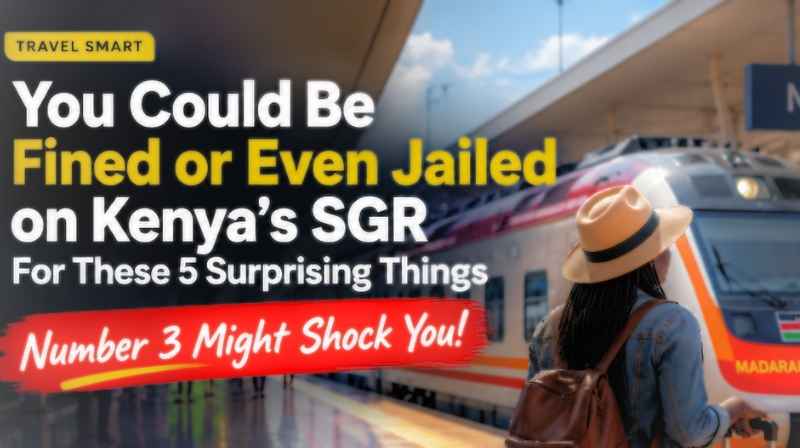

A comfortable seat, beautiful views of the Kenyan countryside and a smooth ride towards Mombasa. What could possibly go wrong aboard the Madaraka Express?
Quite a lot, apparently, if you happen to misunderstand some of the rules governing Kenya’s Standard Gauge Railway (SGR).
From giving away your ticket to wandering into the wrong carriage, certain seemingly innocent actions can attract legal consequences. Others could leave you explaining yourself to railway security before your holiday has even begun.
The surprising part? Some are actual offences under the Kenya Railways Corporation Act, while others are restrictions imposed through Kenya Railways’ passenger conditions.
ALSO READ: Airport Rules in Kenya: Passenger Laws, Security Rules and Traveller Guide
Here are five surprising SGR rules every passenger should know before boarding the Madaraka Express.
1. Giving Your SGR Ticket to a Friend Could Land You in Trouble
Imagine booking a ticket to Mombasa, only for your plans to change at the last minute.
Your friend wants to travel, so you decide to give them your ticket. After all, the seat has already been paid for. What is the problem?
Well, Kenya’s railway law has other ideas.
Under Section 70 of the Kenya Railways Corporation Act, unauthorised selling or transferring of railway tickets to enable another person to travel is an offence. Buying or obtaining a ticket from someone other than an authorised railway employee or agent is also prohibited.
The punishment can include a fine of up to KSh 3,000, imprisonment for up to three months, or both.
In other words, your generosity could become a rather expensive favour.
Passengers whose travel plans change should instead use Kenya Railways’ official ticket cancellation or rescheduling procedures.
2. That Empty First-Class Seat Is Not an Invitation
You have been travelling in Economy Class for several hours when you notice an empty First Class seat.
It looks comfortable. Nobody is sitting there. Surely moving over for a few minutes cannot hurt?
Not so fast.
Section 68 of the Kenya Railways Corporation Act makes it an offence to travel in a higher class than your ticket permits with the intention of avoiding payment of the additional fare.
A passenger convicted under the provision may face a fine of up to KSh 3,000, imprisonment for up to three months, or both, alongside applicable fare-related penalties.
The law is concerned with deliberate fare avoidance, not merely the innocent act of looking at an empty seat.
Nevertheless, passengers should obtain permission and pay any applicable upgrade charges before changing classes.
That luxurious empty seat may look welcoming, but your Economy ticket has not magically promoted itself.
ALSO READ: Can Airport Security Search Your Luggage in Kenya? What Passengers Should Know
3. Your Favourite Perfume or Body Spray Could Be a Security Problem
This is perhaps one of the most unexpected restrictions.
You pack your clothes, toiletries and favourite body spray for a weekend in Mombasa.
Everything seems perfectly normal until your luggage reaches the security checkpoint.
Kenya Railways’ revised 2025 prohibited-items list includes aerosol sprays, naming products such as hair sprays, body sprays, shaving cream and certain sunscreens.
The restriction relates to railway safety and security, including the potential hazards associated with pressurised containers.
However, it is important to distinguish between aerosol products and ordinary non-aerosol toiletries. Not every perfume bottle or deodorant is necessarily prohibited simply because it smells nice.
Passengers should check the product packaging and confirm the latest restrictions before travelling.
And yes, the irony is difficult to ignore. You may be preparing for a relaxing coastal holiday, but your aerosol body spray could face more scrutiny than your entire wardrobe.
4. Bringing Your Own Alcohol Is Prohibited
Planning to enjoy a drink while watching the countryside roll past?
If your plan involves packing your own alcoholic beverages, Kenya Railways has a restriction you should know about.
According to the operator’s published conditions, passengers are not permitted to bring alcoholic beverages into Madaraka Express stations or aboard the trains.
This applies to alcohol carried in personal luggage as well.
The restriction is an operator rule and should not be confused with a separate criminal offence simply for possessing an otherwise lawful alcoholic beverage.
Passengers should also remember that smoking aboard the Madaraka Express is prohibited.
The lesson? Your holiday may begin at the station, but the celebrations involving your own bottle will have to wait until you reach your destination.
ALSO READ: Smoking and Alcohol Rules at Kenyan Airports: What Passengers Need to Know
5. Misusing the Train’s Emergency Communication Equipment Could Be a Criminal Offence
Imagine noticing a communication device inside the train and deciding to test it out of curiosity.
Perhaps you want to see whether it works, or you think pressing a button might summon someone to answer a question.
That curiosity could have consequences.
Section 69 of the Kenya Railways Corporation Act makes it an offence for a passenger, without reasonable cause, to use or interfere with communication facilities provided for contacting railway employees.
A conviction can attract a fine of up to KSh 3,000, imprisonment for up to three months, or both.
The provision is intended to protect essential communication systems from unnecessary interference.
Importantly, passengers should not be discouraged from using designated emergency communication equipment when there is a genuine emergency or another reasonable cause.
If someone collapses, a fire breaks out or a serious safety threat develops, seeking assistance is entirely different from treating emergency equipment like an entertainment button.
ALSO READ: Airport Security Checks in Kenya: Can You Refuse a Search?
What Happens If You Break an SGR Rule?
The consequences depend on the nature of the violation.
Some actions, including deliberate fare evasion, certain unauthorised ticket transfers and interference with passenger communication facilities, are specifically addressed by the Kenya Railways Corporation Act.
Other restrictions, such as bringing prohibited aerosols or alcoholic beverages, are governed by the operator’s conditions of carriage.
Kenya Railways also provides procedures for handling items surrendered during security screening. Its published conditions specify that passengers should receive an item surrender form and that eligible confiscated property may be retained for collection for 14 days before disposal under the applicable procedure.
Passengers should therefore understand what rule has allegedly been breached rather than assume that every security restriction automatically carries a criminal penalty.
Know the Rules Before You Board
The Madaraka Express has transformed long-distance passenger travel between Nairobi and Mombasa, offering an alternative to hours spent navigating highway traffic.
But modern trains also come with operating rules, safety procedures and legal responsibilities.
For passengers, understanding these requirements is about more than avoiding fines or embarrassing encounters with security officers.
It is also about knowing the difference between a lawful instruction, a company policy and a criminal offence.
So, the next time you board the SGR, check your ticket, pack carefully and resist the temptation to upgrade yourself to First Class.
That empty seat might be tempting, but it is certainly not worth an unnecessary legal headache.
Reporting references: Kenya Railways Corporation Act, Sections 68–70; Kenya Railways Madaraka Express Passenger Service Conditions of Carriage and revised prohibited-items list.