

By Metros Kenya | Weather | 14 October 2026
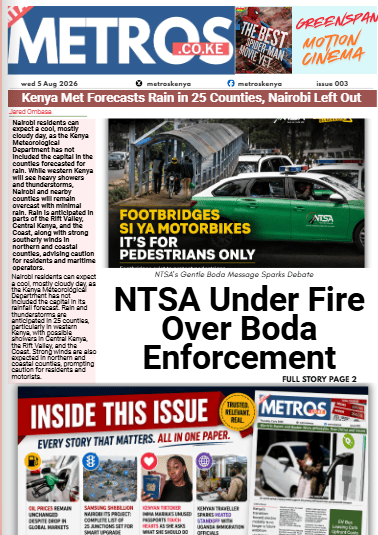
Nairobi residents have spent weeks hearing warnings about El Niño, above-normal rainfall and the possibility of serious flooding. Government agencies have been mobilised, drainage systems cleared and emergency plans announced in anticipation of the rains. Yet, as of Wednesday, October 14, much of Nairobi was enjoying sunshine, leaving commuters wondering when the much-publicised heavy rains would arrive.
ALSO READ: Nairobi Matatu Routes: Complete Guide to Routes and Destinations
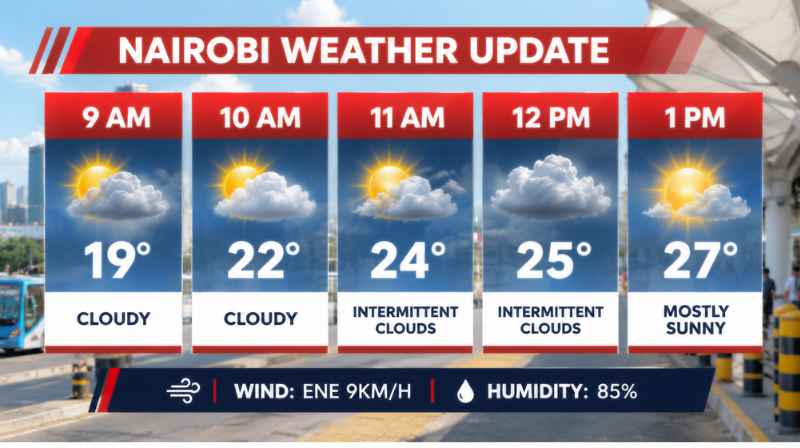
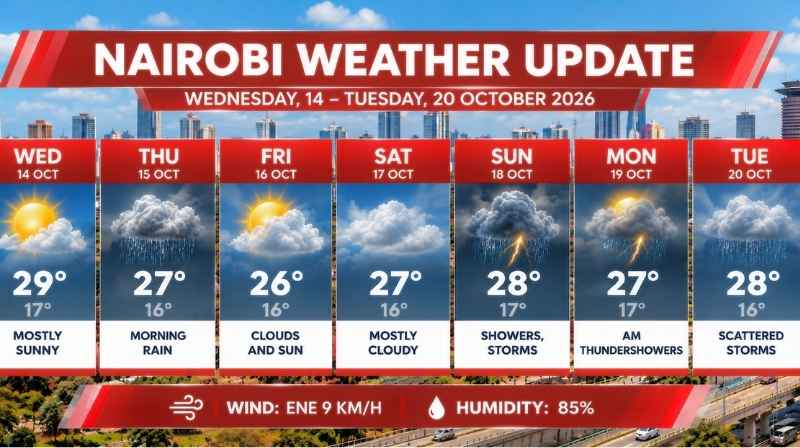
With temperatures forecast to reach 29°C and only a small chance of daytime rainfall, the contrast between the warnings and the weather outside has become difficult to ignore.
Perhaps Nairobi commuters should now consider checking Google Weather before leaving home rather than relying exclusively on announcements from the tax-funded Kenya Meteorological Department.
After all, an umbrella is useful when it rains. Carrying one for weeks because of alarming headlines is another matter entirely.
But behind the sarcasm lies a serious question about weather communication, government accountability and the value taxpayers receive from public institutions.
Tax-Funded Kenya Met Warned of Enhanced Rainfall
Ahead of the October–December 2026 short-rains season, the tax-funded Kenya Meteorological Department warned of increased rainfall associated with developing El Niño conditions.
According to The Star’s October 5 report, the department expected light to moderate rainfall across parts of Kenya’s 47 counties as the short-rains season began.
The warnings prompted heightened attention to flooding risks, particularly in urban areas such as Nairobi, where drainage problems and settlements along waterways have repeatedly exposed residents to danger.
However, on October 9, the tax-funded department issued an important clarification.
According to K24 Digital, the department explained that El Niño does not automatically translate into heavy rainfall in Kenya.
It said the amount of rain received depends on several interacting weather systems, including Indian Ocean conditions, prevailing winds and other atmospheric factors.
Scientifically, that explanation makes sense.
But ordinary commuters may reasonably ask why this distinction has not been more prominent in public discussions about the expected rains.
When people hear repeated warnings about El Niño, they often associate the phenomenon with the destructive flooding Kenya experienced in previous years.
The responsibility of a publicly funded forecasting institution should therefore extend beyond issuing technical predictions. It should ensure the public understands the uncertainty surrounding those predictions.
A forecast should inform the public, not leave commuters wondering whether to carry an umbrella, sunglasses or both.
Nairobi County Was Already Preparing for the Worst
While residents waited for the anticipated heavy rains, Nairobi Governor Johnson Sakaja’s administration was implementing flood-prevention measures.
According to The Star’s October 8 report, Sakaja announced a six-point preparedness plan involving drainage clearance, river restoration, relocation of residents from vulnerable areas, community awareness and emergency response coordination.
The county reported desilting and dredging activities along the Nairobi, Mathare and Ngong rivers to improve water flow and reduce flooding risks.
The administration also reported deploying approximately 4,500 Green Army workers to assist with waste collection and clearing blocked drainage channels.
According to Citizen Digital, Sakaja said the county had collected more than 100,000 tonnes of garbage within a month as part of preparations for the anticipated rains.
The governor argued that coordinated drainage clearance, river restoration and waste management operations had reduced flooding risks in several parts of the capital.
These activities are important, regardless of when the rains arrive.
Nairobi’s drainage problems did not begin with the latest El Niño warnings, and they will not disappear simply because the skies remain clear for several days.
However, announcements about government activity should not automatically be treated as evidence that the city is adequately prepared.
Sh5.17 Billion Sought for Flood Response — But Is Nairobi Ready?
The financial implications of Nairobi’s flood preparations are substantial.
According to YNews Digital’s October 12 report, Nairobi County was seeking approximately KSh 5.17 billion to support flood prevention and emergency response measures.
The report indicated that the county had identified 227 flood-prone hotspots across its 17 sub-counties.
Governor Sakaja reportedly acknowledged that work had been completed at only 26 of the 61 critical drainage sites requiring intervention.
That means 35 of the identified sites still required work at the time of the report.
The county also warned that approximately 100,000 people could be affected in a worst-case flooding scenario, particularly residents living near vulnerable waterways and informal settlements.
These figures deserve serious public scrutiny.
If heavy rainfall arrived tomorrow, how many of Nairobi’s flood-prone neighbourhoods would actually be protected?
How many drainage systems have been permanently restored rather than temporarily cleared?
And how much of the proposed funding would go towards lasting infrastructure improvements?
The KSh 5.17 billion figure represents funding being sought for preparedness and response. It should not be confused with money already approved or spent.
Nevertheless, taxpayers deserve clear explanations about the proposed expenditure, the projects it would finance and how success would be measured.
Was Nairobi County’s Preparation Sufficient?
Based on the information publicly available by October 14, it would be premature to declare Nairobi fully prepared for serious flooding.
According to the same YNews report, the county had cleared approximately 80% of identified riparian areas along the Nairobi, Mathare and Ngong rivers.
However, Sakaja also acknowledged equipment shortages, funding constraints and delays affecting some infrastructure projects.
The report indicated that only about 20% of the critical equipment required for flood-prevention operations was available, forcing the county to hire additional machinery.
These are not minor operational challenges.
They raise questions about whether Nairobi has sufficient resources to respond effectively if several flood-prone areas experience heavy rainfall simultaneously.
The county’s preparedness will ultimately be judged by whether roads remain passable, residents receive timely warnings and emergency teams can respond when needed.
For public transport users, the consequences of inadequate preparation can be immediate.
A flooded road can disrupt matatu operations, strand passengers, delay buses and expose pedestrians to dangerous conditions.
A city that knows its flood hotspots should not wait for a disaster before addressing them.
Equally, an approaching rainy season should not become an excuse for poorly documented spending.
Perhaps Google Weather Deserves a Place in the Commuter’s Routine
For Nairobi commuters, the difference between a seasonal weather outlook and an hourly forecast is significant.
A seasonal forecast may indicate that October, November and December are likely to experience increased rainfall.
But it cannot reliably tell someone leaving Rongai at 7 AM whether rain will begin before they reach Nairobi CBD.
It cannot tell a commuter in Westlands precisely whether to expect showers during lunch or whether the evening journey along Mombasa Road will be affected.
That is where services such as Google Weather become useful.
Through hourly forecasts, temperature updates and rainfall probabilities, commuters can make more immediate travel decisions.
Google Weather is not perfect, and its predictions can change. It should also not replace official severe-weather warnings.
But there is no reason commuters should depend on a single forecasting source when other accessible services can provide additional information.
The tax-funded Kenya Meteorological Department should be judged not simply by the scientific sophistication of its forecasts, but by how useful and understandable those forecasts are to the people financing its operations.
After all, taxpayers are not funding weather forecasting merely to be told that rain is possible during a three-month season.
They also need timely information that helps them organise their daily lives.
Commuters Need Forecasts, Not Just Headlines
For matatu passengers, bus operators, boda boda riders and pedestrians, weather information has practical consequences.
Heavy rainfall can cause traffic delays, poor visibility, slippery roads and flooding at pedestrian crossings.
Passengers travelling between residential estates and the city centre need information that helps them decide when to leave home and which precautions to take.
A commuter should be able to distinguish between a long-term seasonal outlook, a seven-day forecast and an immediate warning about potentially dangerous rainfall.
This is where public weather communication needs to improve.
According to The Star’s October 1 report, meteorologists had not yet formally declared the onset of the El Niño rains and were advising Kenyans to follow regional forecasts.
That distinction matters.
If the onset of seasonal rainfall has not been formally established, public communication should make that clear instead of allowing broad warnings to be interpreted as promises of immediate heavy rain.
A forecast can be scientifically valid while still being poorly understood by the public.
The tax-funded department should therefore communicate rainfall probabilities, expected onset periods and forecast uncertainty in language ordinary Kenyans can easily understand.
The Rainy Season Is Not Over — Neither Is the Accountability Question
It is important to acknowledge that the October–December rainy season has only just begun.
The absence of widespread heavy rainfall in parts of Nairobi by October 14 does not prove that the seasonal forecast has failed.
Indeed, the latest seven-day outlook indicates an increased possibility of showers and thunderstorms later in the week.
Nor should anyone wish for destructive flooding merely to prove that a forecast was correct.
The central issue is whether public institutions are communicating uncertainty responsibly and whether money allocated to preparedness is delivering measurable improvements.
The tax-funded Kenya Meteorological Department must provide clear, accessible and frequently updated forecasts.
Nairobi County must demonstrate that its flood-prevention activities are effective and that any public expenditure is properly accounted for.
And commuters should be encouraged to consult multiple reliable weather sources rather than depend entirely on dramatic seasonal headlines.
Until then, Nairobi residents may find themselves checking Google Weather, looking out of the window and comparing both with the latest government announcement.
Because while forecasts can change, taxpayers should never have to guess what their money is achieving.
Make the criticism more balancedShorten the article for stronger impact