

By Metros Kenya | Metros Exchange
For many Nairobi residents, getting to work means waking up early, joining long matatu queues, spending time in traffic and repeating the same routine in the evening.
But imagine a different morning. Instead of waiting at a bus stop, you unplug your electric scooter, leave home at your preferred time and travel directly to your destination.
It is a vision that Leah Onduso, popularly known as ‘Nduthi Girl‘, believes could become increasingly familiar on Kenyan roads.
Leah, a sales executive and manager at Kenwing Electric Scooters, has become an enthusiastic advocate for electric mobility, using social media to demonstrate how electric scooters can serve ordinary commuters, delivery riders, traders and households.
Speaking during an interview on Metros Exchange, the interview programme by Metros Kenya, she explained why she believes electric scooters are no longer simply recreational machines but an emerging alternative for everyday transport.
From charging at home to navigating Nairobi traffic, Leah is working to change perceptions about a technology many Kenyans are still discovering.
And she is doing it in a particularly unconventional way: by turning her daily journeys into a moving showroom.
ALSO READ: Nairobi Matatu Routes: Complete Guide to Routes and Corridors
Who Is Nduthi Girl?
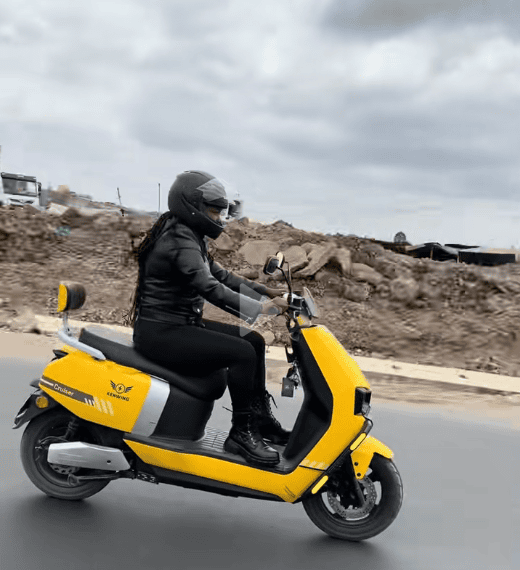
Before becoming known as Nduthi Girl, Leah Onduso was an ordinary salesperson employed to market electric scooters.
Her responsibility at Kenwing was to explain the machines to potential buyers and encourage them to visit the company’s warehouse.
But she soon encountered a problem.
Many Kenyans did not understand what an electric scooter could do. Some considered the machines toys, while others doubted their power, range and suitability for Kenyan roads.
“Nduthi girl” realised that explaining specifications was not enough.
She needed people to see the scooters working.
“Why don’t I take this scooter? I use it on my own. I understand the specs of this bike. I see how it functions,” she recalled.
She began riding scooters herself and recording videos showing how they perform in everyday situations.
Instead of presenting the machines inside a showroom, she demonstrated them on Nairobi roads, in traffic, at car washes and during routine errands.
The approach gradually transformed how customers responded.
“Now it’s different. I’m not talking, but you can see what I do,” she told Metros Exchange.
According to Leah, people who once dismissed electric scooters as toys began enquiring about prices, visiting the showroom and requesting deliveries.
Meet Kenwing Electric Scooters: A Company Bringing Electric Mobility to Kenyan Roads
Behind Nduthi Girl’s demonstrations is Kenwing, an electric mobility business marketing scooters for urban commuting, deliveries and personal transportation.
On its official website, Kenwing positions itself as a premium electric vehicle brand focused on practical mobility for Kenyan conditions.
The company highlights Nairobi’s traffic congestion, potholes, demanding delivery routes and the rising importance of affordable daily transport.
Its approach is to offer different scooters for different needs rather than promote one model for every customer.
Kenwing’s website presents three principal models: Cruiser, Runner and CityLite.
The company also advertises local spare-parts availability, technical support and opportunities for prospective customers to experience the scooters through test rides.
For Kenyans considering switching from petrol-powered motorcycles or relying less on public transport, the company offers a starting point for exploring electric two-wheelers.
Prospective buyers can browse the models, enquire about specifications and contact the company through its official website:
Visit Kenwing Electric Scooters — www.kenwing.co.ke
Kenwing Cruiser: The Electric Scooter Turning Heads in Nairobi Traffic
Among Kenwing’s models, the Cruiser holds a special place in Leah’s story.
It is the scooter she frequently uses in her videos, including when travelling through Nairobi traffic.
According to Kenwing’s website, the Cruiser is designed for longer-distance commuting, with an emphasis on performance, battery capacity and rider comfort.
During the interview, Leah identified it as one of the company’s most sought-after models.
“The Cruiser model is honestly on demand,” she said.
She explained that the company had sold out of its available Cruiser stock at the time of the interview and was awaiting another shipment.
According to Leah, approximately 120 Cruiser units had previously been available, with additional customers placing advance orders for the next consignment.
She attributed part of that demand to her social media demonstrations.
How much does the Kenwing Cruiser cost?
Nduthi girl indicated that the Cruiser starts at approximately KSh 150,000.
That price was provided during the interview and should be confirmed directly with Kenwing, since prices, configurations and availability may change.
For someone who regularly pays matatu fares, boda boda charges or petrol expenses, the Cruiser represents a different financial decision.
The buyer must consider the upfront purchase price against future electricity, maintenance, insurance and other ownership costs.
Kenwing markets the Cruiser as a personal mobility option for people seeking greater flexibility in their daily travel.
Explore the Kenwing Cruiser and enquire about availability
Kenwing Runner: An Electric Scooter for Rural Roads and Everyday Work
Electric scooters are often associated with smooth urban roads.
However, Leah believes their potential extends beyond Nairobi.
During the interview, she identified the Kenwing Runner as a model attracting interest from customers outside major cities.
According to Kenwing’s website, the Runner is positioned as a heavy-duty delivery scooter with a reinforced chassis, all-terrain suspension and cargo rack options.
Leah particularly highlighted its ground clearance, which she believes makes it more suitable for some rural road conditions.
She said the Runner is a model she sometimes recommends to people considering buying scooters for parents or relatives living upcountry.
Imagine a small-scale trader travelling to a nearby market, a resident making trips to a shopping centre or someone transporting light goods between local businesses.
For such journeys, a suitably configured electric scooter could provide an alternative to walking long distances or relying on occasional motorcycle transport.
However, buyers should confirm the Runner’s load capacity, suspension specifications, battery range and suitability for their particular roads.
A scooter marketed for rougher terrain is not necessarily suitable for every unpaved road or heavy load.
Learn more about the Kenwing Runner
Kenwing CityLite: A Smaller Scooter for Urban Movement
Kenwing also markets a model called CityLite.
According to the company’s website, CityLite is a lightweight, efficient scooter aimed at beginners and people making shorter urban journeys.
It is presented as an option for quick trips around town rather than the heavier delivery work associated with the Runner or the longer-distance commuting focus of the Cruiser.
For example, someone who needs transport between home, nearby shops and other local destinations may have different requirements from a delivery rider travelling throughout Nairobi.
That is why Leah emphasises understanding a customer’s intended use before recommending a machine.
A buyer should consider daily travel distance, terrain, carrying requirements, budget and whether the scooter is legally suitable for the intended roads.
View Kenwing’s electric scooter range
Can Electric Scooters Replace Your Daily Matatu Commute?
One of the most interesting questions raised during the Metros Exchange interview was whether electric scooters could become a practical alternative to matatus for some Nairobi commuters.
Leah believes they can.
She gave examples of people travelling between Nairobi and surrounding residential areas, including Kitengela and neighbourhoods along Thika Road.
However, she stressed that buyers must first calculate the distance they intend to travel.
A person commuting to work should consider not only the morning journey but also the return trip and any errands completed during the day.
For someone travelling 20 kilometres to work, a round trip would already require approximately 40 kilometres of range before accounting for detours or additional journeys.
Leah warned against purchasing a scooter whose advertised range only just matches the intended distance.
“To be honest with you, me as a salesperson, I cannot sell you that scooter. I’ll have to advise you for another, higher, maybe like 50 kilometers,” she said while discussing a hypothetical shorter-range scooter.
The advice reflects an important principle: electric scooters should be selected according to actual transport needs.
Leah mentioned scooters with advertised ranges of approximately 60, 80, 100, 120 and 200 kilometres, as well as longer-range options.
These figures were discussed generally during the interview and should not be assumed to apply to every Kenwing model.
Actual range depends on battery capacity, speed, rider weight, terrain, riding habits and other conditions.
For Nairobi residents considering a switch, Metros Kenya’s Nairobi Matatu Routes Guide provides information on existing public transport routes that can help commuters understand and compare their travel options.
Charging an Electric Scooter at Home: How Does It Work?
A major concern among potential electric scooter buyers is charging.
Do electric scooters require special charging stations? Must they be charged every day? Will they significantly increase electricity bills?
Leah explained that compatible electric scooters can be charged using a normal household electricity connection and appropriate charging equipment.
She also challenged the assumption that owners must recharge after every journey.
“Most people think that charging is done every day. It’s not every day,” she said.
For example, if a scooter has a sufficiently large battery and its owner travels only a short distance, there may be enough remaining charge for further journeys.
Leah estimated that charging a heavily depleted scooter could take approximately three to six hours, depending on the model and battery condition.
She cautioned owners against allowing their scooters to run completely out of charge during a journey.
Instead, riders should monitor their battery levels and understand how much distance they can reasonably cover.
How much electricity does a scooter consume?
Kenwing’s website promotes electric scooters as a way of reducing daily operating expenses.
The company advertises potential running-cost savings of up to 80% compared with petrol-based alternatives.
However, this is a company marketing claim. Actual savings will depend on the scooter, the comparable petrol vehicle, travel distance, electricity tariffs and maintenance costs.
The interview did not establish a specific electricity cost per full charge.
To calculate that figure accurately, buyers should request the scooter’s usable battery capacity in kilowatt-hours and estimate electricity consumption using their applicable tariff.
Prospective customers can contact Kenwing to request charging specifications and operating-cost estimates for individual models.
Electric Scooters for Delivery Businesses in Kenya
Beyond personal commuting, Leah believes electric scooters could become increasingly attractive to delivery businesses.
Kenya’s delivery sector depends heavily on motorcycles transporting food, parcels and other goods.
Leah argued that electric scooters designed for commercial use could perform some of these duties.
She described delivery riders as an important customer group for Kenwing.
For someone planning to undertake local deliveries, an electric scooter could offer an alternative to a petrol motorcycle, depending on the delivery radius, cargo requirements and charging arrangements.
Kenwing markets its Runner model specifically toward delivery work, highlighting its chassis design and cargo-carrying options.
The company also promotes lower running costs as a selling point for commercial riders.
Nevertheless, prospective operators should evaluate the full business case, including purchase price, daily mileage, battery performance, charging downtime, servicing, financing and legal compliance.
For a delivery business, reliability and vehicle availability can be just as important as energy savings.
Can Electric Scooters Help Rural Families?
Leah’s vision for electric scooters extends to rural households.
During the interview, she discussed how older residents and people making short local journeys might benefit from scooters with accessible seating and simple controls.
She described some scooters as easier to operate than conventional petrol motorcycles because many controls are positioned conveniently for the rider.
For example, a family might consider a scooter for an older relative who regularly travels to a nearby shopping centre.
A trader might also use a suitable model to transport light goods to a local market.
Leah sees these applications as part of the future of electric mobility in Kenya.
However, comfort and ease of operation should not be confused with a lack of training requirements.
Riders must still be capable of controlling the vehicle safely, and its use must comply with applicable traffic regulations.
Can You Charge an Electric Scooter Using Solar Power?
The interview also explored the possibility of charging electric scooters in rural areas with limited access to electricity.
Leah suggested that solar energy could offer an option where suitable charging systems are available.
However, the feasibility depends on the scooter’s battery, charger and the electrical capacity of the solar installation.
A household with solar panels would need a compatible charging arrangement capable of supplying the required energy safely.
For buyers considering off-grid charging, Kenwing should be asked to provide the electrical specifications needed to assess compatibility.
Solar charging could become a useful option in some locations, but it requires proper system sizing rather than simply connecting a scooter to any solar installation.
Maintenance and Spare Parts: What Does Kenwing Offer?
One reason people hesitate to purchase electric vehicles is uncertainty about repairs.
What happens when the scooter needs new tyres, brake components, electrical repairs or a replacement battery?
Leah acknowledged that some customers worry about whether Kenyan mechanics can maintain electric scooters.
She believes local technicians are increasingly capable of working with electric two-wheelers.
Kenwing’s website reinforces the importance of after-sales support.
The company advertises locally available replacement parts and technical support from local technicians, describing its Nairobi warehouse as a source of genuine spare parts.
This is a potentially important selling point for buyers who want reassurance that they will not be left without support after purchasing a scooter.
However, customers should confirm the warranty terms, spare-parts pricing, battery replacement arrangements and availability of qualified technicians for their particular model.
Electric scooter batteries, controllers and charging systems should be handled by appropriately trained personnel.
Contact Kenwing about servicing and spare parts
What Security Features Do Kenwing Electric Scooters Have?
Theft prevention is another important consideration for scooter buyers.
Leah explained that certain electric scooters are equipped with anti-theft features such as alarms and electronic locking systems.
She described how an alarm can sound when someone attempts to interfere with a parked scooter.
She also mentioned that some scooters can support phone-based monitoring.
Such features could provide additional reassurance to people parking scooters at work, shopping centres or residential premises.
However, security equipment varies by model.
Buyers should confirm whether alarms, electronic immobilisers and tracking capabilities are included in the purchase price or require additional equipment.
No security system can guarantee that a vehicle will not be stolen.
Do Electric Scooters Need Registration, Insurance and a Driving Licence?
During the interview, Leah discussed differences between lower-speed scooters and larger electric two-wheelers.
She explained that Kenwing assists customers purchasing certain models with registration documentation, number plates and logbook transfers.
However, the legal requirements for operating an electric scooter in Kenya depend on its classification and intended use.
Buyers should not assume that a vehicle is exempt from registration, licensing or insurance merely because it is electric, is used within an estate or has a particular speed limit.
Anyone planning to ride on public roads should confirm the applicable requirements with the National Transport and Safety Authority and an appropriate insurer.
This is particularly important for commuters intending to use major Nairobi roads.
How Nduthi Girl Is Using TikTok to Market Kenwing
For Leah, social media is not simply about gaining followers.
It has become a way of demonstrating the practical value of electric scooters.
Her videos show her riding through Nairobi, visiting car washes, checking tyre pressure, parking and carrying out everyday activities.
She also demonstrates convenience features available on certain models, including mobile-phone charging and entertainment functions.
According to Leah, this approach has made the sales process easier.
Instead of explaining every feature to customers individually, she can direct them to videos showing the scooters in actual use.
“This is where now I show them the reality on TikTok,” she said.
She explained that some customers contact her directly to request deliveries after watching the demonstrations.
Her experience suggests that practical, real-world demonstrations can help people gain confidence in unfamiliar technology.
For Kenwing, Nduthi Girl has become a visible connection between the company’s products and the people who might use them.
Why Nairobi Traffic Has Become Nduthi Girl’s Biggest Showroom
One of Leah’s favourite places to demonstrate the Cruiser is Nairobi’s traffic.
She described riding along Mombasa Road, where motorists notice her moving through congested sections.
Some of those encounters, she said, have turned into sales enquiries.
Leah believes traffic congestion makes people more receptive to alternative transport options.
She even claimed to have encountered customers considering switching from cars to electric scooters.
“I’ve seen a situation where someone abandons a car and comes for the scooter,” she said.
However, the convenience of a scooter does not remove the need for safe riding.
Riders must comply with applicable road rules, and manoeuvring through congested traffic can expose them to significant risks.
Still, Leah’s broader argument is that personal electric mobility could provide greater flexibility for some commuters.
Kenwing Offers Test Rides for Interested Customers
For people who remain unsure whether an electric scooter would suit their needs, Kenwing advertises opportunities to experience the machines before making a purchase.
According to its website, the company offers free test rides at its Nairobi showroom on Saturdays.
This gives prospective customers an opportunity to ask questions about the available models, understand their features and assess basic riding comfort.
Anyone interested should confirm the showroom location, test-ride availability and applicable safety requirements before visiting.
How to contact Kenwing Electric Scooters
- Official website: www.kenwing.co.ke
- Phone/WhatsApp: 0702 595 600
- Email: info@kenwing.co.ke
- Showroom: Nairobi; contact the company for directions
- Test rides: Advertised for Saturdays, subject to confirmation
Will Electric Scooters Become Common in Kenyan Households?
Leah believes Kenya is only beginning to discover the possibilities of electric scooters.
Having worked in the industry for approximately a year and a half to two years, she says customer interest has grown as more people see the machines being used.
She points to enquiries from across the country and demand for models such as the Cruiser and Runner as reasons for optimism.
When asked whether scooters could become mainstream transport over the next decade, she replied:
“I think that’s where we are heading.”
For her, the future is not necessarily about replacing buses and matatus.
It is about giving Kenyans more choices.
A commuter who works late could travel home without waiting for a matatu. A delivery rider could explore electric transport as a business option. A trader could use a suitable scooter for short local journeys.
But widespread adoption will depend on several factors: affordability, road safety, regulation, product quality, battery durability, reliable charging and after-sales support.
Electric scooters will not be appropriate for every household or journey.
Yet for some commuters and small businesses, they could become an increasingly practical addition to Kenya’s transport options.
The Bigger Picture: Kenya’s Changing Transport Choices
The story of Nduthi Girl reflects a broader shift in how Kenyans are beginning to think about mobility.
For decades, transport decisions have largely revolved around matatus, buses, conventional motorcycles and private cars.
Electric two-wheelers introduce another possibility.
Companies such as Kenwing are seeking to make these alternatives more accessible by offering different models for different customers.
Meanwhile, Leah is helping people understand the technology through everyday demonstrations rather than sales brochures alone.
Whether electric scooters become common across Kenya remains to be seen.
But one thing is clear from the Metros Exchange conversation: public curiosity is growing, and the question is shifting from whether electric scooters can work to where, how and for whom they make sense.
For Leah Onduso, that is already progress.
She is not simply selling electric scooters. She is helping Kenyans imagine a different way of moving.
And for anyone curious about the machines she rides, the models she recommends or the company behind them, Kenwing Electric Scooters provides a place to begin exploring the options.
ALSO READ
This Metros Kenya feature is based on an interview with Leah Onduso, popularly known as Nduthi Girl, on Metros Exchange, supplemented with product and service information published on Kenwing’s official website. Prices, sales volumes, operating-cost savings and advertised performance figures are company or interviewee claims and have not been independently tested by Metros Kenya.