

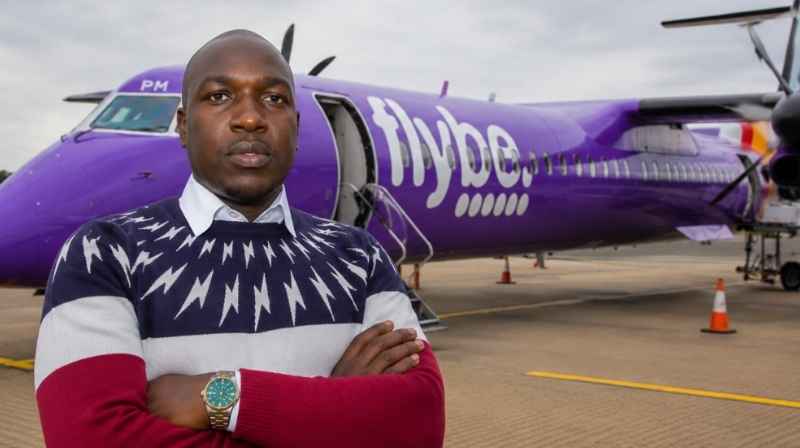

NAIROBI, Kenya — A serious investor looking for an opportunity in Kenya’s domestic aviation market could potentially generate attractive returns by deploying a Dash 8 Q400 on the Nairobi–Mombasa route, according to operating estimates shared by pilot and aviation influencer Barrack Siglain.
Readers looking at the wider market can explore Metros Kenya’s Kenya Domestic Flights guide for the growing network of passenger routes connecting Nairobi, Mombasa and other major destinations around the country.
The numbers point to an interesting business case on one of Kenya’s most important domestic travel corridors, particularly for an operator capable of maintaining strong passenger loads, controlling costs and keeping the aircraft flying several sectors each day.
The De Havilland Canada Dash 8 Q400 is a twin-engine turboprop widely used for short and medium regional services. Depending on configuration, it can accommodate approximately 70 to 80 passengers, giving an operator substantial capacity without necessarily moving to a larger jet aircraft.
According to Siglain, a one-way flight between Nairobi and Mombasa could consume approximately 1,200 litres of fuel.
“The fuel alone is about 1,200 litres, which would cost approximately $1,800 at $1.50 per litre,” Siglain said in a Facebook post.
He estimated ground-handling expenses at about $700, while crew, maintenance and insurance could cost between $750 and $1,000. Navigational and landing charges were estimated at approximately $120 each, with passenger-related taxes placed at about $328.
“Cumulatively, your operational cost will be around $3,800,” Siglain said.
At an illustrative exchange rate of Sh129 to the dollar, the direct operating cost would be approximately Sh490,000 for the one-way flight.
One flight could generate more than Sh700,000
The attraction for an investor becomes clearer when potential passenger revenue is considered.
At an illustrative fare of Sh9,800 per passenger, carrying 70 paying passengers would produce approximately Sh686,000 in ticket sales. Excess-baggage charges could add another Sh30,000, taking total revenue from the flight to approximately Sh716,000.
“If you carry 70 passengers, the total ticket revenue comes to about Sh686,000,” Siglain said.
After deducting estimated direct operating costs of Sh490,000, approximately Sh226,000 would remain from the one-way sector before fixed business expenses, financing costs and taxes.
If the return flight achieved a similar passenger load and cost structure, the theoretical operating margin for a complete Nairobi–Mombasa–Nairobi rotation could approach Sh452,000.
Two successful return rotations in a day could therefore potentially produce an operating margin exceeding Sh900,000 before fixed expenses, based strictly on Siglain’s assumptions.
The figure, however, should not be confused with net profit.
Nairobi–Mombasa could be the anchor route
The bigger investment opportunity may not lie in the earnings from a single flight but in how intensively the aircraft can be used.
“Aircraft are expensive assets, and their economics improve when they spend more time carrying paying passengers rather than sitting on the ground” he says.
A professionally planned schedule could see the Q400 complete several sectors during the day, with early-morning and evening services targeting business travellers and other departures catering to tourists, families and connecting passengers.
The Nairobi–Mombasa corridor provides an attractive starting point because it connects Kenya’s capital with its leading coastal commercial and tourism centre.
For operators considering Wilson Airport as part of their Nairobi strategy, Metros Kenya’s Wilson ↔ Mombasa Flights guide provides a closer look at passenger travel on the route.
But the investment case becomes more interesting when the aircraft is considered as part of a network rather than as an aircraft dedicated permanently to one city pair.
Mombasa could support a wider domestic network
A serious investor would eventually have to ask what the Q400 does after the Nairobi–Mombasa business has been established.
Mombasa could potentially become a secondary network point, allowing an operator to examine passenger flows between the Coast and other major parts of Kenya.
One of the more relevant markets would be western Kenya.
The Mombasa ↔ Kisumu Flights corridor links two of Kenya’s largest regional economic centres and offers a fundamentally different proposition from shorter coastal routes.
Such diversification could reduce an airline’s dependence on Nairobi–Mombasa alone while allowing the aircraft to be deployed according to demand.
The commercial principle is straightforward: the more hours an aircraft can operate profitably each day, the more effectively its fixed ownership or leasing costs can be spread across revenue-generating flights.
That does not mean every domestic route would suit a Q400. Passenger demand, runway capability, airport infrastructure, competition and operating costs would have to be assessed individually before opening another destination.
Strong passenger loads would determine profitability
The investment case depends heavily on how many seats the airline can consistently sell.
A Q400 carrying 70 paying passengers presents a very different financial picture from the same aircraft departing with only 40 or 45.
“Using Siglain’s assumptions, 70 passengers paying Sh9,800 each generate Sh686,000 in gross ticket revenue.At 45 passengers, however, the same fare would generate only Sh441,000 — already below the estimated Sh490,000 direct operating cost before taking other revenue into account” he adds
That illustrates one of the central risks in commercial aviation.
The aircraft can take off whether it has 40 passengers or 70, but many of the costs associated with operating the flight remain.
An investor would therefore need detailed passenger-demand data rather than relying solely on the overall popularity of the Nairobi–Mombasa corridor.
The critical questions would include how many passengers travel at different times of the day, how much they are prepared to pay and how much capacity competing airlines already provide.
Frequency could become a competitive advantage
Schedule design would be equally important.
Business travellers may value an early-morning departure from Nairobi that allows them to complete their work in Mombasa and return in the evening. Leisure travellers may be more price-sensitive and willing to fly at different times.
An airline capable of designing its schedule around those different passenger segments could improve both load factors and aircraft utilisation.
Reliability would also be critical.
A new operator entering Nairobi–Mombasa would be competing against established airlines as well as other forms of transport, including long-distance buses, private vehicles and the Madaraka Express SGR.
The airline would therefore have to sell more than a seat.
It would be selling time, convenience, reliability and frequency.
Coast connectivity could create additional opportunities
Mombasa also sits at the centre of a much wider coastal travel economy.
Passenger movement extends beyond Mombasa itself to destinations such as Diani, Malindi and Lamu.
Metros Kenya’s Mombasa ↔ Lamu Flights guide, for example, covers one of the Coast’s longer aviation connections and the link between Moi International Airport and Manda Airport.
There are also passenger markets between Mombasa and Diani/Ukunda and between Mombasa and Malindi, although these require a different commercial analysis because road transport competes strongly over shorter distances.
For a Q400 investor, the important lesson is not that the aircraft should necessarily operate every coastal route. Rather, Mombasa provides access to a substantial tourism and business market that could feed passengers into a wider airline network.
Revenue could extend beyond passenger tickets
Passenger fares would form the foundation of the business, but they would not necessarily be the only source of revenue.
Excess baggage, cargo, corporate travel agreements, charter operations and partnerships with hotels and tour operators could all contribute additional income.
Corporate contracts could be particularly valuable because they may provide more predictable passenger volumes than relying entirely on individual bookings.
Cargo could also contribute to flight economics, subject to aircraft configuration, passenger baggage, payload limitations and regulatory requirements.
For an investor, the objective would be to maximise the revenue generated by each flight without compromising operational safety or reliability.
The Sh226,000 margin is not net profit
The most important qualification in Siglain’s calculation is that the approximately Sh226,000 remaining after estimated direct operating costs should be regarded as an illustrative operating margin rather than guaranteed profit.
An airline still has substantial expenses beyond the immediate cost of operating an individual sector.
Aircraft leasing or financing, staff salaries, regulatory compliance, crew training, reservations systems, marketing, administration, parking and other overheads would still have to be paid.
Maintenance presents another significant consideration.
An unscheduled maintenance event can simultaneously generate a large expense and remove an aircraft from revenue service.
The treatment of passenger taxes and charges would also have to be examined carefully. If some of these are already included within the Sh9,800 advertised fare, the entire ticket price cannot necessarily be counted as airline revenue.
A professional feasibility study would therefore need to calculate actual net passenger revenue and verify each operating cost before an investment decision is made.
Buying the Q400 is only the beginning
Aircraft acquisition would itself represent one of the largest financial decisions facing an investor.
A Q400 could be purchased outright, financed or leased.
Buying requires substantial upfront capital but gives the company an aircraft asset. Financing reduces the immediate cash requirement but introduces debt repayments, while leasing can lower the initial acquisition burden but creates recurring lease obligations.
Whatever model is selected, substantial working capital would still be required.
Having enough money to acquire an aircraft is not the same as having enough money to operate an airline.
Fuel has to be purchased, employees paid, maintenance completed and airport charges settled even when passenger numbers temporarily fall below expectations.
A serious investor would therefore need sufficient financial reserves to withstand fluctuations in demand and unexpected operational costs.
The real upside is scale
Despite those qualifications, Siglain’s figures illustrate why domestic aviation can be attractive to investors prepared to take a long-term approach.
The real opportunity is not necessarily the theoretical Sh226,000 remaining from one Nairobi–Mombasa sector.
It is what happens if an airline can repeat commercially successful flights hundreds or thousands of times.
One profitable rotation can become several daily rotations. One aircraft can eventually become two. Nairobi–Mombasa can be complemented by other high-demand domestic routes where the economics justify expansion.
The airline can then build corporate accounts, cargo contracts, connecting traffic and brand recognition while spreading its central operating costs across a larger network.
That is the difference between investing in an aircraft and building an airline.
Nairobi–Mombasa could provide the foundation
Siglain’s estimates ultimately provide an interesting starting point rather than a complete investment case.
A Q400 carrying around 70 paying passengers at commercially viable fares could potentially produce a healthy contribution above its direct sector costs under the assumptions presented.
Turning that theoretical margin into sustainable profit would depend on passenger loads, fares, aircraft utilisation, financing costs, maintenance, airport charges, competition and disciplined professional management.
But for a well-capitalised investor prepared to approach aviation as a long-term enterprise, Nairobi–Mombasa could provide something more valuable than the earnings from a single route.
It could provide the foundation from which a broader Kenyan domestic airline is built.
For an investor, the larger op