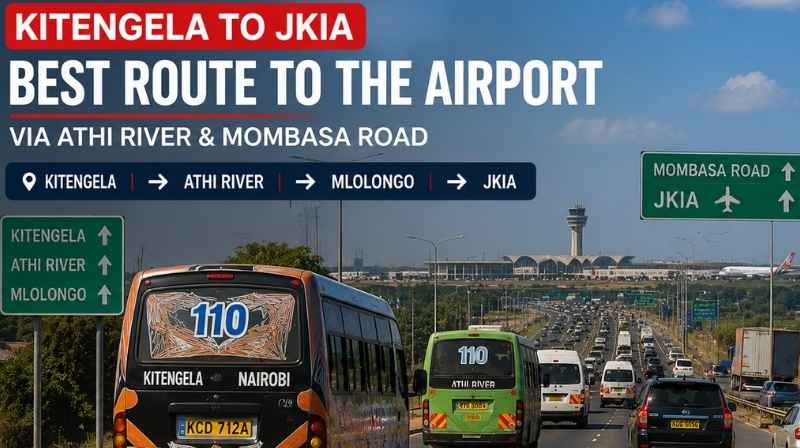

Travelling from Kitengela to Jomo Kenyatta International Airport (JKIA) is different from many other airport journeys around Nairobi because Kitengela already lies on the southeastern side of the metropolitan area. Instead of crossing Nairobi CBD, the main task is to connect from Kitengela towards Athi River and the Mombasa Road airport corridor, then travel back towards JKIA.
Kitengela, Athi River and Mlolongo form part of the wider Mombasa Road commuter network. Metros documents this corridor through Route 110, which connects Nairobi with Mlolongo, Athi River and Kitengela, although individual services can have different termini. (Metros Kenya)
← View all Nairobi Matatu Routes and Numbers
For an airport passenger, the important point is that travelling all the way into Nairobi CBD is unnecessary. Once you connect from Kitengela towards Athi River and Mombasa Road, you are already on the main corridor serving the JKIA side of Nairobi.
Understanding the Kitengela to JKIA Journey
The basic road journey can be understood as:
Kitengela → Athi River → Mombasa Road → Mlolongo/Syokimau side → JKIA airport connection → terminal
Unlike the Ruiru or Rongai airport journeys, there is no major need to choose between completely different sides of Nairobi.
Mombasa Road is the defining corridor.
The bigger decisions concern where you join Mombasa Road, how you approach the airport from the highway, and whether you travel entirely by private vehicle or combine a matatu with a taxi or ride-hailing vehicle.
Kitengela Town to JKIA
For somebody starting in Kitengela Town, the first objective is to connect towards the Athi River/Mombasa Road side.
Metros’ Athi River–Kitengela Road Matatu Routes and Transport Guide documents the local connection between the two towns. It also notes that passengers should confirm whether a vehicle goes directly to Athi River because Nairobi-bound and other services do not necessarily follow identical operating patterns. (Metros Kenya)
Once the traveller reaches the Mombasa Road corridor, the airport journey becomes considerably easier to understand.
Broadly:
Kitengela → Athi River → Mombasa Road → JKIA direction
The traveller is essentially moving towards Nairobi along Mombasa Road before leaving the main corridor for the airport.
Why Athi River Matters
Athi River is the key transport junction in the Kitengela–JKIA journey.
It connects Kitengela with Mombasa Road and provides onward movement towards Mlolongo, Syokimau and Nairobi.
Metros documents this corridor through both Route 110 and Route 110A Nairobi to Athi River. Route 110A is primarily associated with Athi River, while Route 110 is more broadly associated with Mlolongo, Athi River and Kitengela services. (Metros Kenya)
For airport passengers, this means Athi River should be viewed as the point where the Kitengela journey joins the wider Mombasa Road transport system.
Athi River to JKIA
From Athi River, the journey heads towards Nairobi along Mombasa Road.
The broad direction becomes:
Athi River → Mlolongo → Mombasa Road airport corridor → JKIA
This is effectively the reverse direction of the normal Nairobi-to-Athi River commuter journey.
Metros’ Route 110A guide documents the city-bound sequence as:
Athi River → Mlolongo → Mombasa Road → Nairobi CBD. (Metros Kenya)
An airport passenger does not need to complete that journey to the CBD.
Instead, the traveller leaves the Mombasa Road corridor at the appropriate airport connection and proceeds towards JKIA.
Mlolongo to JKIA
Mlolongo is another important landmark because it sits directly along the Mombasa Road corridor between Athi River and Nairobi.
Route 110 services connect Mlolongo with Athi River, Kitengela and Nairobi, making the town an important public transport interchange. (Metros Kenya)
For somebody travelling from Kitengela, reaching Mlolongo means they are already approaching the wider airport side of the metropolitan area.
The journey can broadly continue:
Mlolongo → Mombasa Road → airport connection → JKIA
There is no reason for an airport passenger to remain on a Nairobi-bound matatu all the way to the CBD simply because that is the vehicle’s final destination.
Instead, the important question is where to transfer safely and conveniently for the final airport section.
What About Syokimau?
Syokimau sits within the same wider transport corridor and is important because of its proximity to both Mombasa Road and Nairobi Terminus.
Metros’ Nairobi Central to Syokimau Commuter Train Guide identifies Route 110 as one of the Mombasa Road public transport connections serving Mlolongo, Athi River and Kitengela from the Syokimau side. (Metros Kenya)
This reinforces the basic geography:
Kitengela → Athi River → Mlolongo → Syokimau/Mombasa Road side → JKIA
However, passengers should not assume that reaching Syokimau or Nairobi Terminus means they have reached the airport.
JKIA is a separate destination requiring an onward road connection.
Nairobi Terminus Is Not JKIA
This distinction is particularly important for visitors unfamiliar with Nairobi.
Nairobi Terminus, where Madaraka Express SGR trains arrive and depart, is located in Syokimau.
JKIA is a separate airport complex.
Metros’ Nairobi Central Railway Station to Nairobi SGR Terminus Link Train Guide notes that passengers around Nairobi Terminus can connect with Route 110 and 110A services along the Mombasa Road corridor, but local road transport may still be needed between the highway and the terminus itself. (Metros Kenya)
Airport passengers therefore need to make sure their vehicle is taking them to JKIA, not simply to Syokimau or Nairobi Terminus.
Can You Use Nairobi Expressway From Kitengela?
The Nairobi Expressway is much less central to the Kitengela–JKIA journey than it is for somebody travelling from Westlands or Nairobi CBD.
Metros’ Nairobi Expressway JKIA Airport Access Guide explains that the Expressway is particularly useful for journeys between JKIA and Nairobi CBD or Westlands. It does not run directly to the airport terminal doors. (Metros Kenya)
A Kitengela traveller is already approaching JKIA from the Athi River/Mlolongo side of Mombasa Road.
Travelling farther towards Nairobi simply to use the Expressway would therefore not normally be the defining strategy.
The important route is Mombasa Road itself and the appropriate airport connection.
Can You Travel From Kitengela to JKIA by Matatu?
You can use matatus for a substantial part of the journey, but passengers should not assume there is one standard Kitengela-to-JKIA matatu operating directly to the passenger terminals.
Metros’ Route 110 Nairobi–Mlolongo–Athi River–Kitengela Guide identifies Route 110 with the wider corridor. (Metros Kenya)
When travelling from Kitengela towards the airport, passengers should look for an appropriate service towards:
Athi River
Mlolongo
or Nairobi via Mombasa Road
depending on where they intend to transfer.
The destination displayed on the vehicle is more important than simply seeing the number 110.
Route 110 From Kitengela
Route 110 is one of the most useful services to understand for this journey.
Metros identifies the route broadly as:
Nairobi CBD ↔ Mlolongo / Athi River / Kitengela
using Mombasa Road. (Metros Kenya)
However, not every Route 110 vehicle necessarily travels the entire corridor.
Some services may terminate at Mlolongo.
Others serve Athi River.
Others are associated with Kitengela.
For this reason, a passenger leaving Kitengela should ask the conductor:
Does this vehicle pass Athi River?
Does it continue through Mlolongo?
Where should I alight for the easiest JKIA connection?
That conversation is more useful than relying on the route number alone.
Route 110A and the Airport Journey
Route 110A is different.
Metros identifies Route 110A primarily with the Nairobi–Athi River corridor via Mombasa Road and Mlolongo. (Metros Kenya)
Passengers starting in Kitengela may therefore first need a local connection to Athi River before using an appropriate Mombasa Road service.
This creates another possible public transport sequence:
Kitengela → Athi River → Route 110/110A or another Mombasa Road service → airport-side interchange → JKIA
Again, this is a connecting journey rather than a guaranteed one-vehicle airport trip.
Where Should a Matatu Passenger Transfer?
For an airport passenger, the best transfer point is not necessarily the place where the matatu terminates.
The objective is to get close enough to the airport corridor that the final taxi or ride-hailing journey becomes manageable without creating unnecessary transfers.
Metros’ Route 110A material identifies Cabanas as an important connection for Embakasi, Airport North Road and JKIA-area services. (Metros Kenya)
This means passengers travelling farther towards Nairobi along Mombasa Road have airport-side connection possibilities before reaching the CBD.
However, the most convenient transfer point can change according to traffic, luggage and the specific service being used.
Confirm with the conductor before travelling.
Matatu Plus Taxi May Be the Practical Option
For many passengers, the most practical compromise is:
Kitengela → matatu towards Athi River/Mombasa Road → suitable airport-side interchange → taxi or ride-hailing → JKIA terminal
This avoids paying for a private vehicle for the entire Kitengela–JKIA journey while simplifying the final airport section.
It also reduces the risk of ending up at an airport-area road or stage that is still some distance from the correct terminal.
For passengers with luggage, that can be particularly valuable.
Why Not Take the Matatu All the Way Towards Nairobi?
A Nairobi-bound Route 110 service may ultimately continue towards the CBD, but an airport passenger does not need to.
JKIA lies off the Mombasa Road corridor before central Nairobi when approaching from Kitengela.
Continuing all the way into Nairobi would mean passing the relevant airport side of the journey and travelling unnecessarily farther into the city.
The basic principle is therefore:
Kitengela → towards Nairobi on Mombasa Road → leave the Nairobi-bound journey at the appropriate airport connection → JKIA
rather than:
Kitengela → Nairobi CBD → travel back to JKIA.
What About Route 34A?
Once a passenger reaches the airport-side Nairobi transport network, other routes become relevant.
The Metros master Nairobi Matatu Routes and Numbers database identifies Route 34A with the Pipeline, Embakasi and JKIA corridor. (Metros Kenya)
That does not mean Route 34A should automatically be recommended as the simplest connection from Kitengela.
It demonstrates that JKIA-area public transport exists once the passenger reaches the relevant Nairobi-side network.
For a flight passenger carrying luggage, however, another matatu transfer may be less convenient than completing the final section by taxi or ride-hailing vehicle.
Airport Area vs Airport Terminal
Always distinguish between JKIA-area transport and transport that actually reaches your passenger terminal.
A vehicle may serve:
Mombasa Road
Cabanas
Embakasi
Airport North Road
or another airport-related corridor without delivering passengers directly to their terminal.
Before boarding the final public transport connection, ask where the vehicle actually stops.
For an airport passenger, “near JKIA” may not be good enough.
Travelling From Kitengela With Heavy Luggage
Luggage changes the practical value of public transport.
A passenger with a backpack may comfortably travel:
Kitengela → Athi River/Mombasa Road matatu → airport connection → JKIA
A family carrying several suitcases faces a different calculation.
Every transfer means unloading luggage, finding another vehicle and potentially walking between stages.
For groups, a direct taxi or ride-hailing vehicle can therefore become more attractive because the total fare is shared among several passengers.
Kitengela to JKIA by Taxi or Ride-Hailing
A direct taxi or ride-hailing vehicle provides the simplest journey:
Kitengela → Athi River/Mombasa Road connection → Mombasa Road → JKIA
The major advantage is that the passenger remains in one vehicle from the starting point to the airport terminal.
It also removes uncertainty about where to transfer from a matatu.
For early-morning or late-night flights, when normal commuter transport may be less convenient, this can become particularly useful.
Could Rail Be Used From the Athi River Side?
There is a commuter rail corridor serving Athi River and Lukenya towards Nairobi.
Metros’ Nairobi Central to Lukenya Commuter Train Route Guide documents the general corridor through Nairobi, Mlolongo and Athi River. (Metros Kenya)
However, this should not be confused with a direct operational rail service from Kitengela to JKIA.
A passenger would still need road connections between Kitengela, the railway corridor and the airport.
For most flight passengers, the additional transfers mean road transport remains easier to understand.
What About the Proposed Syokimau–JKIA Railway?
Metros also tracks the proposed Syokimau–JKIA Airport Railway Link.
That project is intended to connect the Syokimau/Nairobi Terminus side with JKIA, but Metros’ current project guide explicitly notes that the service is not yet operational and that passengers must continue using road transport for the airport connection. (Metros Kenya)
Passengers travelling from Kitengela should therefore not plan their current airport journey around a direct Syokimau–JKIA train.
Check Traffic Along Mombasa Road
Although the Kitengela–JKIA journey does not require crossing central Nairobi, it is still vulnerable to traffic.
Potential congestion points include:
Kitengela
Athi River
Mlolongo
Mombasa Road
Syokimau
airport junctions and JKIA approaches
Mombasa Road carries commuter vehicles, freight trucks, long-distance buses, airport traffic and private vehicles.
Allow additional time during peak periods or when incidents are affecting the highway.
Know Your Terminal Before Leaving Kitengela
Before beginning the journey, confirm your:
Airline
Flight number
Departure time
JKIA terminal
This is especially important when arranging the final connection from Mombasa Road.
A taxi or ride-hailing driver can then take you directly to the correct terminal instead of simply dropping you somewhere within the airport complex.
How Early Should You Leave Kitengela?
Do not calculate departure time using only the estimated driving time between Kitengela and JKIA.
The complete airport journey includes:
Kitengela → Athi River/Mombasa Road → airport approach → JKIA entry → terminal → check-in/baggage → security → boarding gate
Traffic can affect the first three stages.
Give yourself an appropriate buffer, especially during weekday rush hours.
Kitengela to JKIA at a Glance
Starting point: Kitengela
Destination: Jomo Kenyatta International Airport (JKIA)
Main connection: Kitengela → Athi River → Mombasa Road
Main airport direction: Mombasa Road → JKIA connection → airport terminal
Important intermediate areas: Athi River, Mlolongo and Syokimau
Main public transport corridor: Route 110 (Metros Kenya)
Related Athi River route: Route 110A (Metros Kenya)
Direct matatu to JKIA terminal: Do not assume Route 110/110A enters JKIA
With luggage: Matatu + taxi or a direct taxi/ride-hailing vehicle may be more practical
Before travelling: Check Mombasa Road traffic, flight departure time and your JKIA terminal
For other Nairobi matatu routes, numbers, stages and destinations, use the Metros master commuter database: