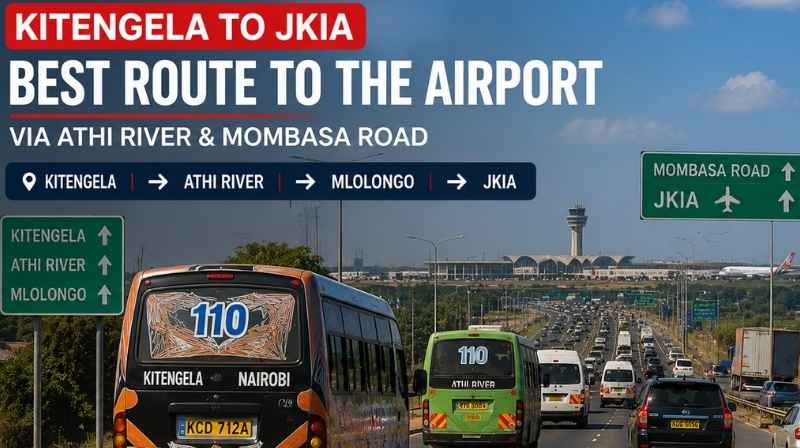

Travelling from Ongata Rongai to Jomo Kenyatta International Airport (JKIA) requires crossing from the southern side of the Nairobi metropolitan area towards the Mombasa Road airport corridor. For many travellers, the key decision is whether to connect towards the Southern Bypass around Bomas or continue through Lang’ata Road and inner Nairobi before turning towards JKIA.
Ongata Rongai’s normal public transport corridor runs through Magadi Road, Multimedia University, Galleria, Bomas and Lang’ata Road towards Nairobi. Metros’ Route 125 guide confirms this as one of the principal commuter connections between Rongai and Nairobi. (Metros Kenya)
← View all Nairobi Matatu Routes and Numbers
For an airport passenger, however, travelling all the way to Nairobi CBD is not necessarily required. The Southern Bypass creates another way of crossing towards Mombasa Road and the JKIA side of the city.
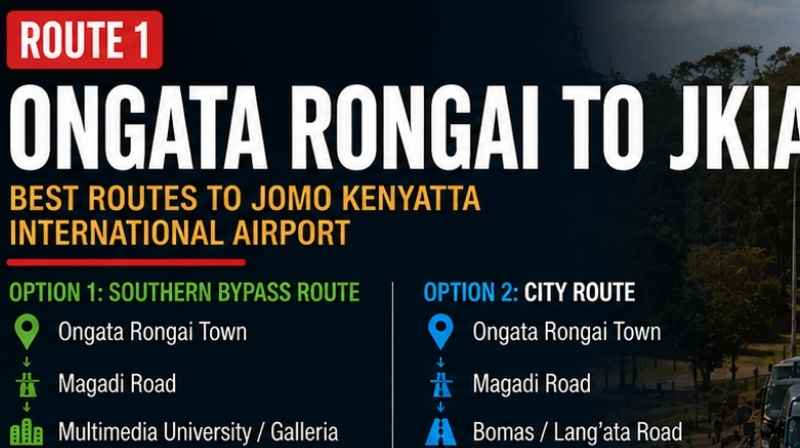
Ongata Rongai to JKIA: The Two Main Routes
There are two main ways to think about the journey.
Option 1: Southern Bypass
Ongata Rongai → Magadi Road → Multimedia University/Galleria → Bomas → Southern Bypass → Mombasa Road → JKIA
This route allows the traveller to cross towards Mombasa Road without first travelling into central Nairobi.
Option 2: Lang’ata Road and Inner Nairobi
Ongata Rongai → Magadi Road → Bomas → Lang’ata Road → Nairobi West/Nyayo Stadium area → Mombasa Road or Expressway connection → JKIA
This follows the traditional Rongai–Nairobi commuter corridor farther into the city before turning towards the airport.
The better route depends on traffic and the traveller’s exact starting point.
Why Southern Bypass Matters From Rongai
The Southern Bypass is the main reason airport passengers from Rongai should not automatically think of Nairobi CBD as their interchange.
Metros’ route database identifies Lang’ata Road/Bomas as a Southern Bypass connection, while the eastern side of the bypass meets the Mombasa Road/Ole Sereni area and the wider JKIA corridor. (Metros Kenya)
This creates a useful cross-city route:
Rongai → Bomas → Southern Bypass → Mombasa Road → JKIA
Instead of travelling north into central Nairobi and then southeast towards the airport, the traveller can cross southern Nairobi.
That is geographically attractive, although it should not automatically be assumed to be faster under every traffic condition.
Ongata Rongai Town to JKIA
For someone beginning in Rongai Town, the first part of the journey generally follows the familiar Nairobi-bound corridor.
The sequence is:
Ongata Rongai → Magadi Road → Multimedia University → Galleria → Bomas
Metros documents this corridor through Route 125 Nairobi to Ongata Rongai, which operates between Nairobi and Rongai through Lang’ata Road, Bomas, Galleria and Magadi Road. (Metros Kenya)
For an airport-bound motorist, however, Bomas becomes the decision point.
Instead of continuing towards Nairobi CBD, the traveller can consider connecting towards the Southern Bypass and crossing towards Mombasa Road.
Multimedia University to JKIA
Multimedia University is an important landmark between Rongai and Galleria.
Metros’ more detailed Route 125 guide via Multimedia University places the university directly on the Nairobi–Rongai public transport corridor between Galleria and Ongata Rongai. (Metros Kenya)
For airport passengers starting around Multimedia University, the broad strategy is similar:
Multimedia University → Galleria/Bomas → Southern Bypass → Mombasa Road → JKIA
or:
Multimedia University → Bomas → Lang’ata Road → inner Nairobi → Mombasa Road → JKIA
Because the starting point is already closer to Bomas than Rongai Town, the first section of the airport journey is shorter.
Galleria to JKIA
Galleria is one of the clearest landmarks along the Rongai–Nairobi corridor.
Route 125 passes Galleria immediately before the Bomas/Lang’ata Road section when travelling towards Nairobi. (Metros Kenya)
From the Galleria side, the Southern Bypass becomes particularly relevant because the traveller is approaching the Bomas connection.
The broad journey can therefore be understood as:
Galleria → Bomas/Southern Bypass connection → Southern Bypass → Mombasa Road → JKIA
Travellers should still compare live journey times before committing to this option.
Bomas Is the Critical Junction
For a Rongai–JKIA journey, Bomas of Kenya is more than an intermediate landmark.
It is where the airport journey can diverge from the normal Rongai-to-Nairobi commuter pattern.
A Route 125 passenger heading towards Nairobi would normally continue along Lang’ata Road. (Metros Kenya)
An airport-bound motorist can instead consider the Southern Bypass.
This creates the choice:
Towards Nairobi:
Bomas → Lang’ata Road → Nairobi
Towards JKIA without going through CBD:
Bomas → Southern Bypass → Mombasa Road → airport corridor
That distinction is central to understanding the Rongai–JKIA journey.
Southern Bypass to Mombasa Road
The Southern Bypass crosses the southern side of Nairobi and connects with Mombasa Road around the wider Ole Sereni area.
Metros has a dedicated Mombasa Road/Ole Sereni Southern Bypass Connection Guide explaining why this junction matters for passengers travelling towards South B, South C and the JKIA corridor. (Metros Kenya)
For Rongai airport travellers, this means the route can broadly continue:
Southern Bypass → Mombasa Road/Ole Sereni connection → JKIA direction
Once Mombasa Road is reached, the traveller has completed the main cross-city section of the journey.
The remaining task is reaching the airport itself.
Reaching JKIA From Mombasa Road
Mombasa Road is one of Nairobi’s principal approaches towards JKIA.
However, there is an important distinction between reaching the JKIA corridor and arriving at a passenger terminal.
A traveller coming from Southern Bypass still needs to follow the appropriate airport access roads from Mombasa Road towards JKIA.
This is particularly important when estimating journey time.
Do not treat reaching the Mombasa Road airport area as the end of the trip.
What About the Lang’ata Road Route?
Southern Bypass is not the only choice.
A traveller can continue from Bomas along Lang’ata Road towards inner Nairobi.
The route broadly becomes:
Ongata Rongai → Magadi Road → Galleria → Bomas → Lang’ata Road → Nairobi West/Nyayo Stadium → Mombasa Road connection → JKIA
This closely follows the normal Rongai–Nairobi commuter corridor for much of the journey.
Metros’ Route 125 guide identifies Lang’ata Road, Nyayo Stadium and Uhuru Highway as part of the connection between Rongai and Nairobi CBD. (Metros Kenya)
The difference is that an airport-bound motorist turns towards the Mombasa Road side instead of simply completing a CBD journey.
Southern Bypass vs City Route: Which Is Better?
The answer depends on current conditions.
Southern Bypass may make more sense when:
You are starting in Rongai, Multimedia University, Galleria or Bomas.
The bypass is moving reasonably well.
You want to avoid travelling through central Nairobi.
Your priority is reaching Mombasa Road without entering the CBD.
The Lang’ata Road/inner Nairobi option may make sense when:
Traffic on Southern Bypass is heavily disrupted.
Your starting point or other journey requirements naturally take you towards Lang’ata Road.
Traffic towards Nairobi West and Mombasa Road is flowing better.
You need to make another stop within Nairobi before going to the airport.
For an airport journey, compare current travel times rather than relying entirely on the route you normally use.
Where Nairobi Expressway Fits In
Nairobi Expressway can potentially form part of the inner Nairobi alternative.
A traveller coming from Rongai through Lang’ata Road may reach an appropriate connection towards the Mombasa Road/Expressway corridor and continue towards the airport side.
However, the Expressway should not be treated as the default Rongai–JKIA route.
If you are already conveniently positioned to use Southern Bypass, travelling farther into Nairobi simply to use the Expressway may add unnecessary distance.
The Expressway is therefore best considered an alternative depending on traffic and the route already being used.
Can You Travel From Rongai to JKIA by Matatu?
Yes, but passengers should expect an interchange.
The main numbered Rongai service is Route 125.
Route 125 Nairobi to Ongata Rongai operates broadly:
Ongata Rongai → Magadi Road → Galleria → Bomas → Lang’ata Road → Nyayo Stadium → Nairobi CBD
when travelling towards Nairobi. (Metros Kenya)
Route 125 is therefore useful for the first part of an airport journey, but it should not be treated as a direct JKIA service.
Passengers need to plan where they will transfer.
Route 125 vs Route 126
Passengers in Rongai will also encounter Route 126.
The distinction matters.
Route 125 is primarily associated with Nairobi ↔ Ongata Rongai, while Route 126 continues beyond Rongai towards Nkoroi, Matasia and Kiserian. (Metros Kenya)
For a passenger travelling from Rongai towards Nairobi, either may sometimes serve part of the required corridor, depending on the vehicle’s actual destination.
Always confirm that the vehicle is Nairobi-bound before boarding.
The Route 126 Nairobi to Kiserian guide explains the longer Kiserian–Rongai–Nairobi corridor. (Metros Kenya)
Public Transport Through Nairobi CBD
For passengers unfamiliar with Nairobi’s interchange network, one of the easiest journeys to understand is:
Ongata Rongai → Route 125 → Nairobi CBD → airport-side public transport → JKIA area
The advantage is simplicity.
Route 125 provides an established connection to Nairobi, and the CBD provides onward services towards eastern Nairobi and the airport corridor.
The disadvantage is geography.
You travel into central Nairobi before heading back towards the southeastern side of the city.
During peak periods, that can add considerable time.
Can You Use Public Transport via Southern Bypass?
This requires more caution.
Southern Bypass is straightforward as a road connection, but it should not be assumed that there is one standard numbered matatu carrying passengers continuously from Rongai through the bypass to JKIA.
Metros’ Southern Bypass material treats these locations primarily as connection and interchange corridors, not as one universal end-to-end matatu route. (Metros Kenya)
A public transport passenger should therefore establish the actual interchange required rather than simply attempting to replicate the private-car route using one vehicle.
For many airport passengers, a mixed public/private journey may be easier.
Matatu Plus Taxi to JKIA
A practical compromise is:
Rongai → Route 125 → convenient interchange → taxi/ride-hailing → JKIA
This allows the passenger to use public transport for the first part of the journey while avoiding complicated transfers during the airport approach.
Possible strategy:
Ongata Rongai → Bomas/Galleria area → taxi → JKIA
or:
Ongata Rongai → Lang’ata Road/inner Nairobi → taxi → JKIA
The best transfer point depends on traffic, luggage and the cost quoted for the final journey.
Travelling With Heavy Luggage
Airport travel changes the practicality of matatu connections.
A normal Rongai commuter may have no difficulty changing vehicles.
A passenger carrying two suitcases faces a different journey.
Multiple transfers can mean:
Rongai stage → matatu → interchange → second vehicle → airport-side drop-off → terminal
That can become inconvenient, particularly for families or passengers travelling with several bags.
A direct taxi or ride-hailing vehicle may therefore make more sense for a group, especially when the fare can be divided between several passengers.
What About Passengers From Nkoroi, Matasia or Kiserian?
Passengers starting farther along Magadi Road first need to reach the Rongai/Bomas side of the corridor.
Route 126 connects Kiserian → Matasia → Nkoroi → Ongata Rongai → Bomas → Lang’ata Road → Nairobi. (Metros Kenya)
Metros also has a dedicated Rongai–Kiserian Road Public Transport Guide for this corridor. (Metros Kenya)
For airport travel, these passengers should allow considerably more time because their journey begins farther from both Bomas and JKIA.
The broad strategy becomes:
Kiserian/Matasia/Nkoroi → Rongai/Bomas corridor → Southern Bypass or city route → JKIA
Check Traffic Before Leaving Rongai
Traffic can develop at several points before the airport is even reached.
Important sections include:
Rongai Town
Magadi Road
Multimedia University/Galleria
Bomas
Southern Bypass
Lang’ata Road
Mombasa Road
JKIA approaches
This is why the fastest route can change substantially during the day.
A route that appears longer geographically may sometimes be faster when another corridor is heavily congested.
Know Your JKIA Terminal
Before leaving Ongata Rongai, establish your:
Airline
Flight number
Departure time
JKIA terminal
This matters because the final airport approach still needs to deliver you to the appropriate terminal.
Airport passengers should not simply tell a driver they are going “towards JKIA” and assume that every airport-side drop-off is suitable.
Allow Enough Time From Ongata Rongai
Rongai to JKIA is a substantial cross-metropolitan journey.
Your total airport journey includes:
Rongai → Magadi Road → cross-city route → Mombasa Road → airport access → JKIA terminal → check-in/baggage → security → boarding gate
A traffic application’s driving estimate covers only part of that process.
Allow additional time, particularly during weekday morning and evening congestion.
Ongata Rongai to JKIA at a Glance
Starting point: Ongata Rongai
Destination: Jomo Kenyatta International Airport (JKIA)
Main corridor from Rongai: Magadi Road
Key landmarks: Multimedia University, Galleria and Bomas
Main road option: Bomas → Southern Bypass → Mombasa Road → JKIA
Alternative: Bomas → Lang’ata Road → inner Nairobi → Mombasa Road/Expressway → JKIA
Main Rongai matatu: Route 125 (Metros Kenya)
Kiserian corridor: Route 126 (Metros Kenya)
Direct matatu to JKIA terminal: Do not assume Route 125 or 126 operates directly to the airport
With luggage: Consider matatu + taxi or a direct taxi/ride-hailing vehicle
Before travelling: Check Rongai, Southern Bypass and Mombasa Road traffic and confirm your JKIA terminal
For other Nairobi matatu numbers, roads, stages and destinations, use the Metros master commuter database: