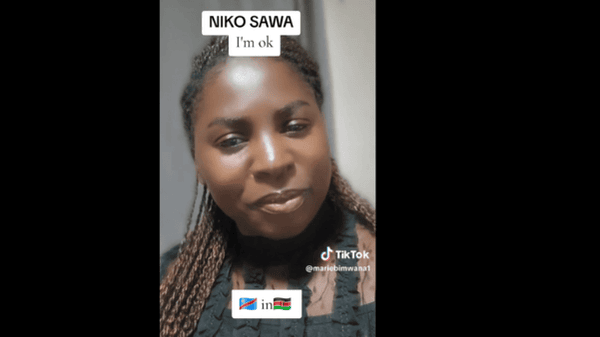
Niko Sawa? How a Congolese Woman Gently Poked at Kenyan Habits

It’s a curious thing when someone who didn’t grow up around you starts noticing your habits. Sometimes it feels uncomfortable. Other times, it’s beautifully enlightening.

That’s exactly what Comfort Marie, a Congolese woman living and working in Kenya, has been doing — observing, noticing, and quietly holding up a mirror to the way we live, laugh, and talk.

Her gentle inquiry? One simple, yet revealing question: do Kenyans really mean it when we say “niko sawa”?


The Phrase We Say Without Thinking

If you live in Kenya, you know the phrase. Chances are you said it today. Twice. Or more.

“Unataka maji?”
“Niko sawa.”

“Chai?”
“Niko sawa.”

“Are you okay?”
“Niko sawa.”

“Do you need help?”
“Niko sawa.”

For Comfort, this was fascinating. She noticed that we use “niko sawa” almost everywhere, even when a clear “no” would suffice. It’s a reflex, a cultural shorthand — but what does it really mean? Are we always okay, or are we just polite by default? Is it a slogan for life?

And when she asked these questions on social media, the responses came flooding in.


Kenyans Respond

Kenyans are nothing if not expressive. Some wrote simply:

“Tulia tuko sawa.”
Relax. We are fine.

Others pointed out our other all-purpose phrase, “Sasa”, a greeting that can mean hello, what’s up, or even “I see you.”

Then came the more philosophical explanations:

  • We don’t announce our problems.
  • We don’t want to burden anyone.
  • We don’t want to be seen as beggars.
  • It’s a way to cut conversation politely.
  • We have limited time.
  • It’s our way of minding our own business.

In short: Kenyans are okay — mostly — but we protect ourselves from over-explaining.


The Many Shades of “Niko Sawa”

If you really break it down, “niko sawa” isn’t just “I’m fine.” It’s a shield, a cultural tool.

It can mean:

  • I don’t want to inconvenience you.
  • I am actually hungry, but I’ll wait for your insistence.
  • I don’t want to explain my life right now.
  • I am broke but dignified.
  • I am stressed but functioning.
  • I am alive, so technically okay.

As one commenter summed up:

“Ukiwa hai uko sawa, anything else ni mambo ya dunia.”
(If you’re alive, you’re okay. Everything else is worldly.)

There’s a kind of understated philosophy in that.


Niko Sawa and the Art of Kenyan Hospitality

Sometimes “niko sawa” is practical, too. A Kenyan explained that when visiting a host unexpectedly, we say it to avoid stressing the household budget. Tea, milk, sugar, gas, maybe mandazi — all of it costs money. Saying “niko sawa” is a polite way to let the host adjust.

If the host insists, we may eventually say yes. But initially? Niko sawa.


Emotional Boundaries

Another insight Comfort’s question revealed is our guarded emotional side. Kenyans are socially warm but emotionally private. We laugh, joke, and banter freely. But personal struggles? Those stay quietly tucked away.

“Niko sawa” becomes a tool of self-preservation, a gentle way to say: “I hear you, but don’t pry too deep.”


Why This Matters

Comfort’s curiosity isn’t criticism. It’s perspective. She doesn’t mock or judge; she simply notices and asks questions that make us think. Sometimes, we act so automatically that we forget to consider why. Her observations make us pause and reflect — perhaps even laugh at ourselves.


Our Kenyan Superpower

So what does “niko sawa” really say about us?

It’s resilience.
It’s maintaining dignity in struggle.
It’s protecting the host.
It’s social efficiency.
It’s peacekeeping.
And, occasionally, yes — it’s a shortcut for laziness.


Final Thoughts

Are Kenyans okay? Mostly.
Are we always okay? Definitely not.
Will we continue saying “niko sawa”? Without question.

Thanks to Comfort Marie, we’re reminded that sometimes, an outsider’s curiosity is exactly what we need to see ourselves more clearly.

Hot this week

Nairobi Tested Scheduled Buses and Fixed Fares in 2025. What Happened to the Plan?

Nairobi tested scheduled bus departures and fixed fares along Route 111 in 2025. More than a year later, questions remain about the pilot's lasting impact.

Changa Fuel: Kenyan Platform Wants to Make Shared Travel Cheaper and Safer

A Kenyan technology company is seeking to change how...

Could Nairobi Become Africa’s Most Photographed City?

Nairobi's streets are becoming open-air photography studios. As county authorities move to recognise street photographers, some welcome the change while others fear growing competition could threaten their livelihoods. Could Nairobi become Africa's most photographed city?

Could Ebola Bring Back Lockdowns? How Nairobi Commuters Should Prepare

Kenya’s Ebola cases have reached seven. Here are the symptoms to know, how to protect yourself on public transport, and why commuters should plan quietly for the possibility of movement restrictions.

Why You Must Get Out of Your Car on the Likoni Ferry: 5 Reasons That Might Surprise You

Passengers crossing the Likoni Channel are required to leave their vehicles, but why? From the danger of sinking cars to insurance complications and emergency evacuations, here are five reasons behind this important ferry safety rule. Copy

Topics

Nairobi Tested Scheduled Buses and Fixed Fares in 2025. What Happened to the Plan?

Nairobi tested scheduled bus departures and fixed fares along Route 111 in 2025. More than a year later, questions remain about the pilot's lasting impact.

Changa Fuel: Kenyan Platform Wants to Make Shared Travel Cheaper and Safer

A Kenyan technology company is seeking to change how...

Could Nairobi Become Africa’s Most Photographed City?

Nairobi's streets are becoming open-air photography studios. As county authorities move to recognise street photographers, some welcome the change while others fear growing competition could threaten their livelihoods. Could Nairobi become Africa's most photographed city?

Could Ebola Bring Back Lockdowns? How Nairobi Commuters Should Prepare

Kenya’s Ebola cases have reached seven. Here are the symptoms to know, how to protect yourself on public transport, and why commuters should plan quietly for the possibility of movement restrictions.

Why You Must Get Out of Your Car on the Likoni Ferry: 5 Reasons That Might Surprise You

Passengers crossing the Likoni Channel are required to leave their vehicles, but why? From the danger of sinking cars to insurance complications and emergency evacuations, here are five reasons behind this important ferry safety rule. Copy

Delta’s Premium Seats Now Out-Earn Economy. Kenya Airways Has 30 Per Dreamliner.

Delta Air Lines is betting on premium passengers with 101 premium seats on its new Airbus A350-1000. Kenya Airways operates just 30 business-class seats on each Dreamliner. Could the American airline's strategy offer lessons for Kenya's national carrier? Copy

Government Raises Fuel Prices, Matatus Raise Fares — And Kenyans Are Expected to Pay for Everyone’s Failures

The government has increased fuel prices, and matatu owners now want fares raised by 10%. But who is protecting commuters? Metros Kenya examines the role of the government, EPRA, the Ministry of Transport and matatu operators in Kenya's growing transport costs.

You Could Be Fined or Even Jailed on Kenya’s SGR for These 5 Surprising Things — Number 3 Might Shock You

Did you know that certain actions aboard Kenya's Madaraka Express could attract fines or even imprisonment? Discover five surprising SGR passenger rules, from ticket transfers and First Class seating to prohibited items and emergency equipment.

Related Articles

Popular Categories

spot_imgspot_img