

By Metros Kenya
Delta Air Lines has shown that a seat at the front of the plane can earn more than the seats behind it. Kenya Airways, short of aircraft and cash, is flying a very different jet.
For most of aviation’s history, long-haul flying worked like this: pack the back of the aircraft with economy passengers, and treat the business-class seats at the front as a profitable extra. In the second quarter of 2026, that logic flipped at one of the world’s biggest airlines.
Delta Air Lines reported that its premium ticket revenue for the three months to 30 June reached $6.92 billion, edging past the $6.85 billion it earned from Main Cabin tickets. The gap is only about $69 million, but it is the first time premium has come out ahead. Premium ticket revenue grew 17% year on year, against 8% for Main Cabin.
Delta’s response is to redesign its aircraft around the shift. And the question for Kenya, where the national carrier is fighting for survival, is whether any of it applies.
ALSO READ: Airport Rules in Kenya: Passenger Laws, Security Rules and Traveller Guide
What Delta Is Building
The clearest expression of the strategy is the Airbus A350-1000, which Delta expects to start receiving in 2027. The planned layout has 53 Delta One business suites and 48 Premium Select (premium economy) seats, a total of 101 premium seats.
Delta’s existing A350-900s carry 32 business seats and 48 premium economy seats. Delta also counts its Comfort seats as part of the premium mix, which puts roughly half the aircraft in products that command higher fares.
The airline is not abandoning economy: Main Cabin revenue still grew. But its leadership has said it would rather grow the value of each seat than keep adding economy capacity.
Corporate demand is part of the reason, with Delta reporting that premium corporate sales rose more than 25%.
Cost pressure is another. Delta’s adjusted fuel price in the quarter was $3.93 a gallon, up 75% on a year earlier, and higher-yielding seats are one way to protect margins when fuel bites.
There is also a second revenue engine behind the cabin. Delta’s co-branded card partnership with American Express paid it $8.2 billion in 2025, money that helps fund lounges, suites and refits.
Delta is spending more than $1 billion refreshing 42 of its older A330s, so the premium product reaches beyond the newest aircraft.
What Kenya Airways Is Flying
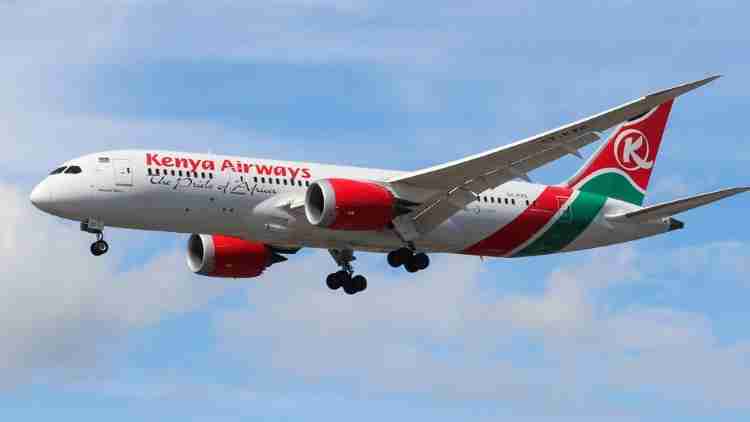
Kenya Airways’ long-haul flagship is the Boeing 787-8. Published seat maps show 234 seats in two classes: 30 lie-flat Premier World business seats and 204 economy seats.
Its single Boeing 777-300ER is listed with 28 business seats and 372 economy. On the information available, there is no premium economy cabin on either type.
Put side by side, Delta’s A350-1000 offers 101 seats in its two premium cabins alone. A Kenya Airways Dreamliner has 30.
That does not make Kenya Airways’ product weak. Its business cabin has won regional awards, and its Nairobi lounges are well regarded.
The point is structural: the airline has a two-class model in a market where its competitors, and now Delta, are adding a middle step between economy and business.
For passengers, cabin comfort is only part of the experience. Baggage handling, airport procedures and passenger protections also influence the choice of airline.
ALSO READ: Lost or Damaged Luggage in Kenya: Passenger Rights and How to Make a Claim
The Problem Is Aircraft, Not Demand
The airline’s half-year results, released on 25 August, tell a story where cabin mix is only one chapter.
Revenue rose 9% to KSh81.25 billion. But net loss widened to KSh16.08 billion from KSh12.15 billion, and operating costs rose by about KSh11 billion to KSh91.9 billion.
Jet fuel cost the airline 32% more than a year earlier and made up roughly a third of operating expenses.
The revealing number is capacity.
Kenya Airways flew 9% fewer available seat kilometres than a year earlier, because component shortages and long lead times kept aircraft on the ground.
According to fleet data compiled by CAPA, two of its nine 787-8s were inactive, along with several narrowbody and regional jets.
A 787-8 returned to service in mid-July and a 777-300ER has been redelivered, but the airline entered the second half still short of aircraft.
Yet revenue still rose.
By a simple calculation of revenue against seat kilometres flown, the airline earned around a fifth more per unit of capacity.
That figure is only an approximation. Cargo, which grew 18% to KSh8.77 billion, exchange rates and fare mix all feed into it.
But it hints at something Delta would recognise: when seats are scarce, each one has to earn more.
The airline reported a load factor of 76.3% and 2.2 million passengers in the half. These figures indicate that Kenya Airways continues to attract passengers, although they do not establish that demand is sufficient on every route.
For travellers, aircraft shortages can also create concerns about schedule reliability, particularly when disruptions lead to missed connections.
ALSO READ: Flight Delays and Cancellations in Kenya: What Are Your Passenger Rights?
Why a Delta-Style Cabin Is Hard for KQ
Three things stand in the way of copying the Delta playbook.
Cash
Delta can fund cabin refits from strong premium income and a card partnership worth billions.
Kenya Airways has total liabilities of about KSh328 billion against assets of about KSh180 billion.
Even the airline’s satellite Wi-Fi programme, which will cost an estimated $20 million to $22 million, is being rolled out slowly, with the service free for at least the first year.
Fleet
Adding a premium economy cabin means refitting aircraft, and each aircraft in the shop is one not flying.
For an airline already losing capacity to maintenance delays, that is a heavy price.
Market
Delta’s premium customers include US corporate travellers and affluent leisure passengers.
Kenya Airways’ long-haul traffic includes price-sensitive diaspora and family-visit passengers.
Nairobi also has a significant potential premium market, including UN agencies, development institutions, regional headquarters and a growing technology sector.
However, Gulf, European, Turkish and Ethiopian carriers compete hard for that traffic.
The challenge is determining whether enough passengers would pay for premium economy to justify removing some existing seats.
The Investor Question
There is one development that could change the picture.
The Treasury is seeking a strategic investor for a stake in Kenya Airways, targeting the end of the fourth quarter of 2026.
A new shareholder with capital and aircraft access could help determine whether the airline stays a two-class operator or follows the path Delta is now taking.
The cargo side is already moving.
Kenya Airways is pursuing additional Boeing 747 freighter capacity, aiming to lift its regional cargo market share from 11% to 40%.
If the airline can show it can grow revenue from cargo and higher-yield seats at the same time, it will make a stronger case to investors.
However, passenger experience remains an important part of the airline’s competitive position. Airlines must balance the pursuit of higher-paying customers with reliable services and the rights of ordinary travellers.
ALSO READ: Denied Boarding in Kenya: What Airlines Can and Cannot Do
What to Watch
Delta’s numbers show how quickly the economics of the cabin can change.
Kenya Airways does not need to copy a 53-suite A350. But the airline will have to decide whether its next fleet and cabin investments reflect a market where premium travellers want more choice, and whether it can afford them.
Three questions will answer that: how quickly its grounded aircraft return, whether the strategic investor arrives with a fleet and cabin plan, and whether any premium economy product appears on its next refit.
For Kenya Airways, the immediate priority remains getting aircraft back into service. But the longer-term decision may be just as important: what kind of aircraft should it fly, and how much should each seat earn?
Figures for Delta are from its second-quarter 2026 results and cabin announcements. Figures for Kenya Airways are from its unaudited half-year results to 30 June 2026 and published seat configurations.