A Kenyan motorist’s account of an alleged KSh 20,000 demand to push a broken-down vehicle just 200 metres raises a bigger question: Why does the Nairobi Expressway have an organised rescue system while motorists on other major highways struggle to identify who should help them?
A vehicle breakdown on Thika Superhighway should be a mechanical inconvenience, not the beginning of an expensive roadside confrontation.
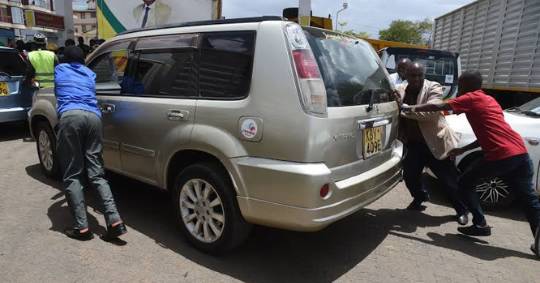
But one Kenyan motorist has described an experience involving individuals he calls the “Thika Road agents”, alleging that they demanded KSh 20,000 after helping push his friend’s disabled vehicle approximately 200 metres.
The account raises an important question about Kenya’s highway management: Who comes to the rescue when a motorist breaks down on a public road?
While the Nairobi Expressway operates with dedicated patrol and emergency-response arrangements, motorists on other major roads may not know whom to call, how quickly help should arrive or whether assistance should attract a fee.
As Metros Kenya previously explained in Nairobi’s Major Roads Explained: The Corridors That Keep the City Moving, Thika Superhighway is one of the capital’s most important transport arteries, carrying thousands of commuters and commercial vehicles.
Yet the experience of being stranded on such a road can be very different from driving along it.
The Thika Road Agents: KSh 20,000 for 200 Metres?
In a video shared with fellow motorists, the man warned drivers about people who allegedly approach stranded vehicles and offer unsolicited roadside assistance.
“The worst thing that could ever happen to you ni gari yako iharibikie Thika Superhighway,” he said.
He described individuals who appear when vehicles suffer mechanical problems, punctures or accidents.
According to him, the men offer to move disabled vehicles away from the highway before demanding substantial payments.
“Those guys will exploit you mbaya sana. Them touching your car, you’ll have to pay a lot of money. 10K, 20K, those are the amounts that they ask for,” he claimed.
The motorist then narrated an incident involving a friend whose vehicle had developed a mechanical problem.
“Beshtangu, gari yake imechapa mguu. So nilikuwa naenda kum-rescue,” he explained.
By the time he arrived, he said, the roadside agents had helped move the vehicle.
“They were asking for 20,000. Just pushing, like from a distance of like 200 metres. 20,000. For what reason?”
A disagreement followed.
“So tulianza ku-argue na wao, tuka-argue, tuka-argue,” he recalled.
Eventually, the group allegedly accepted KSh 5,000.
“Ilibidi tuwape 5K.”
Metros Kenya has not independently verified the incident or established whether the individuals involved were authorised recovery operators.
Nevertheless, the account highlights the uncertainty facing motorists who encounter mechanical problems along major highways.
Why Does the Nairobi Expressway Have an Organised Rescue System?
The Nairobi Expressway offers an interesting comparison.
The toll road has a centralised operator, Moja Expressway, responsible for its day-to-day management.
Its operations include traffic monitoring, road patrols and incident-response arrangements.
Motorists can contact the Expressway’s published 24-hour rescue hotline, 0111 039 888, when emergencies occur on the toll road.
The Expressway is designed to provide a managed driving environment in which breakdowns and incidents can be reported to an identifiable operator.
Metros Kenya has previously covered the road’s role in connecting Nairobi’s transport network in Nairobi Expressway JKIA Access: Airport Entry, Exit & Route Guide.
But the contrast raises an uncomfortable question.
Why should a motorist on a tolled expressway have a clearly identifiable emergency-response system while another driver on an equally important public highway may struggle to find the right assistance?
The difference in funding models is understandable.
The absence of equally visible emergency-response information on conventional roads is harder to justify.
Thika Superhighway Is Not Without Official Responsibility
Thika Superhighway falls under the Kenya National Highways Authority (KeNHA), which manages major national highways.
KeNHA has maintenance and incident-management responsibilities, including arrangements for highway patrols and responding to disabled vehicles.
In July 2025, Roads and Transport Cabinet Secretary Davis Chirchir informed the Senate that performance-based road maintenance contractors were responsible for patrols and breakdown assistance on certain highways, including Thika Superhighway.
This means the central issue is not necessarily the absence of any official roadside assistance arrangements.
It is whether those arrangements are visible, accessible and effective for ordinary motorists.
When a vehicle develops a mechanical problem around Kasarani, Roysambu, Githurai, Ruiru or Juja, does its driver know which authorised service to contact?
How quickly should help arrive?
Are the patrol teams clearly identified?
And can a stranded motorist distinguish an official highway responder from an unauthorised individual offering assistance?
The importance of Thika Road extends beyond private motorists. As highlighted in Metros Kenya’s Thika Road to JKIA: How to Get to Jomo Kenyatta International Airport, the corridor connects major residential and commercial areas to Nairobi’s wider transport network.
A disabled vehicle can therefore create a risk not only for its occupants but also for other road users.
The Vulnerability of Stranded Motorists
A breakdown on a high-speed highway is not an ordinary parking problem.
A driver may be exposed to approaching traffic, unable to move the vehicle safely or uncertain about the nearest recovery service.
Passengers may be stranded on a dangerous roadside while traffic continues moving at speed.
Such circumstances can create an opportunity for exploitation.
When someone offers to push a vehicle away from danger, a distressed driver may agree without first negotiating a price.
The driver may only discover the financial demand after the vehicle has been moved.
This is precisely the situation described by the motorist in the video.
“It’s even better kuita flatbed ikuje ikutoe Thika Road,” he advised.
Professional recovery may provide clearer arrangements, particularly when the service provider and charges are agreed upon beforehand.
However, immediate personal safety must take priority. Motorists should avoid standing in live traffic lanes and should contact authorised emergency responders when a breakdown creates a hazard.
Kenya Has Invested in Roads. What About Roadside Rescue?
Over the years, Kenya has invested billions of shillings in expanding highways, constructing bypasses and improving urban transport connections.
Thika Superhighway remains one of the most recognisable examples of that investment.
But a modern highway requires more than smooth asphalt, multiple lanes and elaborate interchanges.
It also needs dependable emergency-response arrangements.
The ability to identify a stranded vehicle, dispatch help, protect occupants and clear a dangerous obstruction is an essential part of highway management.
Metros Kenya has previously examined road safety enforcement in Nairobi Speed Cameras: Roads, Reported Locations, Speed Limits and Penalties.
While speed enforcement is important, road safety should also include what happens when vehicles unexpectedly stop moving.
A broken-down bus carrying passengers presents a particularly serious challenge.
Passengers may need to disembark near fast-moving traffic while the operator arranges a replacement vehicle or mechanical assistance.
Commercial trucks, private vehicles and electric city buses also require dependable incident-response arrangements.
A road network designed to move people efficiently should be equally prepared to protect them when their journeys are interrupted.
Should Basic Highway Assistance Be Free?
The motorist’s account raises another important issue: the cost of assistance.
When a vehicle becomes disabled in a dangerous location, moving it away from traffic may be necessary to prevent a collision.
But who should pay for that initial intervention?
Should basic assistance provided under a government-funded highway patrol contract be free to motorists?
Where paid recovery services are required, should charges be clearly communicated before the work begins?
And who should motorists contact when individuals claiming to offer roadside assistance demand unreasonable amounts?
These questions require transparent answers from the relevant road authorities.
The Nairobi Expressway has demonstrated the practical value of an identifiable operator with a published emergency contact.
Ordinary public highways should have equally clear procedures, even where their management and funding arrangements differ.
KeNHA Should Explain How Its Highway Patrol System Works
The allegations involving the so-called Thika Road agents present an opportunity for greater public accountability.
KeNHA should clarify the current roadside assistance arrangements along Thika Superhighway, including the contractors responsible for highway patrols.
Motorists also need to know how to contact those patrol teams, what services are available, whether charges apply and how to report suspected exploitation.
Clear signage displaying emergency assistance numbers at strategic points along major highways could help drivers identify legitimate responders.
A publicly accessible system for verifying authorised recovery operators would also reduce uncertainty.
These measures would benefit motorists using other major roads, including Mombasa Road, Waiyaki Way and the country’s expanding network of bypasses.
Who Helps the Motorist Who Cannot Move?
The motorist who shared his experience ended with a warning.
“Usiwahi taka kujipata hapo. Those guys will exploit you kama vipi.”
His allegations remain unverified, but the broader question deserves a national conversation.
Kenya has built major highways to move vehicles faster and connect communities more efficiently.
Yet the true measure of a safe road is not simply how quickly traffic moves when everything is functioning normally.
It is also what happens when a tyre bursts, an engine fails or an accident leaves a vehicle stranded.
The Nairobi Expressway provides one model of organised highway response.
For Thika Superhighway and other public roads, the challenge is making existing emergency-response arrangements visible, reliable and accessible.
The question is simple: If a Kenyan motorist breaks down on a public highway today, who is officially responsible for coming to their rescue?
Until every driver can answer that question with confidence, Kenya’s highway safety system still has an important gap to close.
Metros Kenya welcomes responses from KeNHA, authorised recovery operators and motorists regarding roadside assistance arrangements on Thika Superhighway and other national highways.