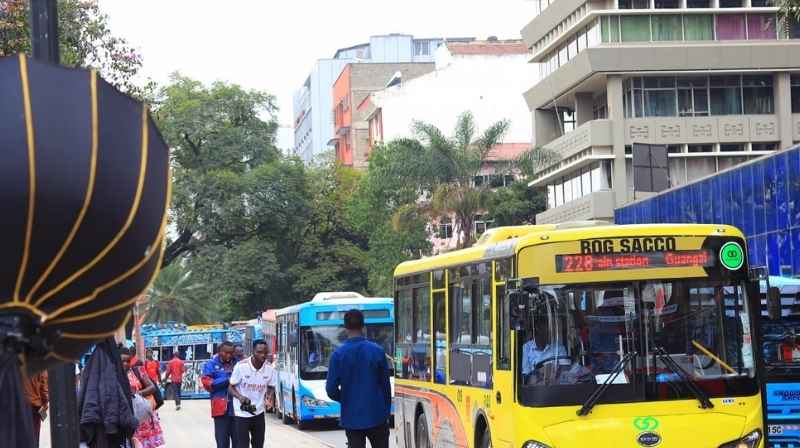

NAIROBI, Kenya, Aug 20 — Nairobi’s Eastlands could become the decisive testing ground for public transport fares if the government eventually takes control of matatu pricing, with the densely populated part of the capital carrying some of the city’s largest commuter flows and some of its most important matatu corridors.
The question of who should determine what commuters pay has returned to the fore after matatu operators ruled out an immediate reduction in fares despite diesel prices falling by Sh5 per litre to Sh217.86 in Nairobi.
ALSO READ Dash 8 Q400 Could Offer Attractive Returns on Nairobi–Mombasa Route, Pilot Barrack Siglain Says
Operators argue that the reduction is too small to significantly change their operating costs, pointing to expensive spare parts, maintenance, insurance and staff salaries.
For commuters, however, the frustration is familiar: fares rise quickly when fuel becomes expensive but rarely retreat by the same margin when fuel prices fall.
That tension is now unfolding alongside attempts in Parliament to establish a formal mechanism for regulating public service vehicle fares — a change that could fundamentally alter the economics of commuting in Nairobi.
And if the government ultimately has to determine what constitutes a fair matatu fare, Eastlands may provide its most important reference point.
Eastlands could become Nairobi’s fare benchmark
Eastlands combines high population density with heavy dependence on public transport and a vast network of matatu services feeding Nairobi’s CBD, Industrial Area and other employment centres.
That makes it significantly different from analysing fares on a single suburban route.
Along Jogoo Road alone, Metros Kenya’s Nairobi Matatu Routes database identifies numerous services connecting the city centre with Buruburu, Donholm, Umoja, Kayole, Komarock, Dandora, Embakasi, Pipeline, Njiru and Ruai.
Nairobi Matatu Routes database
These overlapping services provide an unusually useful picture of how Nairobi’s informal public transport market actually works.
A commuter travelling to Buruburu, for example, can use Route 58, which serves the Jogoo Road–Makadara–Rabai Road–Buruburu corridor. Farther east, Route 35/60 serves Donholm, Tena, Mutindwa and Umoja, while other services continue deeper into Kayole and Komarock.
The further a passenger travels into Eastlands, the more complicated the pricing question becomes.
That is why a future regulated system would probably have to consider distance, operating costs and different commuter zones rather than simply declaring one fare for the whole of Nairobi.
Fares could settle higher rather than lower
Government regulation would also not necessarily mean cheaper matatu fares.
For some of Nairobi’s medium and longer commuter routes, a formal pricing formula could conceivably result in approved fares in the region of Sh130 to Sh200, particularly if regulators incorporate the full cost of operating a PSV.
That range is not contained in the proposed legislation and has not been announced by the government. It represents a possible pricing scenario if a future formula takes into account distance, fuel, maintenance, insurance, labour and other operating expenses.
That distinction is important because the principal benefit of fare regulation may ultimately be predictability rather than universally lower prices.
A commuter could potentially end up paying Sh150 under a regulated system but know that Sh150 is the approved fare.
That would be fundamentally different from a vehicle charging Sh100 in the morning, Sh150 during the evening rush and Sh200 when it rains or when passenger demand suddenly exceeds the number of available vehicles.
Kayole illustrates the complexity
Kayole provides a particularly good example of why Eastlands could influence the eventual structure of regulated fares.
It is not served by one simple route.
Metros Kenya’s database shows Route 1960 travelling from Nairobi through Jogoo Road, Donholm and Umoja towards Kayole. Route 61 also serves Kayole but uses the Jogoo Road and Manyanja Road corridor.
The routes illustrate an important problem policymakers would encounter.
Two passengers may both say they are travelling between Nairobi and Kayole, yet the vehicles they use can follow different operating patterns and serve different intermediate markets.
A serious fare-control system would therefore have to understand the route network rather than simply calculate straight-line distances between estates and the CBD.
Embakasi adds another major commuter market
The same pattern can be seen towards Embakasi and Pipeline.
Route 33, for instance, connects Nairobi with the wider Donholm–Outering Road–Fedha–Pipeline–Embakasi corridor. Metros’ route information shows that it shares parts of the Jogoo Road and Donholm corridor with Kayole-bound services before separating towards Fedha, Pipeline and Embakasi. Route 33 Nairobi to Embakasi and Pipeline
This matters because Eastlands is not one homogeneous transport market.
Buruburu, Umoja, Kayole, Pipeline, Embakasi, Dandora and Ruai sit at different distances from the city centre and have different route characteristics.
A regulated fare system would have to recognise those differences.
One possibility would be some form of distance-based or zonal pricing in which shorter Eastlands journeys fall into one fare band while longer journeys towards the outer parts of the city fall into another.
Whether Kenya eventually adopts such a structure would depend on the regulations developed if Parliament approves the proposed changes.
Parliament wants to end unpredictable pricing
The wider debate stems from proposals to give the National Transport and Safety Authority a greater role in determining PSV fares.
The National Transport and Safety Authority (Amendment) Bill, 2023, sponsored by Kimilili MP Didmus Barasa, seeks to establish guidelines governing how public transport fares are determined.
The proposed framework would allow regulations covering maximum and minimum fares and mechanisms for reviewing them, while requiring fare information to be displayed for passengers.
Supporters argue that the current system gives passengers too little certainty over what they will pay.
Their central complaint is particularly familiar in Nairobi: the same journey can cost different amounts depending on demand, weather or the time of day.
Fare regulation would seek to replace some of that discretion with an established pricing mechanism.
The real challenge will be determining what a matatu journey costs
That may prove considerably harder than passing the law itself.
Fuel is a major operating expense, but it is not the only one.
Operators have consistently pointed to tyres, spare parts, vehicle financing, insurance, maintenance, salaries and regulatory expenses when explaining why fares do not necessarily decline every time diesel becomes cheaper.
A credible government formula would therefore have to establish how much weight should be assigned to each cost.
It would also have to account for passenger volumes.
A matatu travelling a heavily populated Eastlands corridor and filling most of its seats throughout the day operates under different economics from a vehicle serving a lower-demand route.
That is another reason Eastlands could become particularly influential.
Its enormous commuter market provides the passenger volumes against which regulators could assess what an economically sustainable urban fare looks like.
A Sh20 increase becomes significant over a month
For passengers, apparently small fare changes accumulate quickly.
A commuter paying an additional Sh20 each way spends another Sh40 every working day.
Over 26 commuting days, that represents Sh1,040 in additional monthly transport expenditure.
If the increase is Sh30 each way, the additional monthly cost rises to Sh1,560.
For a household with two people commuting daily, the effect can easily run into several thousand shillings.
That helps explain why the difference between a Sh100, Sh150 and Sh200 fare matters enormously in Eastlands, where large numbers of residents depend on matatus for everyday journeys.
Regulation may finally challenge the ‘rain fare’
One of the biggest changes could concern the way fares respond to temporary demand.
Nairobi commuters are familiar with fares increasing when it rains, during rush hour, when there is a vehicle shortage or following disruption on a major road.
The economics are straightforward: more passengers are competing for fewer available seats.
But for commuters, the result is an unpredictable household expense.
A regulated system could potentially establish a maximum amount an operator may charge for a particular journey even when demand rises sharply.
Operators could theoretically remain free to charge below that ceiling when demand is weak, depending on the eventual regulations, but passengers would know the maximum amount they should be expected to pay.
That could be one of the most significant practical changes arising from regulation.
Eastlands is also at the centre of Nairobi’s mass-transit plans
The importance of Eastlands goes beyond matatus.
Nairobi’s proposed mass rapid transit system also prioritises the eastern part of the city, reflecting the enormous number of commuters moving between Eastlands and central Nairobi.
The approved first phase includes an underground CBD orbital line alongside an Eastlands Line intended to provide high-capacity public transport towards the city’s densely populated eastern neighbourhoods.
That is significant.
The same part of Nairobi that could provide the strongest test for regulated matatu fares is also being targeted for some of the city’s most ambitious future public transport investment.
The reason is essentially the same: passenger density.
Transport infrastructure works most effectively where large numbers of people need to move along the same corridors.
Eastlands provides that market.
Matatus may eventually compete directly with mass transit
If the Eastlands mass-transit system is eventually completed, fare policy becomes even more important.
A passenger travelling between Eastlands and the CBD could eventually have a choice between matatu and high-capacity mass transit.
If a regulated matatu journey costs Sh180 while mass transit offers the same broad journey considerably cheaper, passengers may shift towards rail.
If the prices are close, matatus could retain an advantage because of their flexibility, route coverage and ability to penetrate neighbourhoods that fixed rail infrastructure cannot reach.
The eventual fare charged by Nairobi’s future mass-transit system could therefore indirectly influence what commuters consider reasonable for matatus.
That creates a much bigger transport-policy question than simply whether operators should reduce fares by Sh10 after a fuel-price reduction.
Ruai shows how far the Eastlands network extends
The eastern commuter market also continues well beyond Kayole.
Metros Kenya’s Route 38/39 guide traces services through Jogoo Road, Outering Road, Umoja and Kangundo Road towards Njiru and Ruai, demonstrating how Nairobi’s public transport network extends from the CBD into increasingly distant eastern settlements. Route 38/39 Nairobi to Njiru and Ruai
A passenger travelling all the way to Ruai clearly cannot be treated exactly like one alighting at Donholm.
This is where Eastlands could ultimately force policymakers to confront the weaknesses of a simplistic fare-control model.
If government regulation comes, it may require fare bands based on actual journeys, rather than one prescribed Nairobi fare.
Fuel prices have exposed the weakness of the current system
The latest diesel reduction has once again exposed the longstanding disagreement between operators and passengers.
When fuel becomes more expensive, operators face an immediate increase in operating costs and often respond by increasing fares.
When fuel prices subsequently decline, operators argue that other expenses have not fallen.
Passengers therefore see fares remaining at the higher level.
Both sides are looking at different parts of the same cost structure.
A transparent fare formula could potentially establish when an increase is justified and when a reduction should follow.
Instead of passengers negotiating with conductors at individual stages, fare reviews could be triggered by measurable movements in operating costs.
That would be a profound change for Nairobi’s largely market-driven matatu industry.
But government would have to get the number right
Poorly designed fare regulation could create another set of problems.
Set fares too low and some operators may conclude that certain routes are no longer economically viable.
That could reduce the number of vehicles available, worsen waiting times or discourage investment in vehicle maintenance and replacement.
Set fares too high and regulation would do little to protect passengers.
Eastlands therefore presents perhaps the toughest test because even small pricing decisions would affect enormous numbers of daily journeys.
The objective would have to be finding a fare that allows operators to remain commercially viable while preventing passengers from being subjected to arbitrary increases.
Eastlands may ultimately determine what Nairobi considers a fair fare
The bigger debate is therefore not simply whether today’s Sh100 fare should return to Sh80 because diesel has fallen.
It is about how Nairobi values public transport.
Eastlands provides the scale, passenger density and diversity of routes necessary to expose almost every weakness in the current system.
There are relatively short journeys into Buruburu and Donholm, medium-distance services towards Umoja and Embakasi, longer movements into Kayole and Komarock, and services extending towards Njiru and Ruai.
Those corridors are already visible across the Metros Kenya matatu database.
If the government eventually takes responsibility for regulating fares, it will have to understand precisely those differences.
The result may not necessarily be cheaper transport. Some regulated fares could conceivably settle around Sh130 to Sh200, depending on distance and whatever cost formula is eventually adopted.
But commuters could gain something they largely do not have today: certainty.
For matatu operators, regulation would mean demonstrating what it actually costs to move a passenger.
For government, it would mean balancing affordability against the economics of keeping thousands of PSVs operating.
And because nowhere in Nairobi puts those competing pressures together on quite the same scale as Eastlands, the eastern side of the capital could ultimately help determine the answer to one of the city’s most difficult transport questions:
What should a Nairobi matatu ride really cost?