
Kenya’s transition to electric public transport is introducing commuters to a different approach to urban mobility, one that is already familiar in many major cities around the world.
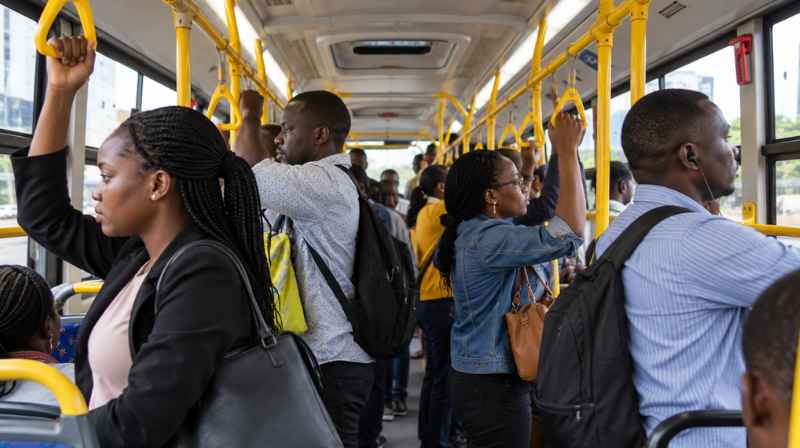
As electric city buses become increasingly visible on Kenyan roads, questions have emerged about their design, passenger capacity and comfort, particularly the practice of allowing some passengers to stand while travelling.
For many Kenyans accustomed to conventional diesel matatus and buses, where passengers are generally expected to occupy designated seats, seeing commuters standing inside a moving bus raises understandable questions about safety, comfort and whether the vehicle is carrying more people than it should.
However, in cities such as London, Singapore, Hong Kong and Amsterdam, standing passengers are a familiar part of everyday urban public transport. Many city buses are specifically designed with standing areas, overhead grab handles and support rails to accommodate passengers within their approved carrying capacities.
The distinction lies in understanding the different purposes of urban city buses and long-distance passenger coaches, as well as the engineering and regulatory standards governing their operation.
For commuters navigating Nairobi’s existing transport network, Metros Kenya maintains the Nairobi Matatu Routes and Numbers: Complete Commuter Guide, documenting the routes and corridors that form the backbone of daily urban mobility.
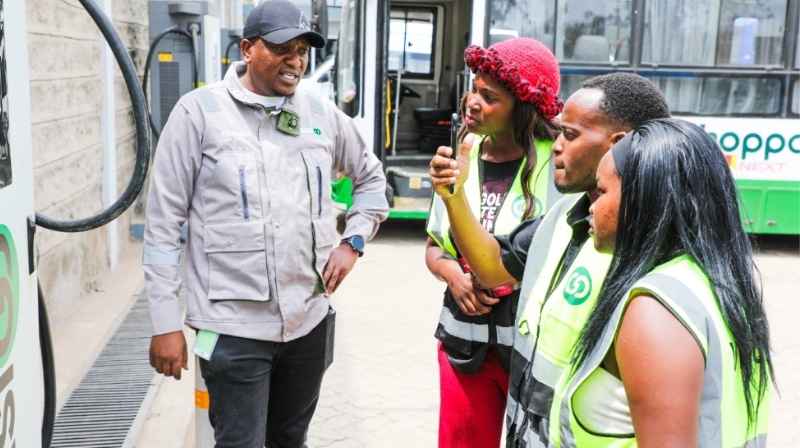
During a visit to BasiGo’s fleet operations, Francis Mungai, the company’s Fleet Manager, offered insights into the technology, passenger-load testing and safety features incorporated into electric buses.
His explanations, alongside observations from two Tawala Sacco drivers interviewed by Metros Kenya, help address some of the questions surrounding electric city buses and the changing expectations of public transport in Kenya.
Inside BasiGo’s 36-Seater Electric Bus
During the demonstration, Mungai introduced a 36-seater electric bus manufactured by Chinese vehicle company CHTC.
According to him, the vehicle has a 210-kilowatt-hour battery, offering an estimated driving range of between 250 and 300 kilometres.
He also revealed that the particular bus had already covered approximately 91,000 kilometres.
These figures provide useful insight into the technology behind electric buses increasingly appearing on Kenyan roads.
But the most interesting part of his demonstration was not the battery capacity or the driving range.
It was his explanation of how BasiGo evaluates the buses before they begin carrying paying passengers.
Metros Kenya previously documented the company’s testing procedures in BasiGo Reveals How Electric Buses Are Tested for Range, Load Capacity and Safety Before Hitting Kenyan Roads.
Passenger Weight Is Calculated Before the Bus Hits the Road
One of the recurring criticisms surrounding electric city buses concerns passenger loading, particularly when commuters stand inside the vehicle.
Some people assume that if every passenger is not sitting, the bus must be carrying more weight than it was designed to accommodate.
Mungai addressed the engineering behind passenger loading.
“During the design phase, we spec out the kind of vehicle that we need, and of course the tare weight as well as the maximum loading of the vehicle,” he explained.
He said BasiGo carries out extensive validation tests before releasing a bus for revenue operations.
“We load sandbags to be able to simulate the weight and see what is the impact on the suspension system, what is the impact on range, what is the impact on things like braking, speed, and things like that.”
According to Mungai, the tests help determine whether the actual vehicle performs as expected under simulated passenger loads.
“We do a comprehensive validation cycle for these vehicles just to make sure that whatever we expect is whatever we’ve gotten in terms of a product.”
The loading of a bus is not determined simply by counting the seats and assuming that any additional passenger automatically exceeds the vehicle’s engineering limits.
Instead, manufacturers establish the maximum permissible vehicle weight and passenger configuration, which must then be reflected in the vehicle’s certification and licensing.
A bus may be designed to accommodate standing passengers, but that does not mean every electric bus is authorised to do so. The approved standing capacity, if any, must be verified for the particular vehicle.
Why Those Overhead Handles Are Not Decorations
Walk into a modern urban bus in London or Singapore and you will encounter overhead handrails, vertical support poles and designated standing areas.
These fixtures are installed for a reason.
City buses operate over relatively short distances, stopping frequently to pick up and drop off passengers.
Unlike long-distance coaches, where passengers are expected to remain seated for extended journeys, many urban buses are configured to move larger numbers of people through busy city corridors.
The standing areas allow passengers to board and alight more efficiently, while grab handles and rails provide support during normal movement.
That is why the sight of a standing passenger inside a city bus is not, by itself, evidence of overloading.
It is also why the argument that every passenger must have a seat before a bus can be considered comfortable or properly designed misses the distinction between urban buses and long-distance coaches.
Of course, the presence of grab handles does not override Kenyan traffic laws or vehicle licensing conditions. A standing passenger must be accommodated within an approved configuration.
Even Tawala Sacco Drivers Are Learning About City Bus Design
During separate interviews conducted by Metros Kenya, two drivers from Tawala Sacco shared their observations about electric buses.
One driver acknowledged that although he understood the technology, he had not previously realised that standing passengers are a normal feature of many urban bus systems internationally.
His reaction illustrates how unfamiliar some aspects of modern city-bus design remain, even among experienced public transport drivers.
Another Tawala Sacco driver expressed a different view, observing that while conventional diesel buses may provide seated accommodation, he considered the newer electric buses superior.
The drivers’ comments highlight an important reality: the introduction of electric buses is also an opportunity for public transport education.
Kenya’s transport system is made up of numerous SACCOs and operators serving different commuter corridors, as documented in the Nairobi Matatu SACCOs: Major Operators, Routes and Destinations guide.
The debate should move beyond whether a passenger is sitting or standing to whether the bus is safe, properly licensed, comfortable for its intended journey and operated within its approved limits.
Francis Mungai Explains Ventilation Inside the Electric Bus
Another concern raised about electric city buses is whether passengers receive adequate ventilation, especially when the vehicle is carrying a large number of people.
Mungai demonstrated the ventilation arrangements inside the CHTC bus.
“In terms of ventilation, as you can see, all windows are compliant with the regulations, and you can see we have enough ventilation.”
He pointed to additional fans installed around the overhead emergency hatches.
“These vents here, as you can see, there are four fans. Just in case it gets a bit hot, we can be able to use that as part of the ventilation.”
The explanation shows that ventilation has been considered in the bus’s design, although the actual effectiveness of the system under full passenger loading would require separate assessment.
Rather than assuming that a city bus is uncomfortable because passengers may stand, commuters should be asking more useful questions about airflow, temperature, passenger density and operating conditions.
Cameras, Emergency Hammers and Roof Exits: Safety Features Explained
Mungai also demonstrated several safety features fitted inside the electric bus.
According to him, the vehicle is equipped with onboard cameras to improve visibility in the event of an emergency.
He also pointed out the emergency glass-breaking hammers installed for passenger evacuation.
“You can see the break glass hammers in case you are trapped inside and the window does not open. You can be able to break glass in case of an emergency.”
He then demonstrated the overhead emergency exits.
“These are overhead emergency exits in case maybe this bus plunges into a river, and the only way is upward, then you can be able to open and escape through there.”
Mungai further confirmed that fire extinguishers were installed on the vehicle.
These are important safety considerations for any public service vehicle, whether powered by diesel or electricity.
The difference is that electric buses also introduce high-voltage electrical systems requiring additional protective measures.
What Happens if an Electric Bus Enters Floodwater?
One of the most interesting explanations from Mungai concerned electrical safety.
With Kenya experiencing periodic flooding, some commuters understandably wonder what happens if an electric bus encounters deep water or becomes involved in an accident.
Mungai explained that the bus incorporates safety measures intended to protect passengers and crew against electrical hazards.
“The bus has additional design safety features to make sure that in case there’s water ingress, there’s no risk of shock to any people, passengers or crew.”
He identified the Battery Management System, commonly known as the BMS, as one of the key protective components.
“The batteries have a watchdog called the BMS.”
According to Mungai, the system is designed to respond to certain faults affecting the high-voltage battery system.
“In case there’s ever a leakage into the batteries, then the BMS will be able to isolate the high-voltage system and lock that out, just to make sure that there’s no power going back into the chassis.”
He also explained that the system is intended to detect electrical isolation faults that may occur during an accident.
This does not mean electric buses are completely immune to electrical hazards, nor that they can safely operate through any depth of floodwater.
Rather, it demonstrates that high-voltage protection is part of the vehicle’s engineering. Actual protection depends on the system’s design, condition and proper functioning.
Why Electric Bus Operators Prefer Cashless Payments
Mungai also addressed how passengers pay for journeys aboard electric buses.
He clarified that BasiGo is not itself the passenger transport operator. Instead, the transport operators determine the payment methods available to their customers.
However, he explained that cashless payments are increasingly preferred.
“For electric vehicles, mainly you’ll find that the operators will prefer cashless kind of payment, just to make sure that there is no pilferage and the owner gets maximum returns.”
He acknowledged that cash payments still exist, but said cashless payment was becoming the preferred approach among the electric bus operators he was describing.
This is another example of how the transition to electric mobility can involve operational changes beyond the vehicle’s powertrain.
Cashless fare collection can improve revenue accountability, although it does not automatically guarantee better service or eliminate every form of financial leakage.
City Buses and Long-Distance Coaches Are Not the Same Thing
Perhaps the biggest misunderstanding in this debate is the failure to distinguish between a city bus and a long-distance coach.
A bus operating short journeys around Nairobi does not necessarily need the same passenger configuration as a coach travelling from Nairobi to Kisumu or Mombasa.
City buses are generally designed around frequent stops, passenger movement and efficient use of urban road space.
Long-distance coaches are designed around extended seated travel, passenger comfort and luggage requirements.
The fact that a passenger may stand in an appropriately designed and licensed city bus does not mean the same practice is suitable or lawful on a long-distance coach.
Importantly, not all city buses are electric, just as not all electric buses permit standing passengers. These are vehicle-design and regulatory distinctions, not properties of the electric motor itself.
Maybe It Is Time to Retire the Diesel Matatu as Our Only Reference Point
For decades, the diesel matatu has shaped the Kenyan commuter’s understanding of public transport.
If a vehicle has fourteen seats, people expect fourteen passengers. If a bus has a particular number of seats, many assume that number must also represent its entire passenger capacity.
Then a modern city bus arrives with handrails, emergency hatches, electronic monitoring systems and a different interior configuration, and suddenly some people assume something has gone terribly wrong.
The comparison overlooks the different roles these vehicles are designed to perform.
Instead of asking whether a vehicle is operating within its certified limits, some critics have concluded that standing passengers are proof of inferior engineering.
Mungai’s demonstration provides a useful counterpoint.
He described passenger-load validation using sandbags, suspension and braking assessments, ventilation systems, emergency exits, onboard cameras and high-voltage battery protection.
These are tangible engineering and safety considerations that deserve more attention than arguments based solely on whether every passenger has a seat.
BasiGo is also introducing smaller electric passenger vehicles, including the Golden Dragon electric van, which Metros Kenya examined in Inside BasiGo’s Golden Dragon Electric Van: Francis Mungai Takes Metros Through Kenya’s 15-Seater EV.
The development demonstrates that electric mobility is not limited to one vehicle size or passenger configuration.
None of this means electric buses should escape scrutiny.
Passengers should demand safe operations, clear capacity information, accessible boarding, reliable schedules, fair fares and comfortable conditions appropriate to the length of the journey.
Standing for a few stops may be acceptable in an authorised urban bus. Being forced to stand for a lengthy journey in overcrowded conditions is a different matter entirely.
The Real Conversation Kenya Should Be Having
Electric buses represent an opportunity for Kenya to modernise public transport, reduce tailpipe pollution and introduce quieter vehicles into busy urban corridors.
But the technology alone will not transform the commuter experience.
Operators must respect passenger limits. Regulators must clarify the requirements governing different bus configurations. Manufacturers and suppliers must demonstrate compliance. And passengers need accessible information about the vehicles they are using.
As Nairobi continues to expand, understanding the city’s road network and commuter corridors is equally important. Metros Kenya explores these connections in Nairobi’s Major Roads Explained: The Corridors That Keep the City Moving.
BasiGo’s Francis Mungai has helped explain some of the engineering behind these buses.
The Tawala Sacco drivers interviewed by Metros Kenya have also illustrated how perceptions can change as people learn more about urban bus systems.
Perhaps the next time someone sees passengers standing inside an electric city bus, the response should not automatically be outrage.
It should be curiosity.
How many passengers is this bus approved to carry? Is it licensed for standing passengers? What safety provisions have been installed? And is the operator complying with the law?
Those are the questions that matter.
Because Kenya cannot build a modern public transport culture if every new vehicle is judged solely by the standards of yesterday’s diesel matatu.
And standing in a properly designed and authorised city bus is not a sign that public transport has gone backwards.
It is simply one of the ways urban public transport has worked around the world for decades.
ALSO READ
- BasiGo Reveals How Electric Buses Are Tested for Range, Load Capacity and Safety Before Hitting Kenyan Roads
- Inside BasiGo’s Golden Dragon Electric Van: Francis Mungai Takes Metros Through Kenya’s 15-Seater EV
- Nairobi Matatu Routes and Numbers: Complete Commuter Guide
- Nairobi Matatu SACCOs: Major Operators, Routes and Destinations
- Nairobi’s Major Roads Explained: The Corridors That Keep the City Moving